Mostrar el registro sencillo del ítem
dc.contributor.author
Van Zwanenberg, Patrick
dc.contributor.author
Millstone, Erik
dc.contributor.author
Livingston Ortolani, Alice
dc.date.available
2025-12-23T15:11:23Z
dc.date.issued
2025-08
dc.identifier.citation
Van Zwanenberg, Patrick; Millstone, Erik; Livingston Ortolani, Alice; Asymmetric evaluations of scientific evidence indicating harm compared to evidence indicating an absence of harm in regulatory appraisals; Nature; Environmental Sciences Europe; 37; 1; 8-2025; 1-20
dc.identifier.uri
http://hdl.handle.net/11336/278459
dc.description.abstract
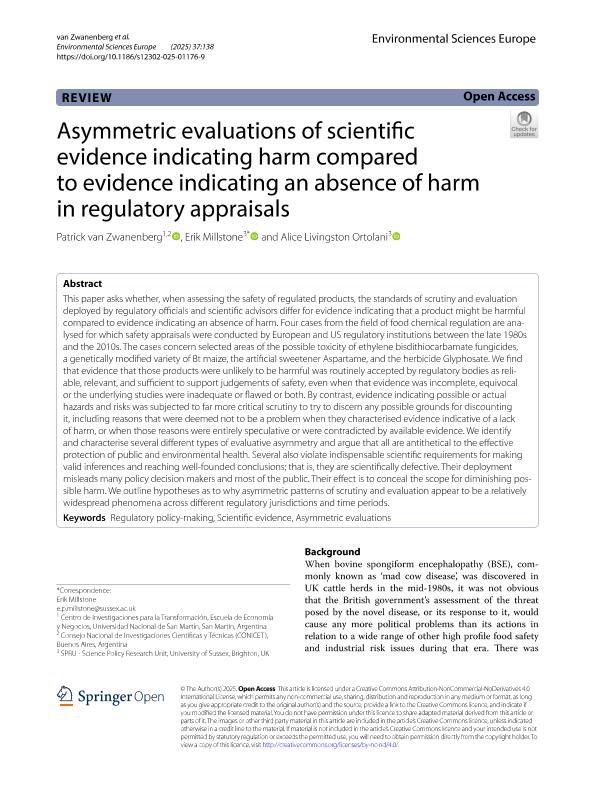
This paper asks whether, when assessing the safety of regulated products, the standards of scrutiny and evaluation deployed by regulatory officials and scientific advisors differ for evidence indicating that a product might be harmful compared to evidence indicating an absence of harm. Four cases from the field of food chemical regulation are analysed for which safety appraisals were conducted by European and US regulatory institutions between the late 1980s and the 2010s. The cases concern selected areas of the possible toxicity of ethylene bisdithiocarbamate fungicides, a genetically modified variety of Bt maize, the artificial sweetener Aspartame, and the herbicide Glyphosate. We find that evidence that those products were unlikely to be harmful was routinely accepted by regulatory bodies as reliable, relevant, and sufficient to support judgements of safety, even when that evidence was incomplete, equivocal or the underlying studies were inadequate or flawed or both. By contrast, evidence indicating possible or actual hazards and risks was subjected to far more critical scrutiny to try to discern any possible grounds for discounting it, including reasons that were deemed not to be a problem when they characterised evidence indicative of a lack of harm, or when those reasons were entirely speculative or were contradicted by available evidence. We identify and characterise several different types of evaluative asymmetry and argue that all are antithetical to the effective protection of public and environmental health. Several also violate indispensable scientific requirements for making valid inferences and reaching well-founded conclusions; that is, they are scientifically defective. Their deployment misleads many policy decision makers and most of the public. Their effect is to conceal the scope for diminishing possible harm. We outline hypotheses as to why asymmetric patterns of scrutiny and evaluation appear to be a relatively widespread phenomena across different regulatory jurisdictions and time periods.
dc.format
application/pdf
dc.language.iso
eng
dc.publisher
Nature
dc.rights
info:eu-repo/semantics/openAccess
dc.rights.uri
https://creativecommons.org/licenses/by-nc-nd/2.5/ar/
dc.subject
Asymmetries
dc.subject
Regulatory science
dc.subject.classification
Ciencias Sociales Interdisciplinarias
dc.subject.classification
Otras Ciencias Sociales
dc.subject.classification
CIENCIAS SOCIALES
dc.title
Asymmetric evaluations of scientific evidence indicating harm compared to evidence indicating an absence of harm in regulatory appraisals
dc.type
info:eu-repo/semantics/article
dc.type
info:ar-repo/semantics/artículo
dc.type
info:eu-repo/semantics/publishedVersion
dc.date.updated
2025-12-23T10:09:27Z
dc.identifier.eissn
2190-4715
dc.journal.volume
37
dc.journal.number
1
dc.journal.pagination
1-20
dc.journal.pais
Reino Unido
dc.journal.ciudad
Basingstoke
dc.description.fil
Fil: Van Zwanenberg, Patrick. Consejo Nacional de Investigaciones Científicas y Técnicas; Argentina. Universidad Nacional de San Martin. Escuela de Economia y Negocios. Centro de Investigaciones Para la Transformacion.; Argentina
dc.description.fil
Fil: Millstone, Erik. University of Sussex; Reino Unido
dc.description.fil
Fil: Livingston Ortolani, Alice. University of Sussex; Reino Unido
dc.journal.title
Environmental Sciences Europe
dc.relation.alternativeid
info:eu-repo/semantics/altIdentifier/url/https://link.springer.com/article/10.1186/s12302-025-01176-9
dc.relation.alternativeid
info:eu-repo/semantics/altIdentifier/doi/http://dx.doi.org/10.1186/s12302-025-01176-9
Archivos asociados

Tamaño:
1.188Mb
Formato:
PDF