Artículo
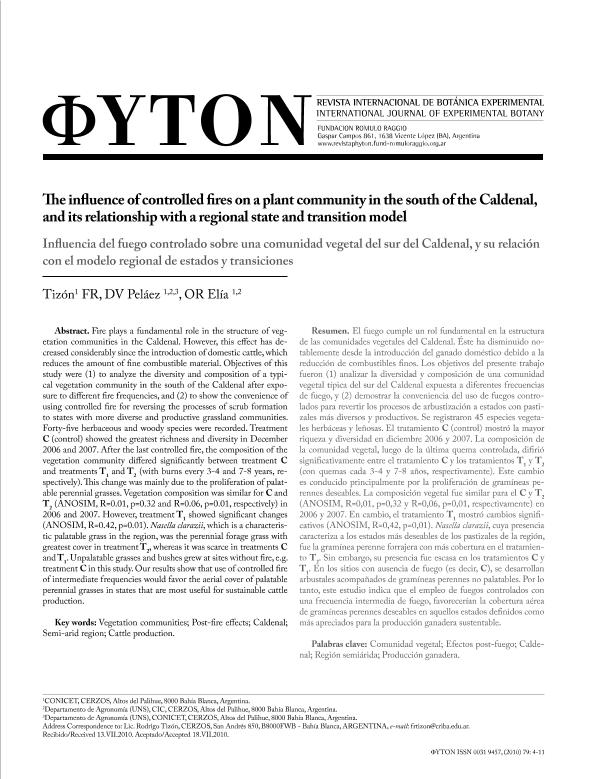
Fire plays a fundamental role in the composition and structure of vegetation communities in the Caldenal, however this effect has decreased notably since the introduction of domestic cattle due to the reduction of fine combustible material. The aim of the present study was to analyse the diversity and composition of a typical vegetation community in the south of the Caldenal exposed to different fire frequencies and to show the convenience of the use of controlled fire for reversing the processes of scrub formation to states with more diverse and productive grassland. Forty-five herbaceous and woody species were recorded. Treatment C (control) showed the greatest richness and diversity for December 2006 and 2007. After the last controlled fire the compostition of the vegetation community differed significantly between treatment C and treatments T1 and T2 (with burns every 3-4 and 7-8 years respectively). This change is mainly due to the proliferation of palatable perennial grasses. The vegetation composition of the same treatments, for both dates in 2006 and 2007, was similar for C and T2 (ANOSIM, R=0.01, p=0.32 y R=0.06, p=0.01, respectively). However, treatment T1 showed significant changes (ANOSIM, R=0.42, p=0.01). Nasella clarazii, which is characteristic of the palatable grasses in the region, was the perennial forage grass with greatest cover in treatment T2, whereas it was scarce in treatments C y T1. Unpalatable grasses and bushes grow at sites without fire, e.g. treatment C in this study, and so it is seen that the use of controlled fire of intermediate frequency would favour the aerial cover of palatable perennial grasses in those states that are most useful for sustainable cattle production. El fuego cumple un rol fundamental en la estructura de las comunidades vegetales del Caldenal. Éste ha disminuido notablemente desde la introducción del ganado doméstico debido a la reducción de combustibles finos. Los objetivos del presente trabajo fueron (1) analizar la diversidad y composición de una comunidad vegetal típica del sur del Caldenal expuesta a diferentes frecuencias de fuego, y (2) demostrar la conveniencia del uso de fuegos controlados para revertir los procesos de arbustización a estados con pastizales más diversos y productivos. Se registraron 45 especies vegetales herbáceas y leñosas. El tratamiento C (control) mostró la mayor riqueza y diversidad en diciembre 2006 y 2007. La composición de la comunidad vegetal, luego de la última quema controlada, difirió significativamente entre el tratamiento C y los tratamientos T1 y T2 (con quemas cada 3-4 y 7-8 años, respectivamente). Este cambio es conducido principalmente por la proliferación de gramíneas perennes deseables. La composición vegetal fue similar para el C y T2 (ANOSIM, R=0,01, p=0,32 y R=0,06, p=0,01, respectivamente) en 2006 y 2007. En cambio, el tratamiento T1 mostró cambios significativos (ANOSIM, R=0,42, p=0,01). Nasella clarazii, cuya presencia caracteriza a los estados más deseables de los pastizales de la región, fue la gramínea perenne forrajera con más cobertura en el tratamiento T2. Sin embargo, su presencia fue escasa en los tratamientos C y T1. En los sitios con ausencia de fuego (es decir, C), se desarrollan arbustales acompañados de gramíneas perennes no palatables. Por lo tanto, este estudio indica que el empleo de fuegos controlados con una frecuencia intermedia de fuego, favorecerían la cobertura aérea de gramíneas perennes deseables en aquellos estados definidos como más apreciados para la producción ganadera sustentable.
The influence of controlled fires on a vegetation community in the south of the Caldenal and its relationship with a regional model of states and transitions
Título:
Influencia del fuego controlado sobre una comunidad vegetal del sur del Caldenal, y su relación con el modelo regional de estados y transiciones

Fecha de publicación:
03/2010
Editorial:
Fundación Rómulo Raggio
Revista:
Phyton
ISSN:
0031-9457
Idioma:
Inglés
Tipo de recurso:
Artículo publicado
Clasificación temática:
Resumen
Palabras clave:
COMUNIDAD VEGETAL
,
EFECTOS POST FUEGO
,
CALDENAL
,
REGION SEMIARIDA
Archivos asociados

Tamaño:
173.0Kb
Formato:
PDF
Licencia
 Excepto donde se diga explícitamente, este item se publica bajo la siguiente descripción:
Creative Commons Attribution-NonCommercial 2.5 Unported (CC BY-NC 2.5)
Excepto donde se diga explícitamente, este item se publica bajo la siguiente descripción:
Creative Commons Attribution-NonCommercial 2.5 Unported (CC BY-NC 2.5)
Identificadores
Colecciones
Articulos(CERZOS)
Articulos de CENTRO REC.NAT.RENOVABLES DE ZONA SEMIARIDA(I)
Articulos de CENTRO REC.NAT.RENOVABLES DE ZONA SEMIARIDA(I)
Citación
Tizón, Francisco Rodrigo; Pelaez, Daniel Valerio; Elia, Omar Raul; The influence of controlled fires on a vegetation community in the south of the Caldenal and its relationship with a regional model of states and transitions; Fundación Rómulo Raggio; Phyton; 79; 3-2010; 141-146
Compartir

