Artículo
Beyond the Trail—Understanding Non‐Native Plant Invasions in Mountain Ecosystems
Barros, Ana Agustina ; Fuentes Lillo, Eduardo; Aschero, Valeria
; Pauchard, Aníbal; Alvarez, María Alisa
; Wedegärtner, Ronja; Clavel, Jan; Müllerová, Jana; Pergl, Jan; Zong, Shengwei; Vítková, Michaela; Klinerová, Tereza; Cavieres, Lohengrin A.; Larson, Christian; Rew, Lisa J.; Seipel, Tim; Meffre, Chloe; Arellano, Tomas; Essl, Franz; Dullinger, Stefan; Gwate, Onalenna; Clark, V. Ralph; Achermann, Marc; Haider, Sylvia; Lembrechts, Jonas J.
; Fuentes Lillo, Eduardo; Aschero, Valeria
; Pauchard, Aníbal; Alvarez, María Alisa
; Wedegärtner, Ronja; Clavel, Jan; Müllerová, Jana; Pergl, Jan; Zong, Shengwei; Vítková, Michaela; Klinerová, Tereza; Cavieres, Lohengrin A.; Larson, Christian; Rew, Lisa J.; Seipel, Tim; Meffre, Chloe; Arellano, Tomas; Essl, Franz; Dullinger, Stefan; Gwate, Onalenna; Clark, V. Ralph; Achermann, Marc; Haider, Sylvia; Lembrechts, Jonas J.
; Fuentes Lillo, Eduardo; Aschero, Valeria
; Pauchard, Aníbal; Alvarez, María Alisa
; Wedegärtner, Ronja; Clavel, Jan; Müllerová, Jana; Pergl, Jan; Zong, Shengwei; Vítková, Michaela; Klinerová, Tereza; Cavieres, Lohengrin A.; Larson, Christian; Rew, Lisa J.; Seipel, Tim; Meffre, Chloe; Arellano, Tomas; Essl, Franz; Dullinger, Stefan; Gwate, Onalenna; Clark, V. Ralph; Achermann, Marc; Haider, Sylvia; Lembrechts, Jonas J.
Fecha de publicación:
05/2025
Editorial:
Wiley Blackwell Publishing, Inc
Revista:
Global Ecology and Biogeography
ISSN:
1466-822X
Idioma:
Inglés
Tipo de recurso:
Artículo publicado
Clasificación temática:
Resumen
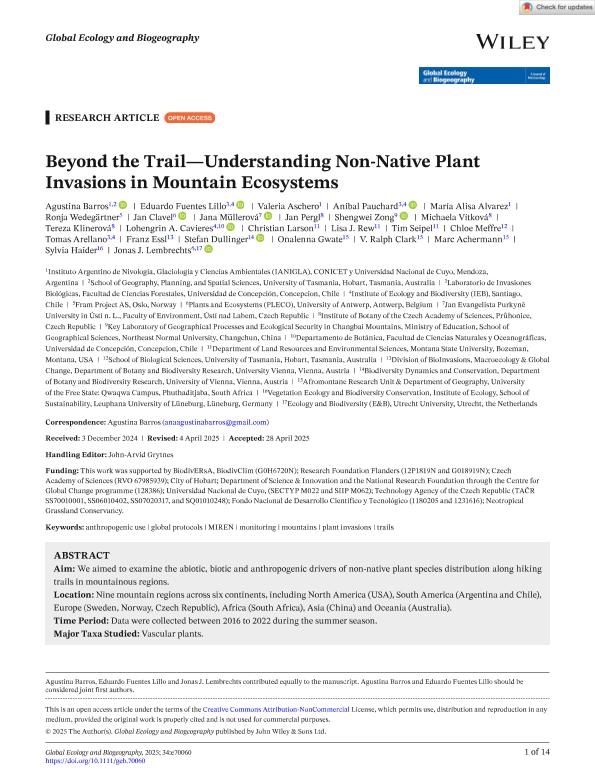
Aim We aimed to examine the abiotic, biotic and anthropogenic drivers of non-native plant species distribution along hiking trails in mountainous regions. Location Nine mountain regions across six continents, including North America (USA), South America (Argentina and Chile), Europe (Sweden, Norway, Czech Republic), Africa (South Africa), Asia (China) and Oceania (Australia). Time Period Data were collected between 2016 to 2022 during the summer season. Major Taxa Studied Vascular plants. Methods We implemented a standardised sampling design (MIREN trail survey) with T-shaped sample sites placed parallel to trails and perpendicular to adjacent vegetation. We examined the main drivers (abiotic, biotic and anthropogenic factors) affecting non-native species' presence, richness and cover. Results At the global scale, abiotic (climatic) variables explained most of the variation in non-native species richness. In contrast, biotic factors were the most important for the presence and cover of non-native plants. Anthropogenic factors, including distance to the trail, use intensity and livestock grazing, were also important but to a lesser extent than the main factors. While the total number of non-native species differed across regions, the patterns explaining plant invasions were consistent. Main Conclusions Our regional study identified mountain trails that are particularly vulnerable to plant invasions. Our findings suggest that under future scenarios of climate change, increased anthropogenic pressure and heightened livestock activity, the presence of non-native species beyond trail edges may become more frequent. This highlights the need to restrict off-trail activities in areas of high conservation value.
Archivos asociados

Tamaño:
2.493Mb
Formato:
PDF
Licencia
 Excepto donde se diga explícitamente, este item se publica bajo la siguiente descripción:
Creative Commons Attribution-NonCommercial-ShareAlike 2.5 Unported (CC BY-NC-SA 2.5)
Excepto donde se diga explícitamente, este item se publica bajo la siguiente descripción:
Creative Commons Attribution-NonCommercial-ShareAlike 2.5 Unported (CC BY-NC-SA 2.5)
Identificadores
Colecciones
Articulos(IANIGLA)
Articulos de INST. ARG. DE NIVOLOGIA, GLACIOLOGIA Y CS. AMBIENT
Articulos de INST. ARG. DE NIVOLOGIA, GLACIOLOGIA Y CS. AMBIENT
Citación
Barros, Ana Agustina; Fuentes Lillo, Eduardo; Aschero, Valeria; Pauchard, Aníbal; Alvarez, María Alisa; et al.; Beyond the Trail—Understanding Non‐Native Plant Invasions in Mountain Ecosystems; Wiley Blackwell Publishing, Inc; Global Ecology and Biogeography; 34; 6; 5-2025; 1-14
Compartir


Altmétricas