Artículo
Are the 2dFGRS superstructures a problem for hierarchical models?

Fecha de publicación:
05/2011
Editorial:
Wiley Blackwell Publishing, Inc
Revista:
Monthly Notices of the Royal Astronomical Society
ISSN:
0035-8711
Idioma:
Inglés
Tipo de recurso:
Artículo publicado
Clasificación temática:
Resumen
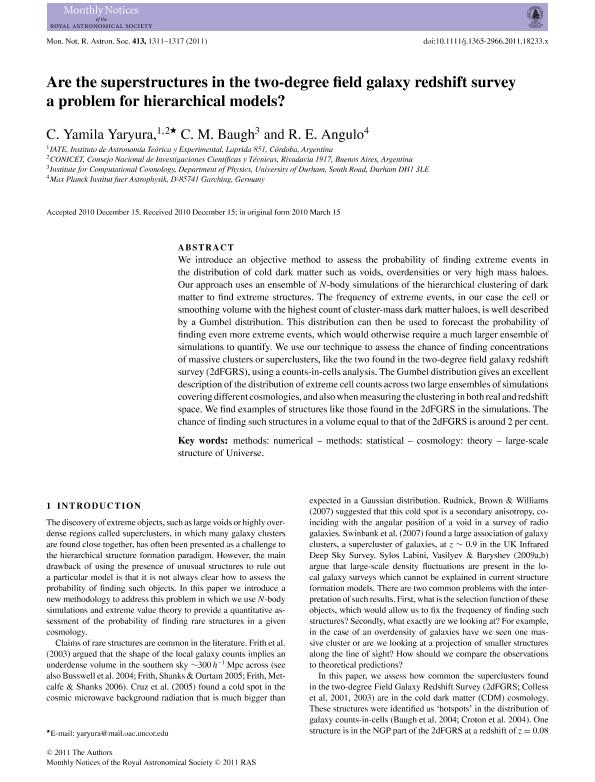
We introduce an objective method to assess the probability of finding extreme events in the cold dark matter such as voids, overdensities or very high mass haloes. Our approach uses an ensemble of N-body simulations of the hierarchical clustering of dark matter to find extreme structures. The frequency of extreme events, in our case the cell or smoothing volume with the highest count of cluster-mass dark matter haloes, is well described by a Gumbel distribution. This distribution can then be used to forecast the probability of finding even more extreme events, which would otherwise require a much larger ensemble of simulations to quantify. We use our technique to assess the chance of finding concentrations of massive clusters or superclusters, like the two found in the two-degree field galaxy redshift survey (2dFGRS), using a counts-in-cells analysis. The Gumbel distribution gives an excellent description of the distribution of extreme cell counts across two large ensembles of simulations covering different cosmologies, and measuring the clustering in both real and redshift space. We find examples of structures like those found in the 2dFGRS in the simulations. The chance of finding such structures in a volume equal to that of the 2dFGRS is around 2 per cent.
Archivos asociados

Tamaño:
17.03Mb
Formato:
PDF
Licencia
 Excepto donde se diga explícitamente, este item se publica bajo la siguiente descripción:
Creative Commons Attribution-NonCommercial-ShareAlike 2.5 Unported (CC BY-NC-SA 2.5)
Excepto donde se diga explícitamente, este item se publica bajo la siguiente descripción:
Creative Commons Attribution-NonCommercial-ShareAlike 2.5 Unported (CC BY-NC-SA 2.5)
Identificadores
Colecciones
Articulos(IATE)
Articulos de INST.DE ASTRONOMIA TEORICA Y EXPERIMENTAL
Articulos de INST.DE ASTRONOMIA TEORICA Y EXPERIMENTAL
Citación
Yaryura, Claudia Yamila; Baugh, C. M.; Angulo, R.; Are the 2dFGRS superstructures a problem for hierarchical models?; Wiley Blackwell Publishing, Inc; Monthly Notices of the Royal Astronomical Society; 413; 2; 5-2011; 1311-1317
Compartir


Altmétricas