Mostrar el registro sencillo del ítem
dc.contributor.author
Padilla, Nelson David
dc.contributor.author
Garcia Lambas, Diego Rodolfo
dc.contributor.author
González, Roberto
dc.date.available
2025-12-17T11:49:10Z
dc.date.issued
2010-12
dc.identifier.citation
Padilla, Nelson David; Garcia Lambas, Diego Rodolfo; González, Roberto; Local and global environmental effects on galaxies and active galactic nuclei; Wiley Blackwell Publishing, Inc; Monthly Notices of the Royal Astronomical Society; 409; 3; 12-2010; 936-952
dc.identifier.issn
0035-8711
dc.identifier.uri
http://hdl.handle.net/11336/278018
dc.description.abstract
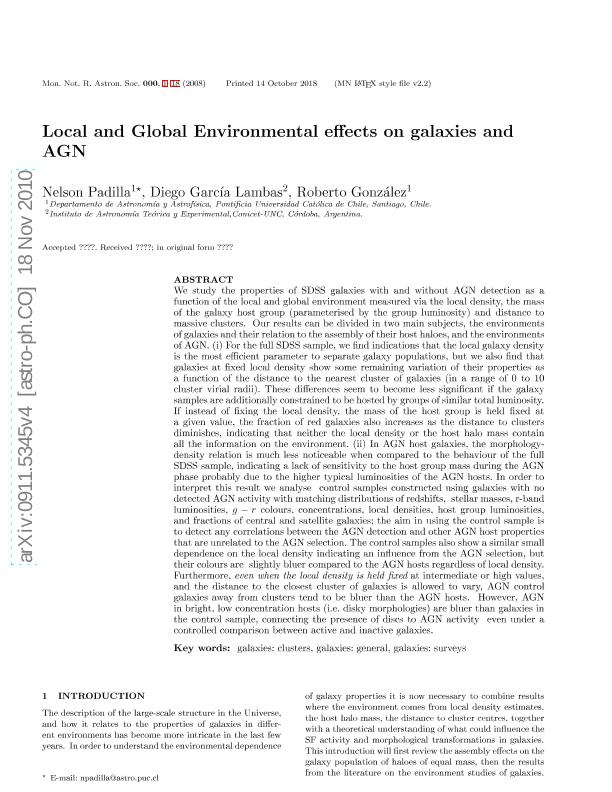
We study the properties of Sloan Digital Sky Survey (SDSS) galaxies with and without active galactic nucleus (AGN) detection as a function of the local and global environment measured via the local density, mass of the galaxy host group (parametrized by the group luminosity) and distance to massive clusters. Our results can be divided into two main subjects: the environments of galaxies and their relation to the assembly of their host haloes, and the environments of AGNs. (i) For the full SDSS sample, we find indications that the local galaxy density is the most efficient parameter to separate galaxy populations, but we also find that galaxies at a fixed local density show some remaining variation in their properties as a function of the distance to the nearest cluster of galaxies (in a range of 0-10 cluster virial radii). These differences seem to become less significant, if the galaxy samples are additionally constrained to be hosted by groups of similar total luminosity. If instead of fixing the local density, the mass of the host group is held fixed at a given value, the fraction of red galaxies also increases as the distance to clusters diminishes, indicating that neither the local density nor the host halo mass contains all the information on the environment. (ii) In AGN host galaxies, the morphology-density relation is much less notable when compared to the behaviour of the full SDSS sample, indicating a lack of sensitivity to the host group mass during the AGN phase, probably due to the higher typical luminosities of the AGN hosts. In order to interpret this result, we analyse control samples constructed using galaxies with no detected AGN activity with matching distributions of redshifts, stellar masses, r-band luminosities, g‑r colours, concentrations, local densities, host group luminosities and fractions of central and satellite galaxies; the aim in using the control sample is to detect any correlations between the AGN detection and other AGN host properties that are unrelated to the AGN selection. The control samples also show a similar small dependence on the local density, indicating an influence from the AGN selection, but their colours are slightly bluer compared to the AGN hosts, regardless of the local density. Furthermore, even when the local density is held fixed at intermediate or high values, and the distance to the closest cluster of galaxies is allowed to vary, AGN control galaxies away from clusters tend to be bluer than the AGN hosts. However, AGN in bright, low-concentration hosts (i.e. discy morphologies) are bluer than galaxies in the control sample, connecting the presence of discs to AGN activity even under a controlled comparison between active and inactive galaxies.
dc.format
application/pdf
dc.language.iso
eng
dc.publisher
Wiley Blackwell Publishing, Inc
dc.rights
info:eu-repo/semantics/openAccess
dc.rights.uri
https://creativecommons.org/licenses/by-nc-sa/2.5/ar/
dc.subject
SURVEYS
dc.subject
GALAXIES
dc.subject
CLUSTERS
dc.subject
LARGE-SCELE
dc.subject.classification
Otras Ciencias Naturales y Exactas
dc.subject.classification
Otras Ciencias Naturales y Exactas
dc.subject.classification
CIENCIAS NATURALES Y EXACTAS
dc.title
Local and global environmental effects on galaxies and active galactic nuclei
dc.type
info:eu-repo/semantics/article
dc.type
info:ar-repo/semantics/artículo
dc.type
info:eu-repo/semantics/publishedVersion
dc.date.updated
2025-12-17T11:02:07Z
dc.journal.volume
409
dc.journal.number
3
dc.journal.pagination
936-952
dc.journal.pais
Reino Unido
dc.journal.ciudad
Londres
dc.description.fil
Fil: Padilla, Nelson David. Consejo Nacional de Investigaciones Científicas y Técnicas. Centro Científico Tecnológico Conicet - Córdoba. Instituto de Astronomía Teórica y Experimental. Universidad Nacional de Córdoba. Observatorio Astronómico de Córdoba. Instituto de Astronomía Teórica y Experimental; Argentina
dc.description.fil
Fil: Garcia Lambas, Diego Rodolfo. Consejo Nacional de Investigaciones Científicas y Técnicas. Centro Científico Tecnológico Conicet - Córdoba. Instituto de Astronomía Teórica y Experimental. Universidad Nacional de Córdoba. Observatorio Astronómico de Córdoba. Instituto de Astronomía Teórica y Experimental; Argentina
dc.description.fil
Fil: González, Roberto. Pontificia Universidad Católica de Chile; Chile
dc.journal.title
Monthly Notices of the Royal Astronomical Society
dc.relation.alternativeid
info:eu-repo/semantics/altIdentifier/doi/http://dx.doi.org/10.1111/j.1365-2966.2010.17396.x
dc.relation.alternativeid
info:eu-repo/semantics/altIdentifier/url/https://academic.oup.com/mnras/article/409/3/936/1094440
Archivos asociados

Tamaño:
1.350Mb
Formato:
PDF