Artículo
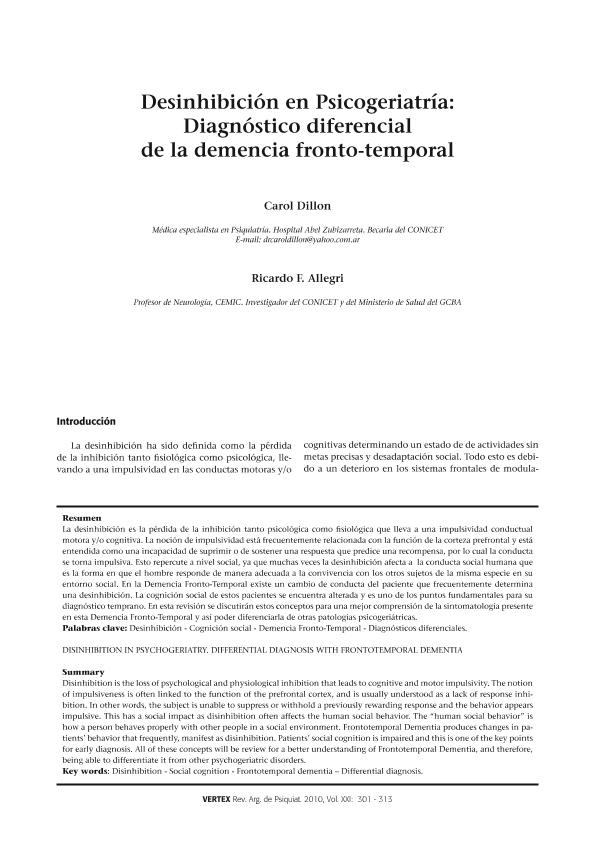
La desinhibición es la pérdida de la inhibición tanto psicológica como fisiológica que lleva a una impulsividad conductual motora y/o cognitiva. La noción de impulsividad está frecuentemente relacionada con la función de la corteza prefrontal y está entendida como una incapacidad de suprimir o de sostener una respuesta que predice una recompensa, por lo cual la conducta se torna impulsiva. Esto repercute a nivel social, ya que muchas veces la desinhibición afecta a la conducta social humana que es la forma en que el hombre responde de manera adecuada a la convivencia con los otros sujetos de la misma especie en su entorno social. En la Demencia Fronto-Temporal existe un cambio de conducta del paciente que frecuentemente determina una desinhibición. La cognición social de estos pacientes se encuentra alterada y es uno de los puntos fundamentales para su diagnóstico temprano. En esta revisión se discutirán estos conceptos para una mejor comprensión de la sintomatología presente en esta Demencia Fronto-Temporal y así poder diferenciarla de otras patologías psicogeriátricas. Disinhibition is the loss of psychological and physiological inhibition that leads to cognitive and motor impulsivity. The notion of impulsiveness is often linked to the function of the prefrontal cortex, and is usually understood as a lack of response inhibition. In other words, the subject is unable to suppress or withhold a previously rewarding response and the behavior appears impulsive. This has a social impact as disinhibition often affects the human social behavior. The “human social behavior” is how a person behaves properly with other people in a social environment. Frontotemporal Dementia produces changes in patients’ behavior that frequently, manifest as disinhibition. Patients’ social cognition is impaired and this is one of the key points for early diagnosis. All of these concepts will be review for a better understanding of Frontotemporal Dementia, and therefore, being able to differentiate it from other psychogeriatric disorders.
Desinhibición en Psicogeriatría: diagnostico diferencial de la demencia fronto-temporal
Título:
Disinhibition in Psychogeriatry: differential diagnosis with frontotemporal dementia

Fecha de publicación:
02/2010
Editorial:
Polemos
Revista:
Vertex
ISSN:
0327-6139
e-ISSN:
2718-904X
Idioma:
Español
Tipo de recurso:
Artículo publicado
Clasificación temática:
Resumen
Palabras clave:
Desinhibición
,
Cognición Social
,
Frontotemporal
,
Demencia
Archivos asociados

Tamaño:
336.5Kb
Formato:
PDF
Licencia
 Excepto donde se diga explícitamente, este item se publica bajo la siguiente descripción:
Atribución-NoComercial-SinDerivadas 2.5 Argentina (CC BY-NC-ND 2.5 AR)
Excepto donde se diga explícitamente, este item se publica bajo la siguiente descripción:
Atribución-NoComercial-SinDerivadas 2.5 Argentina (CC BY-NC-ND 2.5 AR)
Identificadores
Colecciones
Articulos(SEDE CENTRAL)
Articulos de SEDE CENTRAL
Articulos de SEDE CENTRAL
Citación
Dillon, Carol; Allegri, Ricardo Francisco; Desinhibición en Psicogeriatría: diagnostico diferencial de la demencia fronto-temporal; Polemos; Vertex; 21; 91; 2-2010; 301-313
Compartir

