Artículo
Bird Community, Forest Structure and Landscape Affects the Susceptibility to Open-Cup Nest Predation in Austral Forests
Benitez, Julieta ; Peri, Pablo Luis
; Barrera, Marcelo Daniel
; Martínez Pastur, Guillermo José
; Lencinas, María Vanessa
; Peri, Pablo Luis
; Barrera, Marcelo Daniel
; Martínez Pastur, Guillermo José
; Lencinas, María Vanessa
; Peri, Pablo Luis
; Barrera, Marcelo Daniel
; Martínez Pastur, Guillermo José
; Lencinas, María Vanessa
Fecha de publicación:
11/2025
Editorial:
MDPI
Revista:
Forests
ISSN:
1999-4907
Idioma:
Inglés
Tipo de recurso:
Artículo publicado
Clasificación temática:
Resumen
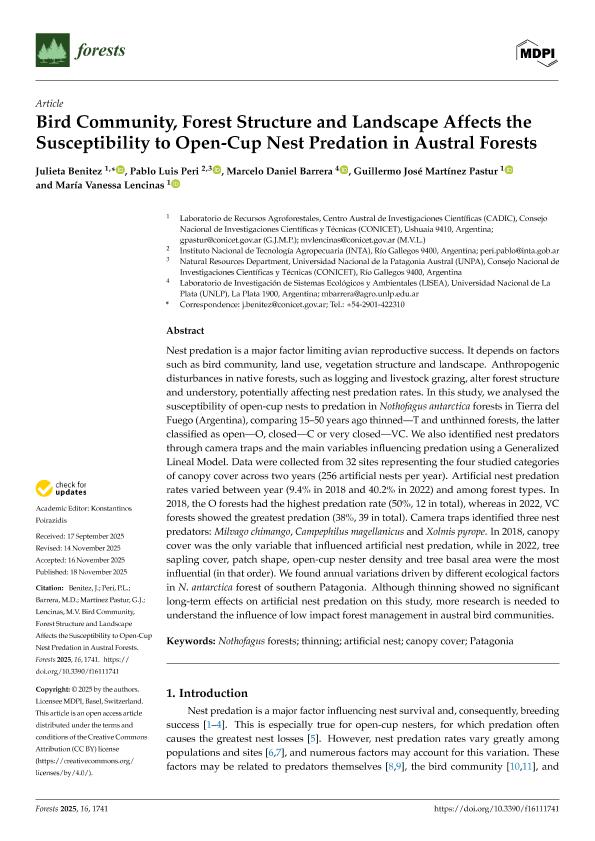
Nest predation is a major factor limiting avian reproductive success. It depends on factors such as bird community, land use, vegetation structure and landscape. Anthropogenic disturbances in native forests, such as logging and livestock grazing, alter forest structure and understory, potentially affecting nest predation rates. In this study, we analysed the susceptibility of open-cup nests to predation in Nothofagus antarctica forests in Tierra del Fuego (Argentina), comparing 15?50 years ago thinned?T and unthinned forests, the latter classified as open?O, closed?C or very closed?VC. We also identified nest predators through camera traps and the main variables influencing predation using a Generalized Lineal Model. Data were collected from 32 sites representing the four studied categories of canopy cover across two years (256 artificial nests per year). Artificial nest predation rates varied between year (9.4% in 2018 and 40.2% in 2022) and among forest types. In 2018, the O forests had the highest predation rate (50%, 12 in total), whereas in 2022, VC forests showed the greatest predation (38%, 39 in total). Camera traps identified three nest predators: Milvago chimango, Campephilus magellanicus and Xolmis pyrope. In 2018, canopy cover was the only variable that influenced artificial nest predation, while in 2022, tree sapling cover, patch shape, open-cup nester density and tree basal area were the most influential (in that order). We found annual variations driven by different ecological factors in N. antarctica forest of southern Patagonia. Although thinning showed no significant long-term effects on artificial nest predation on this study, more research is needed to understand the influence of low impact forest management in austral bird communities.
Palabras clave:
Nothofagus forests
,
thinning
,
artificial nest
,
canopy cover
Archivos asociados

Tamaño:
4.700Mb
Formato:
PDF
Licencia
 Excepto donde se diga explícitamente, este item se publica bajo la siguiente descripción:
Creative Commons Attribution-NonCommercial-ShareAlike 2.5 Unported (CC BY-NC-SA 2.5)
Excepto donde se diga explícitamente, este item se publica bajo la siguiente descripción:
Creative Commons Attribution-NonCommercial-ShareAlike 2.5 Unported (CC BY-NC-SA 2.5)
Identificadores
Colecciones
Articulos(CADIC)
Articulos de CENTRO AUSTRAL DE INVESTIGACIONES CIENTIFICAS
Articulos de CENTRO AUSTRAL DE INVESTIGACIONES CIENTIFICAS
Articulos(SEDE CENTRAL)
Articulos de SEDE CENTRAL
Articulos de SEDE CENTRAL
Citación
Benitez, Julieta; Peri, Pablo Luis; Barrera, Marcelo Daniel; Martínez Pastur, Guillermo José; Lencinas, María Vanessa; Bird Community, Forest Structure and Landscape Affects the Susceptibility to Open-Cup Nest Predation in Austral Forests; MDPI; Forests; 16; 11; 11-2025; 1-16
Compartir


Altmétricas