Artículo
The role of macroinvertebrates and fish in regulating the provision by macrophytes of refugia for zooplankton in a warm temperate shallow lake

Fecha de publicación:
10/2010
Editorial:
Wiley Blackwell Publishing, Inc
Revista:
Freshwater Biology (print)
ISSN:
0046-5070
Idioma:
Inglés
Tipo de recurso:
Artículo publicado
Clasificación temática:
Resumen
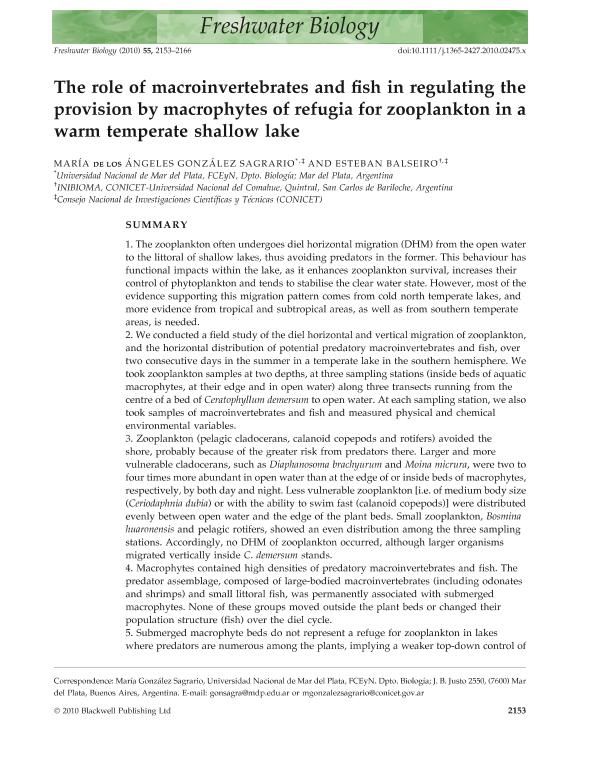
1. The zooplankton often undergoes diel horizontal migration (DHM) from the open water to the littoral of shallow lakes, thus avoiding predators in the former. This behaviour has functional impacts within the lake, as it enhances zooplankton survival, increases their control of phytoplankton and tends to stabilise the clear water state. However, most of the evidence supporting this migration pattern comes from cold north temperate lakes, and more evidence from tropical and subtropical areas, as well as from southern temperate areas, is needed. 2. We conducted a field study of the diel horizontal and vertical migration of zooplankton, and the horizontal distribution of potential predatory macroinvertebrates and fish, over two consecutive days in the summer in a temperate lake in the southern hemisphere. We took zooplankton samples at two depths, at three sampling stations (inside beds of aquatic macrophytes, at their edge and in open water) along three transects running from the centre of a bed of Ceratophyllum demersum to open water. At each sampling station, we also took samples of macroinvertebrates and fish and measured physical and chemical environmental variables. 3. Zooplankton (pelagic cladocerans, calanoid copepods and rotifers) avoided the shore, probably because of the greater risk from predators there. Larger and more vulnerable cladocerans, such as Diaphanosoma brachyurum and Moina micrura, were two to four times more abundant in open water than at the edge of or inside beds of macrophytes, respectively, by both day and night. Less vulnerable zooplankton [i.e. of medium body size (Ceriodaphnia dubia) or with the ability to swim fast (calanoid copepods)] were distributed evenly between open water and the edge of the plant beds. Small zooplankton, Bosmina huaronensis and pelagic rotifers, showed an even distribution among the three sampling stations. Accordingly, no DHM of zooplankton occurred, although larger organisms migrated vertically inside C. demersum stands. 4. Macrophytes contained high densities of predatory macroinvertebrates and fish. The predator assemblage, composed of large-bodied macroinvertebrates (including odonates and shrimps) and small littoral fish, was permanently associated with submerged macrophytes. None of these groups moved outside the plant beds or changed their population structure (fish) over the diel cycle. 5. Submerged macrophyte beds do not represent a refuge for zooplankton in lakes where predators are numerous among the plants, implying a weaker top-down control of phytoplankton biomass by zooplankton and, consequently, a more turbid lake. The effectiveness of macrophytes as a refuge for zooplankton depends on the associated assemblage of predatory macroinvertebrates and fish among the plants.
Palabras clave:
migration
,
predation risk
,
shallow lakes
,
sumerged macrophytes
Archivos asociados

Tamaño:
696.8Kb
Formato:
PDF
Licencia
 Excepto donde se diga explícitamente, este item se publica bajo la siguiente descripción:
Creative Commons Attribution-NonCommercial-ShareAlike 2.5 Unported (CC BY-NC-SA 2.5)
Excepto donde se diga explícitamente, este item se publica bajo la siguiente descripción:
Creative Commons Attribution-NonCommercial-ShareAlike 2.5 Unported (CC BY-NC-SA 2.5)
Identificadores
Colecciones
Articulos(IIMYC)
Articulos de INSTITUTO DE INVESTIGACIONES MARINAS Y COSTERAS
Articulos de INSTITUTO DE INVESTIGACIONES MARINAS Y COSTERAS
Articulos(INIBIOMA)
Articulos de INST. DE INVEST.EN BIODIVERSIDAD Y MEDIOAMBIENTE
Articulos de INST. DE INVEST.EN BIODIVERSIDAD Y MEDIOAMBIENTE
Citación
Gonzalez Sagrario, Maria de Los Angeles; Balseiro, Esteban Gabriel; The role of macroinvertebrates and fish in regulating the provision by macrophytes of refugia for zooplankton in a warm temperate shallow lake; Wiley Blackwell Publishing, Inc; Freshwater Biology (print); 55; 10; 10-2010; 2153-2166
Compartir


Altmétricas