Artículo
Impact of forest fires on water quality and nutrient dynamics in burned streams in Patagonia
Brand, Cecilia ; Dromaz, Walter Mauricio
; Carignano, María Luciana; Ravasi, Cintia; Assef, Yanina Andrea
; Dromaz, Walter Mauricio
; Carignano, María Luciana; Ravasi, Cintia; Assef, Yanina Andrea
; Dromaz, Walter Mauricio
; Carignano, María Luciana; Ravasi, Cintia; Assef, Yanina Andrea
Fecha de publicación:
12/2025
Editorial:
Elsevier
Revista:
Science of the Total Environment
ISSN:
0048-9697
Idioma:
Inglés
Tipo de recurso:
Artículo publicado
Clasificación temática:
Resumen
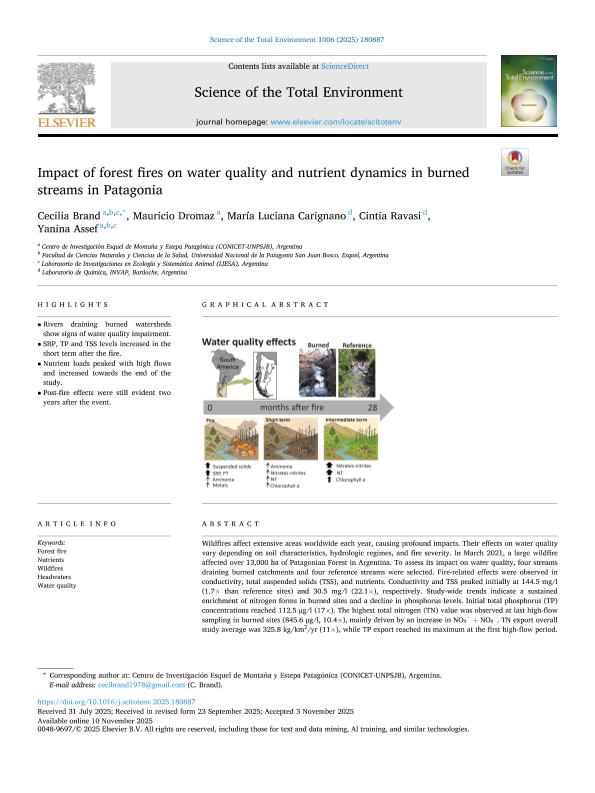
Wildfires affect extensive areas worldwide each year, causing profound impacts. Their effects on water quality vary depending on soil characteristics, hydrologic regimes, and fire severity. In March 2021, a large wildfire affected over 13,000 ha of Patagonian Forest in Argentina. To assess its impact on water quality, four streams draining burned catchments and four reference streams were selected. Fire-related effects were observed in conductivity, total suspended solids (TSS), and nutrients. Conductivity and TSS peaked initially at 144.5 mg/l (1.7× than reference sites) and 30.5 mg/l (22.1×), respectively. Study-wide trends indicate a sustained enrichment of nitrogen forms in burned sites and a decline in phosphorus levels. Initial total phosphorus (TP)concentrations reached 112.5 μg/l (17×). The highest total nitrogen (TN) value was observed at last high-flow sampling in burned sites (845.6 μg/l, 10.4×), mainly driven by an increase in NO₃− + NO₂− . TN export overall study average was 325.8 kg/km2/yr (11×), while TP export reached its maximum at the first high-flow period. Most metal concentrations exhibited similar trends in burned and reference streams, peaking after the first postfire rainfall, with significantly higher levels of arsenic in burned sites. These findings underscore the significant and lasting impacts of wildfires on aquatic ecosystems, highlighting the need for management strategies that mitigate the consequences of such extreme events on freshwater biodiversity and ecosystem functioning. Post-fire conditions require a focused assessment due to potential synergistic impacts on water quality.
Palabras clave:
FOREST FIRES
,
NUTRIENTS
,
WILDFIRES
,
HEADWATERS
,
WATER QUALITY
Archivos asociados

Tamaño:
3.559Mb
Formato:
PDF
Licencia
 Excepto donde se diga explícitamente, este item se publica bajo la siguiente descripción:
Creative Commons Attribution-NonCommercial-ShareAlike 2.5 Unported (CC BY-NC-SA 2.5)
Excepto donde se diga explícitamente, este item se publica bajo la siguiente descripción:
Creative Commons Attribution-NonCommercial-ShareAlike 2.5 Unported (CC BY-NC-SA 2.5)
Identificadores
Colecciones
Articulos(CIEMEP)
Articulos de CENTRO DE INVESTIGACION ESQUEL DE MONTAÑA Y ESTEPA PATAGONICA
Articulos de CENTRO DE INVESTIGACION ESQUEL DE MONTAÑA Y ESTEPA PATAGONICA
Citación
Brand, Cecilia; Dromaz, Walter Mauricio; Carignano, María Luciana; Ravasi, Cintia; Assef, Yanina Andrea; Impact of forest fires on water quality and nutrient dynamics in burned streams in Patagonia; Elsevier; Science of the Total Environment; 1006; 12-2025; 1-12
Compartir


Altmétricas