Artículo
Weed communities of transgenic glyphosate‐tolerant soyabean crops in ex‐pasture land in the southern Mesopotamic Pampas of Argentina
Mas, M. T.; Verdú, A .M. C.; Kruk, Betina Claudia; de Abelleyra, Diego; Guglielmini, Antonio César; Satorre, Emilio Horacio
Fecha de publicación:
01/2010
Editorial:
Wiley Blackwell Publishing, Inc
Revista:
Weed Research
ISSN:
0043-1737
Idioma:
Inglés
Tipo de recurso:
Artículo publicado
Clasificación temática:
Resumen
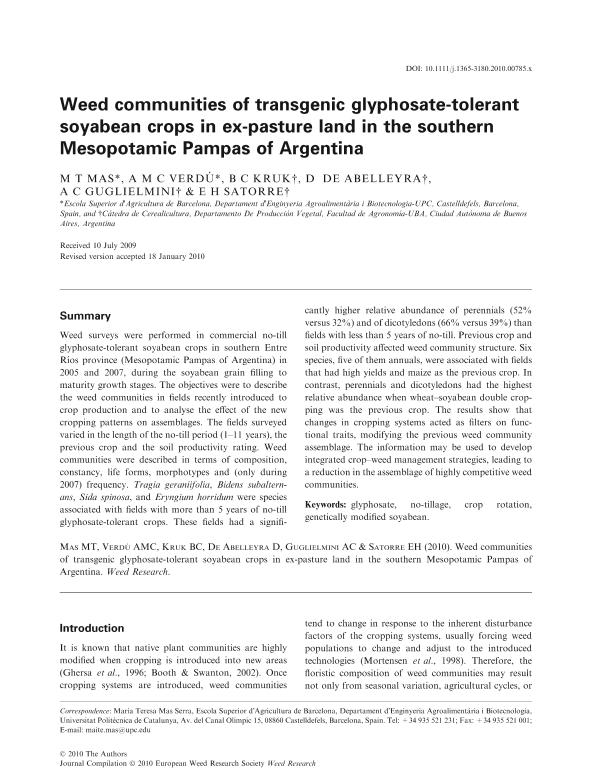
Weed surveys were performed in commercial no-till glyphosate tolerant soybean crop fields in southern Entre Ríos province (Mesopotamic Pampas of Argentina) in 2005 and 2007 during the soybean grain filling to maturity growth stages. The objectives were to describe the weed communities in fields recently introduced to crop production and to analyze the effect of the new cropping patterns on their structure. The fields surveyed varied in the length of the no-till period (1-11 years), the previous crop and the soil productivity rating. Weed communities were described in terms of composition, constancy, life forms, morphotypes and (only during 2007) frequency. Tragia geraniifolia, Bidens subalternans, Sida spinosa, and Eryngium horridum were species associated with fields with more than five years of no-till glyphosate tolerant crops, which had a significantly higher relative abundance of perennials (52% versus 32%) and of dicotyledons (66% versus 39%) than fields with fewer years of no-till. Previous crop and soil productivity greatly affected weed community structure. Six species, five of them annuals, were associated with fields that had high yields and maize as the previous crop. In contrast, perennials and dicotyledons had the highest relative abundance when wheat-soybean double cropping was the previous crop. The results show how changes in cropping systems acted as filters on functional traits, modifying the previous weed community assemblage. The information may be used to develop integrated crop-weed management strategies leading to a reduction in the assemblage of highly competitive weed communities.
Palabras clave:
Glyphosate
,
Non-tillage
,
Crop rotation
,
Genetically modified soyabean
Archivos asociados

Tamaño:
156.1Kb
Formato:
PDF
Licencia
 Excepto donde se diga explícitamente, este item se publica bajo la siguiente descripción:
Creative Commons Attribution-NonCommercial-ShareAlike 2.5 Unported (CC BY-NC-SA 2.5)
Excepto donde se diga explícitamente, este item se publica bajo la siguiente descripción:
Creative Commons Attribution-NonCommercial-ShareAlike 2.5 Unported (CC BY-NC-SA 2.5)
Identificadores
Colecciones
Articulos(IFEVA)
Articulos de INST.D/INV.FISIOLOGICAS Y ECO.VINCULADAS A L/AGRIC
Articulos de INST.D/INV.FISIOLOGICAS Y ECO.VINCULADAS A L/AGRIC
Citación
Mas, M. T.; Verdú, A .M. C.; Kruk, Betina Claudia; de Abelleyra, Diego; Guglielmini, Antonio César; et al.; Weed communities of transgenic glyphosate‐tolerant soyabean crops in ex‐pasture land in the southern Mesopotamic Pampas of Argentina; Wiley Blackwell Publishing, Inc; Weed Research; 50; 4; 1-2010; 320-330
Compartir


Altmétricas