Artículo
Generation of Chemisorbed Benzyl Radicals on Silica Nanoparticles
Arce, Valeria Beatriz; Rosso, Janina Alejandra ; Oliveira, Fernando J. V. E.; Airoldi, Claudio; Soria, Delia Beatriz
; Gonzalez, Monica Cristina
; Allegretti, Patricia Ercilia; Mártire, Daniel O.
; Oliveira, Fernando J. V. E.; Airoldi, Claudio; Soria, Delia Beatriz
; Gonzalez, Monica Cristina
; Allegretti, Patricia Ercilia; Mártire, Daniel O.
; Oliveira, Fernando J. V. E.; Airoldi, Claudio; Soria, Delia Beatriz
; Gonzalez, Monica Cristina
; Allegretti, Patricia Ercilia; Mártire, Daniel O.
Fecha de publicación:
09/2010
Editorial:
Wiley Blackwell Publishing, Inc
Revista:
Photochemistry and Photobiology
ISSN:
0031-8655
Idioma:
Inglés
Tipo de recurso:
Artículo publicado
Clasificación temática:
Resumen
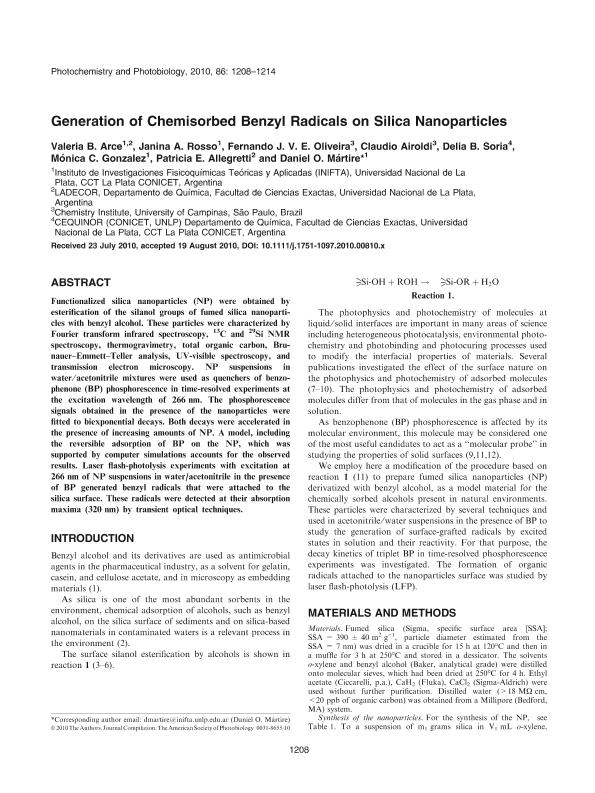
Functionalized silica nanoparticles (NP) were obtained by esterification of the silanol groups of fumed silica nanoparticles with benzyl alcohol. These particles were characterized by Fourier transform infrared spectroscopy, 13C and 29Si NMR spectroscopy, thermogravimetry, total organic carbon, Brunauer– Emmett–Teller analysis, UV-visible spectroscopy, and transmission electron microscopy. NP suspensions in water ⁄ acetonitrile mixtures were used as quenchers of benzophenone (BP) phosphorescence in time-resolved experiments at the excitation wavelength of 266 nm. The phosphorescence signals obtained in the presence of the nanoparticles were fitted to biexponential decays. Both decays were accelerated in the presence of increasing amounts of NP. A model, including the reversible adsorption of BP on the NP, which was supported by computer simulations accounts for the observed results. Laser flash-photolysis experiments with excitation at 266 nm of NP suspensions in water/acetonitrile in the presence of BP generated benzyl radicals that were attached to the silica surface. These radicals were detected at their absorption maxima (320 nm) by transient optical techniques.13C and 29Si NMR spectroscopy, thermogravimetry, total organic carbon, Brunauer– Emmett–Teller analysis, UV-visible spectroscopy, and transmission electron microscopy. NP suspensions in water ⁄ acetonitrile mixtures were used as quenchers of benzophenone (BP) phosphorescence in time-resolved experiments at the excitation wavelength of 266 nm. The phosphorescence signals obtained in the presence of the nanoparticles were fitted to biexponential decays. Both decays were accelerated in the presence of increasing amounts of NP. A model, including the reversible adsorption of BP on the NP, which was supported by computer simulations accounts for the observed results. Laser flash-photolysis experiments with excitation at 266 nm of NP suspensions in water/acetonitrile in the presence of BP generated benzyl radicals that were attached to the silica surface. These radicals were detected at their absorption maxima (320 nm) by transient optical techniques.⁄ acetonitrile mixtures were used as quenchers of benzophenone (BP) phosphorescence in time-resolved experiments at the excitation wavelength of 266 nm. The phosphorescence signals obtained in the presence of the nanoparticles were fitted to biexponential decays. Both decays were accelerated in the presence of increasing amounts of NP. A model, including the reversible adsorption of BP on the NP, which was supported by computer simulations accounts for the observed results. Laser flash-photolysis experiments with excitation at 266 nm of NP suspensions in water/acetonitrile in the presence of BP generated benzyl radicals that were attached to the silica surface. These radicals were detected at their absorption maxima (320 nm) by transient optical techniques.
Palabras clave:
NANOPARTICLES
,
LASER FLASH PHOTOLYSIS
,
BENZYL ALCOHOL
,
BENZOPHENONE
Archivos asociados

Tamaño:
769.1Kb
Formato:
PDF
Licencia
 Excepto donde se diga explícitamente, este item se publica bajo la siguiente descripción:
Creative Commons Attribution-NonCommercial-ShareAlike 2.5 Unported (CC BY-NC-SA 2.5)
Excepto donde se diga explícitamente, este item se publica bajo la siguiente descripción:
Creative Commons Attribution-NonCommercial-ShareAlike 2.5 Unported (CC BY-NC-SA 2.5)
Identificadores
Colecciones
Articulos(CEQUINOR)
Articulos de CENTRO DE QUIMICA INORGANICA "DR. PEDRO J. AYMONINO"
Articulos de CENTRO DE QUIMICA INORGANICA "DR. PEDRO J. AYMONINO"
Articulos(INIFTA)
Articulos de INST.DE INV.FISICOQUIMICAS TEORICAS Y APLIC.
Articulos de INST.DE INV.FISICOQUIMICAS TEORICAS Y APLIC.
Citación
Arce, Valeria Beatriz; Rosso, Janina Alejandra; Oliveira, Fernando J. V. E.; Airoldi, Claudio; Soria, Delia Beatriz; et al.; Generation of Chemisorbed Benzyl Radicals on Silica Nanoparticles; Wiley Blackwell Publishing, Inc; Photochemistry and Photobiology; 86; 6; 9-2010; 1208-1214
Compartir


Altmétricas