Artículo
Low crowding threshold for induction of sexual reproduction and diapause in a Patagonian rotifer

Fecha de publicación:
06/2010
Editorial:
Wiley Blackwell Publishing, Inc
Revista:
Freshwater Biology (print)
ISSN:
0046-5070
Idioma:
Inglés
Tipo de recurso:
Artículo publicado
Clasificación temática:
Resumen
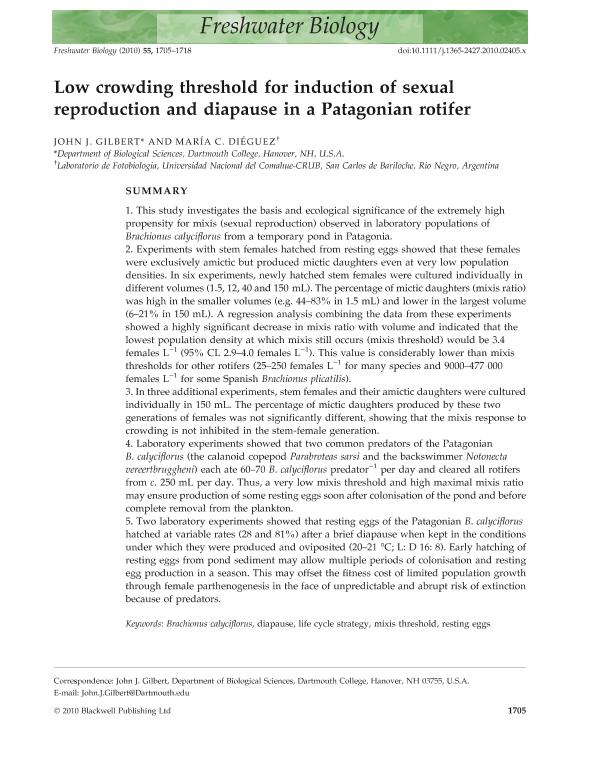
This study investigates the basis and ecological significance ofthe extremely highpropensity for mixis (sexual reproduction) observed in laboratory populations of Brachionus calyciflorus from a temporary pond in Patagonia.2. Experiments with stem females hatched from resting eggs showed that these females were exclusively amictic but produced mictic daughters even at very low population densities. In six experiments, newly hatched stem females were cultured individually in differentvolumes (1.5, 12, 40 and 150 mL). The percentage of mictic daughters (mixis ratio) was high in the smaller volumes (e.g. 44-83% in 1.5 mL) and lower in the largest volume (6-21% in 150 mL).A regression analysis combining the data from these experiments showed a highly significant decrease in mixis ratio with volume and indicated that the lowest population density at which mixis still occurs (mixis threshold) would be 3.4females L-1 (95% CL 2.9 - 4.0 females L-1).This value is considerably lower than mixis thresholds for other rotifers (25-250 females L-1 for many species and 9,000-477,000 females L-1 for some Spanish Brachionus plicatilis).3. In three additional experiments, stem females and their amictic daughters were culturedindividually in 150 mL. The percentage of mictic daughters produced by these two generations of females was not significantly different, showing that the mixis response to crowding is not inhibited in thestem-female generation.4. Laboratory experiments showed that two common predators of the Patagonian B.calyciflorus (the calanoid copepod Parabroteas sarsi and the backswimmer Notonectavereertbruggheni) each ate 60-70 B. calyciflorus predator-1 d-1 and cleared all rotifers from c. 250 mL d-1. Thus, a very low mixis threshold and high maximal mixis ratio may ensure production of some resting eggs soon after colonization of the pond and before complete removal from the plankton.5. Two laboratory experiments showed that resting eggs of the Patagonian B. calyciflorushatched at variable rates (28% and 81%) after a brief diapause when kept in the conditionsunder which they were produced and oviposited (20-21° C; L: D 16: 8). Early hatching ofresting eggs from pond sediment may allow multiple periods of colonization and resting-egg production in a season. This may offset the fitness cost of limited population growth due to female parthenogenesis in the face of unpredictable and abrupt risk of extinction due to predators.
Palabras clave:
Brachionus calyciflorus
,
diapause
,
life cycle strategy
,
mixis threshold
Archivos asociados

Tamaño:
283.9Kb
Formato:
PDF
Licencia
 Excepto donde se diga explícitamente, este item se publica bajo la siguiente descripción:
Creative Commons Attribution-NonCommercial-ShareAlike 2.5 Unported (CC BY-NC-SA 2.5)
Excepto donde se diga explícitamente, este item se publica bajo la siguiente descripción:
Creative Commons Attribution-NonCommercial-ShareAlike 2.5 Unported (CC BY-NC-SA 2.5)
Identificadores
Colecciones
Articulos(INIBIOMA)
Articulos de INST. DE INVEST.EN BIODIVERSIDAD Y MEDIOAMBIENTE
Articulos de INST. DE INVEST.EN BIODIVERSIDAD Y MEDIOAMBIENTE
Citación
Gilbert, John J.; Dieguez, Maria del Carmen; Low crowding threshold for induction of sexual reproduction and diapause in a Patagonian rotifer; Wiley Blackwell Publishing, Inc; Freshwater Biology (print); 55; 8; 6-2010; 1705-1718
Compartir


Altmétricas