Artículo
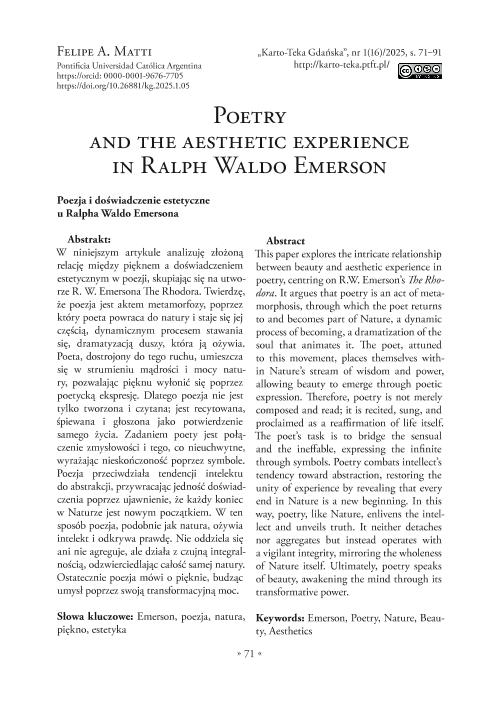
This paper explores the intricate relationship between beauty and aesthetic experience in poetry, centring on R.W. Emerson’s The Rhodora. It argues that poetry is an act of metamorphosis, through which the poet returns to and becomes part of Nature, a dynamic process of becoming, a dramatization of the soul that animates it. The poet, attuned to this movement, places themselves within Nature’s stream of wisdom and power, allowing beauty to emerge through poetic expression. Therefore, poetry is not merely composed and read; it is recited, sung, and proclaimed as a reaffirmation of life itself. The poet’s task is to bridge the sensual and the ineffable, expressing the infinite through symbols. Poetry combats intellect’s tendency toward abstraction, restoring the unity of experience by revealing that every end in Nature is a new beginning. In this way, poetry, like Nature, enlivens the intellect and unveils truth. It neither detaches nor aggregates but instead operates with a vigilant integrity, mirroring the wholeness of Nature itself. Ultimately, poetry speaks of beauty, awakening the mind through its transformative power. W niniejszym artykule analizuję złożoną relację między pięknem a doświadczeniem estetycznym w poezji, skupiając się na utworze R. W. Emersona The Rhodora. Twierdzę, że poezja jest aktem metamorfozy, poprzez który poeta powraca do natury i staje się jej częścią, dynamicznym procesem stawania się, dramatyzacją duszy, która ją ożywia. Poeta, dostrojony do tego ruchu, umieszcza się w strumieniu mądrości i mocy natury, pozwalając pięknu wyłonić się poprzez poetycką ekspresję. Dlatego poezja nie jest tylko tworzona i czytana; jest recytowana, śpiewana i głoszona jako potwierdzenie samego życia. Zadaniem poety jest połączenie zmysłowości i tego, co nieuchwytne, wyrażając nieskończoność poprzez symbole. Poezja przeciwdziała tendencji intelektu do abstrakcji, przywracając jedność doświadczenia poprzez ujawnienie, że każdy koniec w Naturze jest nowym początkiem. W ten sposób poezja, podobnie jak natura, ożywia intelekt i odkrywa prawdę. Nie oddziela się ani nie agreguje, ale działa z czujną integralnością, odzwierciedlając całość samej natury. Ostatecznie poezja mówi o pięknie, budząc umysł poprzez swoją transformacyjną moc.
Poetry and the aesthetic experience in Ralph Waldo Emerson
Título:
Poezja i doświadczenie estetyczne u Ralpha Waldo Emersona

Fecha de publicación:
09/2025
Editorial:
Pomorskie Towarzystwo Filozoficzno-Teologiczne
Revista:
Karto-Teka Gdańska
ISSN:
2720-2054
e-ISSN:
2545-2231
Idioma:
Inglés
Tipo de recurso:
Artículo publicado
Clasificación temática:
Resumen
Palabras clave:
Emerson
,
Beauty
,
Aesthetics
,
Nature
Archivos asociados

Tamaño:
205.0Kb
Formato:
PDF
Licencia
 Excepto donde se diga explícitamente, este item se publica bajo la siguiente descripción:
Atribución-NoComercial-SinDerivadas 2.5 Argentina (CC BY-NC-ND 2.5 AR)
Excepto donde se diga explícitamente, este item se publica bajo la siguiente descripción:
Atribución-NoComercial-SinDerivadas 2.5 Argentina (CC BY-NC-ND 2.5 AR)
Identificadores
Colecciones
Articulos(SEDE CENTRAL)
Articulos de SEDE CENTRAL
Articulos de SEDE CENTRAL
Citación
Matti, Felipe Andres; Poetry and the aesthetic experience in Ralph Waldo Emerson; Pomorskie Towarzystwo Filozoficzno-Teologiczne; Karto-Teka Gdańska; 16; 1; 9-2025; 71-91
Compartir


Altmétricas