Mostrar el registro sencillo del ítem
dc.contributor.author
Cubilla, Marisa Angelica
dc.contributor.author
Sclausero, Ana Clara
dc.contributor.author
Bisbal, Mariano
dc.contributor.author
Asteggiano, Carla Gabriela
dc.date.available
2025-12-05T14:16:32Z
dc.date.issued
2025-10
dc.identifier.citation
Cubilla, Marisa Angelica; Sclausero, Ana Clara; Bisbal, Mariano; Asteggiano, Carla Gabriela; In vitro cell model to dilucidate the underlying molecular mechanism associated with ophthalmic manifestation of congenital disorders of glycosylation: studying an ALG2-CDG patient; Frontiers Media; Frontiers in Genetics; 16; 10-2025; 1-12
dc.identifier.issn
1664-8021
dc.identifier.uri
http://hdl.handle.net/11336/277007
dc.description.abstract
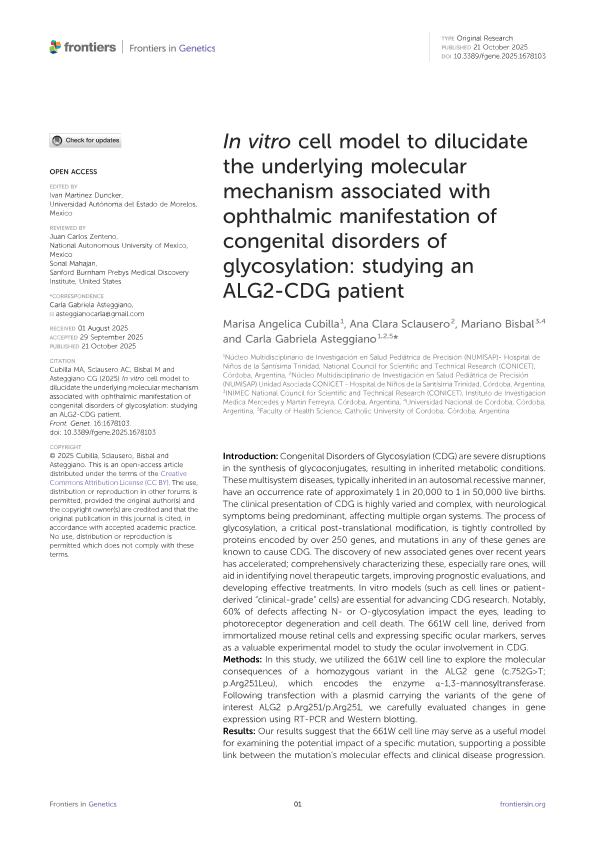
Introduction: Congenital Disorders of Glycosylation (CDG) are severe disruptions in the synthesis of glycoconjugates, resulting in inherited metabolic conditions. These multisystem diseases, typically inherited in an autosomal recessive manner, have an occurrence rate of approximately 1 in 20,000 to 1 in 50,000 live births. The clinical presentation of CDG is highly varied and complex, with neurological symptoms being predominant, affecting multiple organ systems. The process of glycosylation, a critical post-translational modification, is tightly controlled by proteins encoded by over 250 genes, and mutations in any of these genes are known to cause CDG. The discovery of new associated genes over recent years has accelerated; comprehensively characterizing these, especially rare ones, will aid in identifying novel therapeutic targets, improving prognostic evaluations, and developing effective treatments. In vitro models (such as cell lines or patient-derived “clinical-grade” cells) are essential for advancing CDG research. Notably, 60% of defects affecting N- or O-glycosylation impact the eyes, leading to photoreceptor degeneration and cell death. The 661W cell line, derived from immortalized mouse retinal cells and expressing specific ocular markers, serves as a valuable experimental model to study the ocular involvement in CDG.Methods: In this study, we utilized the 661W cell line to explore the molecular consequences of a homozygous variant in the ALG2 gene (c.752G>T; p.Arg251Leu), which encodes the enzyme α-1,3-mannosyltransferase. Following transfection with a plasmid carrying the variants of the gene of interest ALG2 p.Arg251/p.Arg251, we carefully evaluated changes in gene expression using RT-PCR and Western blotting.Results: Our results suggest that the 661W cell line may serve as a useful model for examining the potential impact of a specific mutation, supporting a possible link between the mutation’s molecular effects and clinical disease progression.Discussion: These findings could provide valuable insights to inform the development of targeted therapeutic strategies within the framework of personalized medicine.
dc.format
application/pdf
dc.language.iso
eng
dc.publisher
Frontiers Media
dc.rights
info:eu-repo/semantics/openAccess
dc.rights.uri
https://creativecommons.org/licenses/by-nc-sa/2.5/ar/
dc.subject
661W cell model
dc.subject
congenital disorders of glycosylation (CDG)
dc.subject
ALG2-CDG
dc.subject
photoreceptor, personalized medicine
dc.subject.classification
Genética Humana
dc.subject.classification
Medicina Básica
dc.subject.classification
CIENCIAS MÉDICAS Y DE LA SALUD
dc.title
In vitro cell model to dilucidate the underlying molecular mechanism associated with ophthalmic manifestation of congenital disorders of glycosylation: studying an ALG2-CDG patient
dc.type
info:eu-repo/semantics/article
dc.type
info:ar-repo/semantics/artículo
dc.type
info:eu-repo/semantics/publishedVersion
dc.date.updated
2025-12-04T12:27:21Z
dc.journal.volume
16
dc.journal.pagination
1-12
dc.journal.pais
Suiza
dc.description.fil
Fil: Cubilla, Marisa Angelica. Consejo Nacional de Investigaciones Científicas y Técnicas. Centro Científico Tecnológico Conicet - Córdoba; Argentina. Gobierno de la Provincia de Cordoba. Ministerio de Salud. Hospital de Niños de la Santísima Trinidad.; Argentina
dc.description.fil
Fil: Sclausero, Ana Clara. Gobierno de la Provincia de Cordoba. Ministerio de Salud. Hospital de Niños de la Santísima Trinidad.; Argentina
dc.description.fil
Fil: Bisbal, Mariano. Consejo Nacional de Investigaciones Científicas y Técnicas. Centro Científico Tecnológico Conicet - Córdoba. Instituto de Investigación Médica Mercedes y Martín Ferreyra. Universidad Nacional de Córdoba. Instituto de Investigación Médica Mercedes y Martín Ferreyra; Argentina
dc.description.fil
Fil: Asteggiano, Carla Gabriela. Gobierno de la Provincia de Cordoba. Ministerio de Salud. Hospital de Niños de la Santísima Trinidad.; Argentina. Consejo Nacional de Investigaciones Científicas y Técnicas. Centro Científico Tecnológico Conicet - Córdoba; Argentina
dc.journal.title
Frontiers in Genetics
dc.relation.alternativeid
info:eu-repo/semantics/altIdentifier/url/https://www.frontiersin.org/articles/10.3389/fgene.2025.1678103/full
dc.relation.alternativeid
info:eu-repo/semantics/altIdentifier/doi/http://dx.doi.org/10.3389/fgene.2025.1678103
Archivos asociados

Tamaño:
1.697Mb
Formato:
PDF