Artículo
The use of electrolyte leakage in the evaluation of salinity tolerance at seedling stage in maize (Zea mays L.).
Collado, Nonica Beatriz; Aulicino, Mónica Beatriz; Molina, María del Carmen ; Arturi, Miguel Jacinto
; Arturi, Miguel Jacinto
Fecha de publicación:
01/2010
Editorial:
Universidad de Misuri
Revista:
Maize Genetics Cooperation Newsletter
ISSN:
1090-4573
Idioma:
Inglés
Tipo de recurso:
Artículo publicado
Clasificación temática:
Resumen
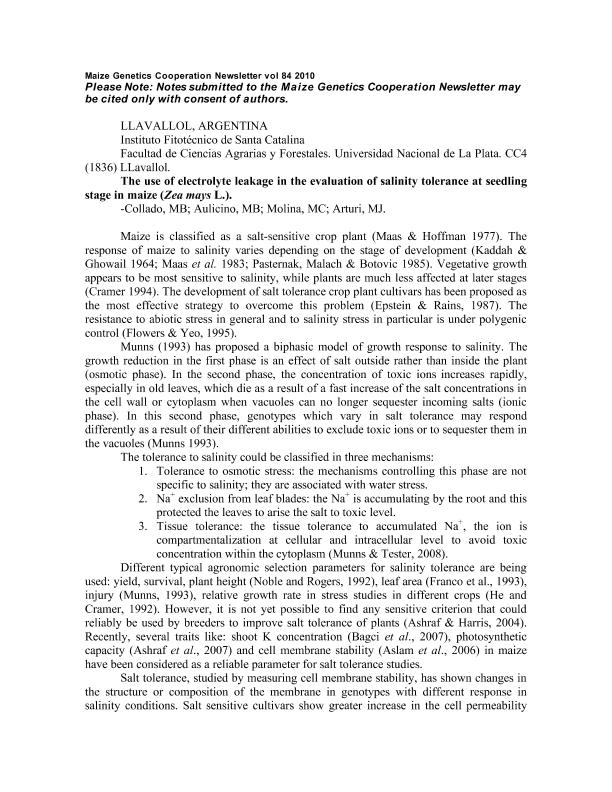
This paper examines the use of the electrolyte leakage (Cell membrane stability) trait in the selection at seedling stage that may be important in the screen for different mechanisms of tolerance in plants exposed to salinity.Eight accessions/lines were used five of which were populations and three inbred lines. Three seeds were planted in each pot containing perlit; these pots were put in trays with a nutrient solution. Two treatments were applied: control (cont.) where no ClNa solution was added and the other treatment receiving 100mM ClNa (salt). The experimental was carried out in controlled environmental room at 25 ºC, with 16 day length and with a relative humidity of 60%. After 14 days of each salt treatment, the seedlings were harvested. The length for shoot and radicle (SL and RL, respectively) were recorded. Shoot and radicle were separated and the samples were dried for two days until constant weight, for dry mass determination (DS and DR respectively). The cell membrane stability was estimated on the third leaf. Consequently, these traits would be extremely useful in salinity tolerance improvement programs, especially Root Length which has shown a major growth reduction compared to the controls. This apparently evidences the importance of the Root Length variable in the identification of a tolerant response. Some lines had divergent pattern to damage in membrane.
Palabras clave:
SALINITY
,
ZEA
,
CELL MEMBRANE STABILITY
Archivos asociados

Tamaño:
223.9Kb
Formato:
PDF
Licencia
 Excepto donde se diga explícitamente, este item se publica bajo la siguiente descripción:
Creative Commons Attribution-NonCommercial-ShareAlike 2.5 Unported (CC BY-NC-SA 2.5)
Excepto donde se diga explícitamente, este item se publica bajo la siguiente descripción:
Creative Commons Attribution-NonCommercial-ShareAlike 2.5 Unported (CC BY-NC-SA 2.5)
Identificadores
Colecciones
Articulos(CCT - LA PLATA)
Articulos de CTRO.CIENTIFICO TECNOL.CONICET - LA PLATA
Articulos de CTRO.CIENTIFICO TECNOL.CONICET - LA PLATA
Citación
Collado, Nonica Beatriz; Aulicino, Mónica Beatriz; Molina, María del Carmen; Arturi, Miguel Jacinto; The use of electrolyte leakage in the evaluation of salinity tolerance at seedling stage in maize (Zea mays L.).; Universidad de Misuri; Maize Genetics Cooperation Newsletter; 84; 1-2010; 17-19
Compartir

