Artículo
Four Large Indels in Barley Chloroplast Mutator (cpm) Seedlings Reinforce the Hypothesis of a Malfunction in the MMR System
Lencina, Franco Daniel Alberto; Prina, Alberto R.; Pacheco, Maria Gabriela ; Kobayashi, Ken
; Landau, Alejandra Mabel
; Kobayashi, Ken
; Landau, Alejandra Mabel
; Kobayashi, Ken
; Landau, Alejandra Mabel
Fecha de publicación:
09/2025
Editorial:
Molecular Diversity Preservation International
Revista:
International Journal of Molecular Sciences
ISSN:
1422-0067
Idioma:
Inglés
Tipo de recurso:
Artículo publicado
Clasificación temática:
Resumen
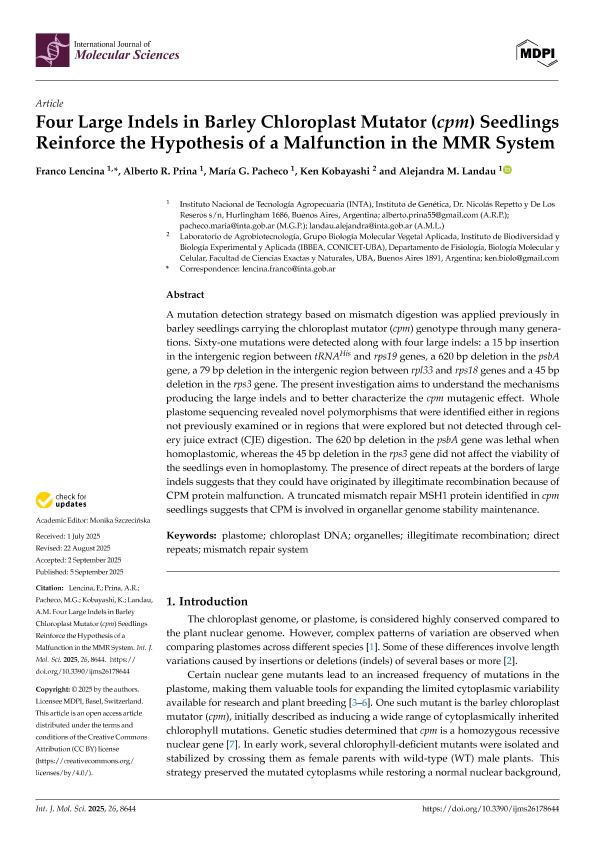
A mutation detection strategy based on mismatch digestion was applied previously in barley seedlings carrying the chloroplast mutator (cpm) genotype through many generations. Sixty-one mutations were detected along with four large indels: a 15 bp insertion in the intergenic region between tRNAHis and rps19 genes, a 620 bp deletion in the psbA gene, a 79 bp deletion in the intergenic region between rpl33 and rps18 genes and a 45 bp deletion in the rps3 gene. The present investigation aims to understand the mechanisms producing the large indels and to better characterize the cpm mutagenic effect. Whole plastome sequencing revealed novel polymorphisms that were identified either in regions not previously examined or in regions that were explored but not detected through celery juice extract (CJE) digestion. The 620 bp deletion in the psbA gene was lethal when homoplastomic, whereas the 45 bp deletion in the rps3 gene did not affect the viability of the seedlings even in homoplastomy. The presence of direct repeats at the borders of large indels suggests that they could have originated by illegitimate recombination because of CPM protein malfunction. A truncated mismatch repair MSH1 protein identified in cpm seedlings suggests that CPM is involved in organellar genome stability maintenance.
Palabras clave:
PLASTOME
,
CHLOROPLAST DNA
,
ORGANELLES
,
ILLEGITIMATE RECOMBINATION
Archivos asociados

Tamaño:
3.729Mb
Formato:
PDF
Licencia
 Excepto donde se diga explícitamente, este item se publica bajo la siguiente descripción:
Creative Commons Attribution-NonCommercial-ShareAlike 2.5 Unported (CC BY-NC-SA 2.5)
Excepto donde se diga explícitamente, este item se publica bajo la siguiente descripción:
Creative Commons Attribution-NonCommercial-ShareAlike 2.5 Unported (CC BY-NC-SA 2.5)
Identificadores
Colecciones
Articulos(IBBEA)
Articulos de INSTITUTO DE BIODIVERSIDAD Y BIOLOGIA EXPERIMENTAL Y APLICADA
Articulos de INSTITUTO DE BIODIVERSIDAD Y BIOLOGIA EXPERIMENTAL Y APLICADA
Citación
Lencina, Franco Daniel Alberto; Prina, Alberto R.; Pacheco, Maria Gabriela; Kobayashi, Ken; Landau, Alejandra Mabel; Four Large Indels in Barley Chloroplast Mutator (cpm) Seedlings Reinforce the Hypothesis of a Malfunction in the MMR System; Molecular Diversity Preservation International; International Journal of Molecular Sciences; 26; 17; 9-2025; 8644-8660
Compartir


Altmétricas