Artículo
The Phylogenetic Architecture of Recruitment Networks
Gleiser, Gabriela Laura ; Alcántara, Julio M.; Bascompte, Jordi; Garrido, José L.; Montesinos Navarro, Alicia; Paterno, Gustavo B.; Valiente Banuet, Alfonso; Verdú, Miguel
; Alcántara, Julio M.; Bascompte, Jordi; Garrido, José L.; Montesinos Navarro, Alicia; Paterno, Gustavo B.; Valiente Banuet, Alfonso; Verdú, Miguel
Fecha de publicación:
12/2024
Editorial:
Wiley Blackwell Publishing, Inc
Revista:
Global Ecology and Biogeography
ISSN:
1466-822X
Idioma:
Inglés
Tipo de recurso:
Artículo publicado
Clasificación temática:
Resumen
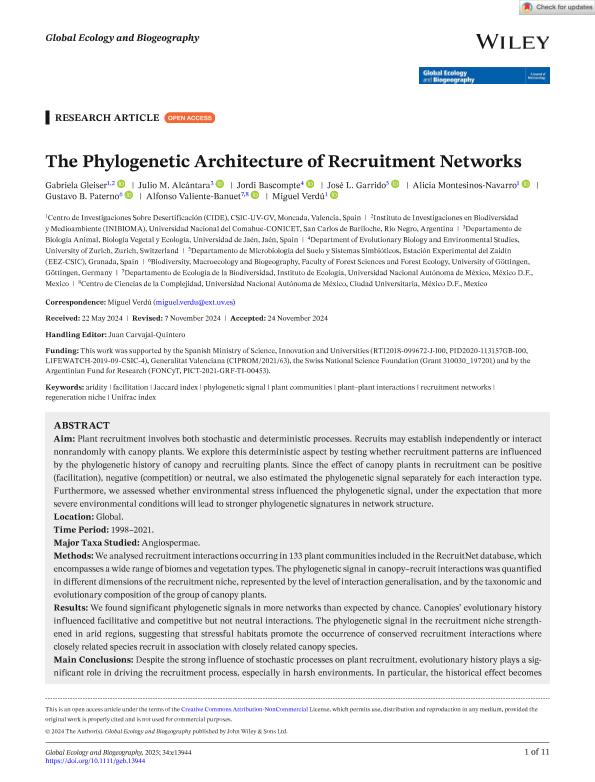
Aim: Plant recruitment involves both stochastic and deterministic processes. Recruits may establish independently or interactnonrandomly with canopy plants. We explore this deterministic aspect by testing whether recruitment patterns are influencedby the phylogenetic history of canopy and recruiting plants. Since the effect of canopy plants in recruitment can be positive(facilitation), negative (competition) or neutral, we also estimated the phylogenetic signal separately for each interaction type.Furthermore, we assessed whether environmental stress influenced the phylogenetic signal, under the expectation that moresevere environmental conditions will lead to stronger phylogenetic signatures in network structure.Location: Global.Time Period: 1998–2021.Major Taxa Studied: Angiospermae.Methods: We analysed recruitment interactions occurring in 133 plant communities included in the RecruitNet database, whichencompasses a wide range of biomes and vegetation types. The phylogenetic signal in canopy–recruit interactions was quantifiedin different dimensions of the recruitment niche, represented by the level of interaction generalisation, and by the taxonomic andevolutionary composition of the group of canopy plants.Results: We found significant phylogenetic signals in more networks than expected by chance. Canopies’ evolutionary historyinfluenced facilitative and competitive but not neutral interactions. The phylogenetic signal in the recruitment niche strengthenedin arid regions, suggesting that stressful habitats promote the occurrence of conserved recruitment interactions whereclosely related species recruit in association with closely related canopy species.Main Conclusions: Despite the strong influence of stochastic processes on plant recruitment, evolutionary history plays a significant role in driving the recruitment process, especially in harsh environments. In particular, the historical effect becomes more important when canopy species have a significant impact on the performance of recruits, either through facilitation or competition. More generally, we show that the analysis of different dimensions of the ecological niche can reveal important insights on the functional roles of interacting species.
Archivos asociados

Tamaño:
1.102Mb
Formato:
PDF
Licencia
 Excepto donde se diga explícitamente, este item se publica bajo la siguiente descripción:
Creative Commons Attribution-NonCommercial 2.5 Unported (CC BY-NC 2.5)
Excepto donde se diga explícitamente, este item se publica bajo la siguiente descripción:
Creative Commons Attribution-NonCommercial 2.5 Unported (CC BY-NC 2.5)
Identificadores
Colecciones
Articulos(INIBIOMA)
Articulos de INST. DE INVEST.EN BIODIVERSIDAD Y MEDIOAMBIENTE
Articulos de INST. DE INVEST.EN BIODIVERSIDAD Y MEDIOAMBIENTE
Citación
Gleiser, Gabriela Laura; Alcántara, Julio M.; Bascompte, Jordi; Garrido, José L.; Montesinos Navarro, Alicia; et al.; The Phylogenetic Architecture of Recruitment Networks; Wiley Blackwell Publishing, Inc; Global Ecology and Biogeography; 34; 1; 12-2024; 1-11
Compartir


Altmétricas