Artículo
Sedimentary facies and architecture of mixed bioclastic‐siliciclastic deposits forming in an inferred strait environment: An example from the Early Pleistocene of Calabria, southern Italy

Fecha de publicación:
07/2025
Editorial:
John Wiley & Sons
Revista:
The Depositional Record
ISSN:
2055-4877
Idioma:
Inglés
Tipo de recurso:
Artículo publicado
Clasificación temática:
Resumen
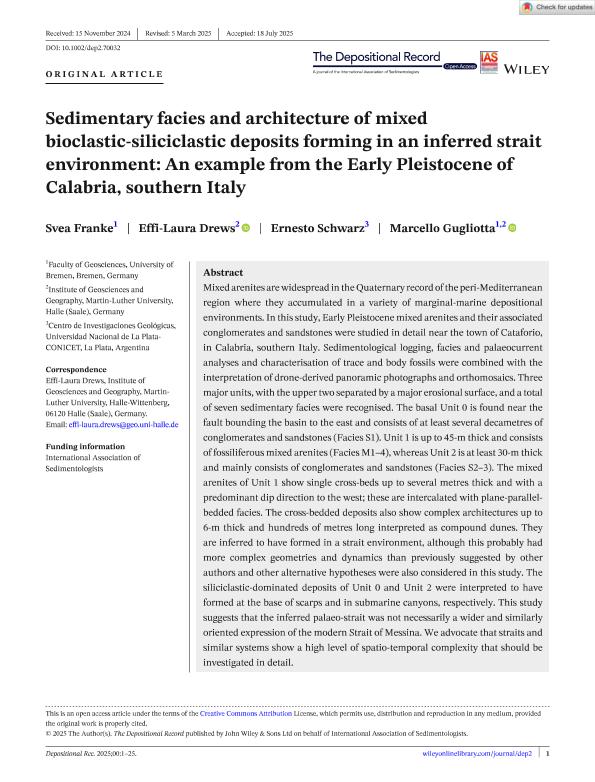
Mixed arenites are widespread in the Quaternary record of the peri-Mediterranean region where they accumulated in a variety of marginal-marine depositional environments. In this study, Early Pleistocene mixed arenites and their associated conglomerates and sandstones were studied in detail near the town of Cataforio, in Calabria, southern Italy. Sedimentological logging, facies and palaeocurrent analyses and characterisation of trace and body fossils were combined with the interpretation of drone-derived panoramic photographs and orthomosaics. Three major units, with the upper two separated by a major erosional surface, and a total of seven sedimentary facies were recognised. The basal Unit 0 is found near the fault bounding the basin to the east and consists of at least several decametres of conglomerates and sandstones (Facies S1). Unit 1 is up to 45-m thick and consists of fossiliferous mixed arenites (Facies M1–4), whereas Unit 2 is at least 30-m thick and mainly consists of conglomerates and sandstones (Facies S2–3). The mixed arenites of Unit 1 show single cross-beds up to several metres thick and with a predominant dip direction to the west; these are intercalated with plane-parallel-bedded facies. The cross-bedded deposits also show complex architectures up to 6-m thick and hundreds of metres long interpreted as compound dunes. They are inferred to have formed in a strait environment, although this probably had more complex geometries and dynamics than previously suggested by other authors and other alternative hypotheses were also considered in this study. The siliciclastic-dominated deposits of Unit 0 and Unit 2 were interpreted to have formed at the base of scarps and in submarine canyons, respectively. This study suggests that the inferred palaeo-strait was not necessarily a wider and similarly oriented expression of the modern Strait of Messina. We advocate that straits and similar systems show a high level of spatio-temporal complexity that should be investigated in detail.
Palabras clave:
MIXED DEPOSITS
,
DUNE FORMATION
,
STRAIT ENVIRONMENTS
,
PLEISTOCENE
Archivos asociados

Tamaño:
26.79Mb
Formato:
PDF
Licencia
 Excepto donde se diga explícitamente, este item se publica bajo la siguiente descripción:
Creative Commons Attribution 2.5 Unported (CC BY 2.5)
Excepto donde se diga explícitamente, este item se publica bajo la siguiente descripción:
Creative Commons Attribution 2.5 Unported (CC BY 2.5)
Identificadores
Colecciones
Articulos(CIG)
Articulos de CENTRO DE INVEST.GEOLOGICAS (I)
Articulos de CENTRO DE INVEST.GEOLOGICAS (I)
Citación
Franke, Svea; Drews, Effi Laura; Schwarz, Ernesto; Gugliotta, Marcello; Sedimentary facies and architecture of mixed bioclastic‐siliciclastic deposits forming in an inferred strait environment: An example from the Early Pleistocene of Calabria, southern Italy; John Wiley & Sons; The Depositional Record; 11; 5; 7-2025; 1329-1353
Compartir


Altmétricas