Evento
Network analysis of splenic gene expression of cattle co-infected with Bovine viral diarrhea virus 2 and Bovine herpes virus 1 following vaccination and trace mineral administration
Scott, Matthew A.; Palomares, Roberto A.; Linson, M'Lehne K.; Gonzalez Altamiranda, Erika Analia ; Hoyos-Jaramillo, Alejandro; Bittar, Joao H.; Rodriguez, Adriana; Urdaneta, Jose
; Hoyos-Jaramillo, Alejandro; Bittar, Joao H.; Rodriguez, Adriana; Urdaneta, Jose
Tipo del evento:
Conferencia
Nombre del evento:
57th Annual Conference of American Association of Bovine Practitioners
Fecha del evento:
12/09/2024
Institución Organizadora:
American Association of Bovine Practitioners;
Título de la revista:
AABP Annual Conference Proceedings
Editorial:
American Association of Bovine Practitioners
ISSN:
0524-1685
Idioma:
Inglés
Clasificación temática:
Resumen
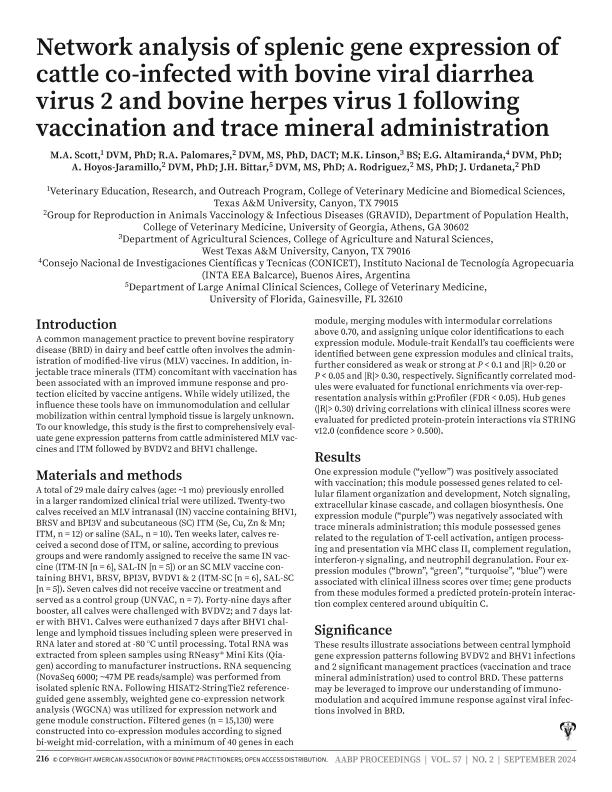
Introduction:A common management practice to prevent bovine respiratory disease (BRD) in dairy and beef cattle often involve the administration of modified-live virus (MLV) vaccines. In addition, injectable trace minerals (ITM) concomitant with vaccination has been associated with an improved immune response and protection elicited by vaccine antigens. While widely utilized, the influence these tools have on immunomodulation and cellular mobilization within central lymphoid tissue is largely unknown. To our knowledge, this study is the first to comprehensively evaluate gene expression patterns from cattle administered MLV vaccines and ITM followed by BVDV2 and BHV1 challenge.Materials and methods:A total of 29 male dairy calves (age: ~1 mo) previously enrolled in a larger randomized clinical trial were utilized. Twenty-two calves received an MLV intranasal (IN) vaccine containing BHV1, BRSV, and BPI3V and subcutaneous (SC) ITM (Se, Cu, Zn & Mn; ITM, n = 12) or saline (SAL, n = 10). Ten weeks later, calves received a second dose of ITM, or saline, according to previous groups and were randomly assigned to receive the same IN vaccine [ITM-IN (n = 6), SAL-IN (n = 5)] or a SC MLV vaccine containing BHV1, BRSV, BPI3V, BVDV1 & 2 [ITM-SC (n = 6), SAL-SC (n = 5)]. Seven calves did not receive vaccine or treatment and served as a control group (UNVAC, n = 7). Forty-nine days after booster, all calves were challenged with BVDV2; and seven days later with BHV1. Calves were euthanized seven days after BHV1 challenge and lymphoid tissues including spleen were preserved in RNA later and stored at -80 ͦ C until processing. Total RNA was extracted from spleen samples using RNeasy Mini Kits (Qiagen®) according to manufacturer instructions. RNA sequencing (NovaSeq 6000; ~47M PE reads/sample) was performed from isolated splenic RNA. Following HISAT2-StringTie2 reference-guided gene assembly, weighted gene co-expression network analysis (WGCNA) was utilized for expression network and gene module construction. Filtered genes (n=15,130) were constructed into co-expression modules according to signed biweight midcorrelation, with a minimum of 40 genes in each module, merging modules with intermodular correlations above 0.70, and assigning unique color identifications to each expression module. Module-trait Kendall’s tau coefficients were identified between gene expression modules and clinical traits, further considered as weak or strong at p<0.1 and |R|>0.20 or p<0.05 and |R|>0.30, respectively. Significantly correlated modules were evaluated for functional enrichments via over-representation analysis within g:Profiler (FDR<0.05). Hub genes (|R|>0.30) driving correlations with clinical illness scores were evaluated for predicted protein-protein interactions via STRING v12.0 (confidence score>0.500).Results:One expression module (“yellow”) was positively associated with vaccination; this module possessed genes related to cellular filament organization and development, Notch signaling, extracellular kinase cascade, and collagen biosynthesis. One expression module (“purple”) was negatively associated with trace minerals administration; this module possessed genes related to the regulation of T-cell activation, antigen processing and presentation via MHC class II, complement regulation, interferon-γ signaling, and neutrophil degranulation. Four expression modules (“brown”, “green”, “turquoise”, “blue”) were associated with clinical illness scores over time; gene products from these modules formed a predicted protein-protein interaction complex centered around ubiquitin C.Significance:These results illustrate associations between central lymphoid gene expression patterns following BVDV2 and BHV1 infections and two significant management practices (vaccination and trace mineral administration) used to control BRD. These patterns may be leveraged to improve our understanding of immunomodulation and acquired immune response against viral infections involved in BRD.
Palabras clave:
SPLENIC GENE EXPRESSION
,
CATTLE
,
BVDV2
,
BHV1
,
TRACE MINERAL
Archivos asociados

Tamaño:
55.76Kb
Formato:
PDF
Licencia
 Excepto donde se diga explícitamente, este item se publica bajo la siguiente descripción:
Creative Commons Attribution-NonCommercial-ShareAlike 2.5 Unported (CC BY-NC-SA 2.5)
Excepto donde se diga explícitamente, este item se publica bajo la siguiente descripción:
Creative Commons Attribution-NonCommercial-ShareAlike 2.5 Unported (CC BY-NC-SA 2.5)
Identificadores
Colecciones
Eventos (IPADS BALCARCE)
Eventos de INSTITUTO DE INNOVACIÓN PARA LA PRODUCCIÓN AGROPECUARIA Y EL DESARROLLO SOSTENIBLE
Eventos de INSTITUTO DE INNOVACIÓN PARA LA PRODUCCIÓN AGROPECUARIA Y EL DESARROLLO SOSTENIBLE
Citación
Network analysis of splenic gene expression of cattle co-infected with Bovine viral diarrhea virus 2 and Bovine herpes virus 1 following vaccination and trace mineral administration; 57th Annual Conference of American Association of Bovine Practitioners; Ohio; Estados Unidos; 2024; 216-216
Compartir

