Evento
The Macroecology of Aquatic Plant Functions (MAP) project: exploring the functional and environmental trait space of macrophytes
Trottier, Lindsay Louise; Pan, Yingji; García Girón, Jorge; Alahuhta, Janne; Bagella, Simonetta; Balk, Pauline; Båstrup Spohr, Lars; Bedoya, Ana Maria; Bolpagni, Rossano; Burke, Colin; Dalle Fratte, Michele; Fares, Ana Luísa; Gayol, Maira Patricia ; Hoblyn, Ashley; Jung, Migyeong; Koleszár, Gergo; Liu, Yang; Lobato De Magalhães, Tatiana; Manzo, Luz Maria
; Michelan, Thaisa Sala; Morandeira, Natalia Soledad
; Mormul, Roger Paulo; Oláh, Viktor; Rivieccio, Giovanni; Rybak, Michal; Tyrrell, Chrisopher; Urrutia Estrada, Jonathan; Van Bodegom, Peter; Ye, Ziqi; Iversen, Lars Lønsmann
; Hoblyn, Ashley; Jung, Migyeong; Koleszár, Gergo; Liu, Yang; Lobato De Magalhães, Tatiana; Manzo, Luz Maria
; Michelan, Thaisa Sala; Morandeira, Natalia Soledad
; Mormul, Roger Paulo; Oláh, Viktor; Rivieccio, Giovanni; Rybak, Michal; Tyrrell, Chrisopher; Urrutia Estrada, Jonathan; Van Bodegom, Peter; Ye, Ziqi; Iversen, Lars Lønsmann
; Hoblyn, Ashley; Jung, Migyeong; Koleszár, Gergo; Liu, Yang; Lobato De Magalhães, Tatiana; Manzo, Luz Maria
; Michelan, Thaisa Sala; Morandeira, Natalia Soledad
; Mormul, Roger Paulo; Oláh, Viktor; Rivieccio, Giovanni; Rybak, Michal; Tyrrell, Chrisopher; Urrutia Estrada, Jonathan; Van Bodegom, Peter; Ye, Ziqi; Iversen, Lars Lønsmann
Colaboradores:
Aguiar, Francisca C.; Santos, Sofia F.
Tipo del evento:
Simposio
Nombre del evento:
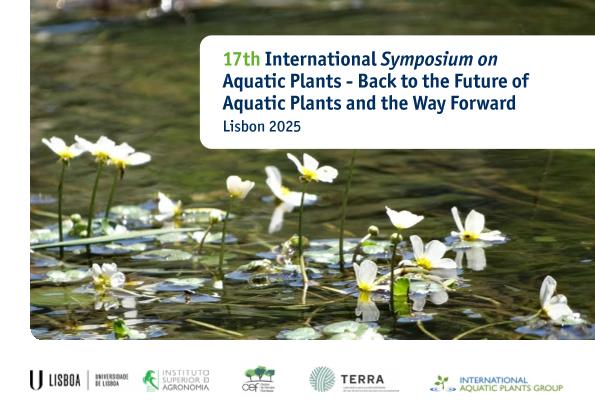
17th International Symposium on Aquatic Plants: Back to the Future of Aquatic Plants and the Way Forward
Fecha del evento:
15/09/2025
Institución Organizadora:
International Aquatic Plants Group;
Universidad de Lisboa;
Instituto Superior de Agronomía;
Título del Libro:
Book of Abstracts of the 17th International Symposium on Aquatic Plants: Back to the Future of Aquatic Plants and the Way Forward
Editorial:
Universidad de Lisboa
Idioma:
Inglés
Clasificación temática:
Resumen
Aquatic plants (macrophytes) are crucial for the maintenance of ecosystem functioning and structure. Functional traits (i.e., physical characteristics linked to growth, reproduction, and survival) can be used to explore the mechanisms by which macrophytes provide structure and stability to freshwater ecosystems. Similarly, functional traits link biodiversity to ecosystem functioning, which is essential for understanding how plants are shaped by and govern the abiotic characteristics of their environment. The phenotypic and physiological adaptations of plants to external factors and how species, communities, and ecosystems worldwide may differ in the future can be explained using functional ecology. This is especially important considering the impact of anthropogenic and climate-induced changes, such as eutrophication and global warming, on the structure and function of freshwater ecosystems worldwide. Despite the ecological significance of macrophytes, functional trait research has been largely centered on terrestrial plants, in part due to the absence of a centralised database for aquatic plant traits. Since 2021, the Macroecology of Aquatic Plant Functions (MAP) Project has been working to address this data gap by compiling measurements of plant height, leaf area, specific leaf area, leaf phosphorus content, and leaf nitrogen content for 3331 macrophyte species. To date, more than 45 collaborators from around the world have contributed functional trait data to the MAP Project. The MAP Database contains over 42,000 records, and 55% of macrophyte species have at least one trait measurement. As in other global trait databases, trait coverage varies by functional trait (ranging from 11% coverage of leaf phosphorus content to 53% for plant height) and by ecozone (ranging from 60% of species in the Neotropics with least one trait measurement, to 93% in the Nearctic). Now, we have begun to employ this unique trait database, in conjunction with global information on environmental conditions (e.g., climate and bicarbonate availability) and species distributions, to explore how trait-trait relationships and trait-environment relationships of macrophytes compare to those of terrestrial plants. We also aim to quantify variation within the trait space of macrophytes and identify possible sources for variation, such as freshwater-adaptive traits which enable macrophytes to survive underwater. The work conducted through the MAP Project is the first attempt at understanding how ecological patterns and processes in freshwater systems are driven by the form and function of the macrophytes inhabiting them. Ultimately, the MAP Project will provide a foundation for future research and conservation efforts stemming from a trait-based ecological framework.
Palabras clave:
MACROECOLOGY
,
AQUATIC PLANTS
,
TRAITS
,
MAP PROJECT
Archivos asociados

Tamaño:
451.3Kb
Formato:
PDF
Licencia
 Excepto donde se diga explícitamente, este item se publica bajo la siguiente descripción:
Creative Commons Attribution-NonCommercial-ShareAlike 2.5 Unported (CC BY-NC-SA 2.5)
Excepto donde se diga explícitamente, este item se publica bajo la siguiente descripción:
Creative Commons Attribution-NonCommercial-ShareAlike 2.5 Unported (CC BY-NC-SA 2.5)
Identificadores
Colecciones
Eventos(CIEMEP)
Eventos de CENTRO DE INVESTIGACION ESQUEL DE MONTAÑA Y ESTEPA PATAGONICA
Eventos de CENTRO DE INVESTIGACION ESQUEL DE MONTAÑA Y ESTEPA PATAGONICA
Citación
The Macroecology of Aquatic Plant Functions (MAP) project: exploring the functional and environmental trait space of macrophytes; 17th International Symposium on Aquatic Plants: Back to the Future of Aquatic Plants and the Way Forward; Lisboa; Portugal; 2025; 103-105
Compartir

