Mostrar el registro sencillo del ítem
dc.contributor.author
Rofes, Adrià
dc.contributor.author
Sampedro, María Bárbara
dc.contributor.author
Abusamra, Lorena
dc.contributor.author
Cañataro, Paola
dc.contributor.author
Jonkers, Roel
dc.contributor.author
Abusamra, Valeria
dc.date.available
2025-12-02T11:29:28Z
dc.date.issued
2021-10
dc.identifier.citation
Rofes, Adrià; Sampedro, María Bárbara; Abusamra, Lorena; Cañataro, Paola; Jonkers, Roel; et al.; What Drives Task Performance in Fluency Tasks in People With HIV?; Frontiers Media; Frontiers in Psychology; 12; 721588; 10-2021; 1-13
dc.identifier.uri
http://hdl.handle.net/11336/276523
dc.description.abstract
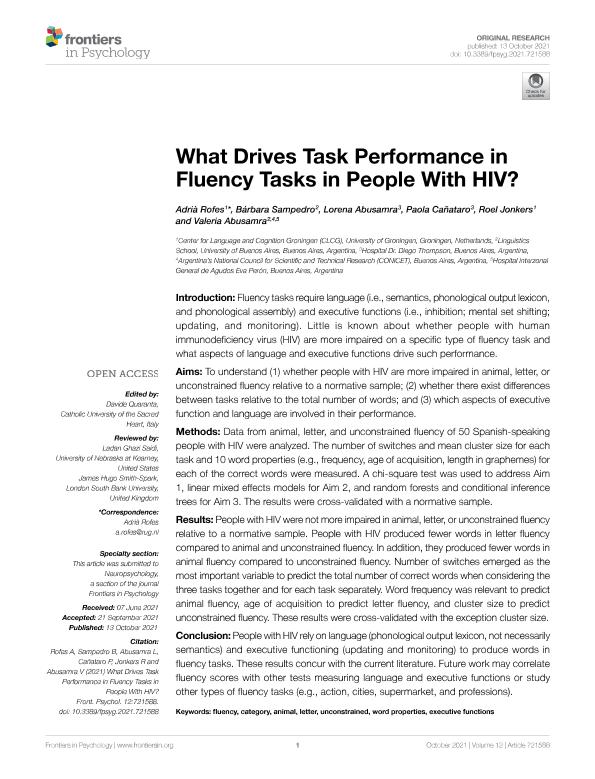
Introduction: Fluency tasks require language (i.e., semantics, phonological output lexicon, and phonological assembly) and executive functions (i.e., inhibition; mental set shifting; updating, and monitoring). Little is known about whether people with human immunodeficiency virus (HIV) are more impaired on a specific type of fluency task and what aspects of language and executive functions drive such performance. Aims: To understand (1) whether people with HIV are more impaired in animal, letter, or unconstrained fluency relative to a normative sample; (2) whether there exist differences between tasks relative to the total number of words; and (3) which aspects of executive function and language are involved in their performance. Methods: Data from animal, letter, and unconstrained fluency of 50 Spanish-speaking people with HIV were analyzed. The number of switches and mean cluster size for each task and 10 word properties (e.g., frequency, age of acquisition, length in graphemes) for each of the correct words were measured. A chi-square test was used to address Aim 1, linear mixed effects models for Aim 2, and random forests and conditional inference trees for Aim 3. The results were cross-validated with a normative sample. Results: People with HIV were not more impaired in animal, letter, or unconstrained fluency relative to a normative sample. People with HIV produced fewer words in letter fluency compared to animal and unconstrained fluency. In addition, they produced fewer words in animal fluency compared to unconstrained fluency. Number of switches emerged as the most important variable to predict the total number of correct words when considering the three tasks together and for each task separately. Word frequency was relevant to predict animal fluency, age of acquisition to predict letter fluency, and cluster size to predict unconstrained fluency. These results were cross-validated with the exception cluster size. Conclusion: People with HIV rely on language (phonological output lexicon, not necessarily semantics) and executive functioning (updating and monitoring) to produce words in fluency tasks. These results concur with the current literature. Future work may correlate fluency scores with other tests measuring language and executive functions or study other types of fluency tasks (e.g., action, cities, supermarket, and professions).
dc.format
application/pdf
dc.language.iso
eng
dc.publisher
Frontiers Media
dc.rights
info:eu-repo/semantics/openAccess
dc.rights.uri
https://creativecommons.org/licenses/by/2.5/ar/
dc.subject
Fluency
dc.subject
Category
dc.subject
Animal
dc.subject
Letter
dc.subject.classification
Otras Psicología
dc.subject.classification
Psicología
dc.subject.classification
CIENCIAS SOCIALES
dc.title
What Drives Task Performance in Fluency Tasks in People With HIV?
dc.type
info:eu-repo/semantics/article
dc.type
info:ar-repo/semantics/artículo
dc.type
info:eu-repo/semantics/publishedVersion
dc.date.updated
2025-11-11T10:56:54Z
dc.identifier.eissn
1664-1078
dc.journal.volume
12
dc.journal.number
721588
dc.journal.pagination
1-13
dc.journal.pais
Suiza
dc.journal.ciudad
Lausana
dc.description.fil
Fil: Rofes, Adrià. University of Groningen; Países Bajos
dc.description.fil
Fil: Sampedro, María Bárbara. Consejo Nacional de Investigaciones Científicas y Técnicas; Argentina. Universidad de Buenos Aires; Argentina
dc.description.fil
Fil: Abusamra, Lorena. Hospital Dr. Diego Thompson; Argentina
dc.description.fil
Fil: Cañataro, Paola. Hospital Dr. Diego Thompson; Argentina
dc.description.fil
Fil: Jonkers, Roel. University of Groningen; Países Bajos
dc.description.fil
Fil: Abusamra, Valeria. Consejo Nacional de Investigaciones Científicas y Técnicas; Argentina. Provincia de Buenos Aires. Ministerio de Salud. Hospital Interzonal de Agudos "Eva Perón"; Argentina. Universidad de Buenos Aires; Argentina
dc.journal.title
Frontiers in Psychology
dc.relation.alternativeid
info:eu-repo/semantics/altIdentifier/url/https://www.frontiersin.org/journals/psychology/articles/10.3389/fpsyg.2021.721588/full
dc.relation.alternativeid
info:eu-repo/semantics/altIdentifier/doi/https://doi.org/10.3389/fpsyg.2021.721588
Archivos asociados

Tamaño:
933.5Kb
Formato:
PDF