Mostrar el registro sencillo del ítem
dc.contributor.author
Crespo, Marcela Gladys
dc.date.available
2025-12-01T15:58:38Z
dc.date.issued
2025-09
dc.identifier.citation
Crespo, Marcela Gladys; Literatura, autoritarismo e direitos humanos na literatura argentina atual, o caso de Ganarse la muerte, de Griselda Gambaro: Uma leitura encarnada; Universidade Federal de Minas Gerais. Faculdade de Letras; O Eixo e a Rosa; 34; 3; 9-2025; 1-14
dc.identifier.issn
2358-9787
dc.identifier.uri
http://hdl.handle.net/11336/276432
dc.description.abstract
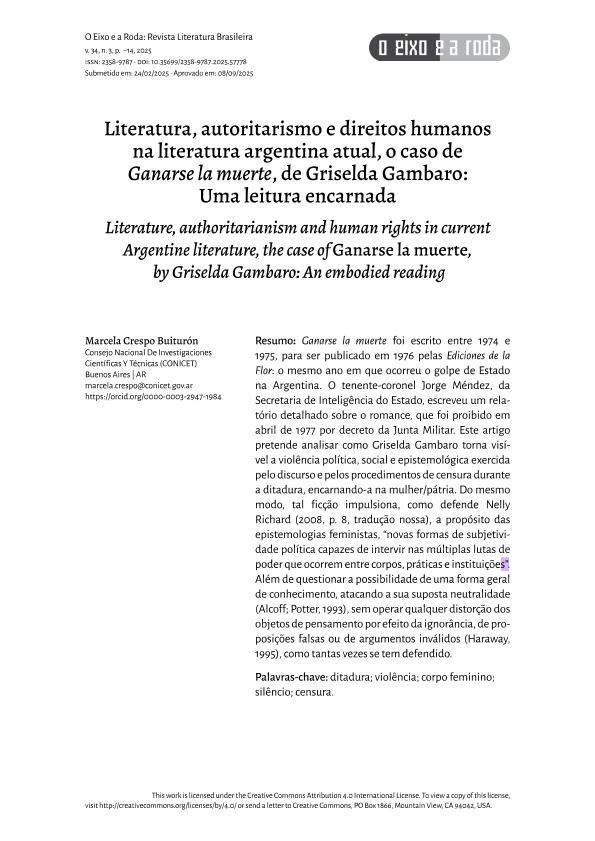
Ganarse la muerte foi escrito entre 1974 e 1975, para ser publicado em 1976 pelas Ediciones de la Flor: o mesmo ano em que ocorreu o golpe de Estado na Argentina. O tenente-coronel Jorge Méndez, da Secretaria de Inteligência do Estado, escreveu um relatório detalhado sobre o romance, que foi proibido em abril de 1977 por decreto da Junta Militar. Este artigo pretende analisar como Griselda Gambaro torna visível a violência política, social e epistemológica exercida pelo discurso e pelos procedimentos de censura durante a ditadura, encarnando-a na mulher/pátria. Do mesmo modo, tal ficção impulsiona, como defende Nelly Richard (2008, p. 8, tradução nossa), a propósito das epistemologias feministas, “novas formas de subjetividade política capazes de intervir nas múltiplas lutas de poder que ocorrem entre corpos, práticas e instituições”. Além de questionar a possibilidade de uma forma geral de conhecimento, atacando a sua suposta neutralidade (Alcoff; Potter, 1993), sem operar qualquer distorção dos objetos de pensamento por efeito da ignorância, de proposições falsas ou de argumentos inválidos (Haraway, 1995), como tantas vezes se tem defendido.
dc.description.abstract
Ganarse la muerte was written between 1974 and 1975, being published in 1976 by Ediciones de la Flor: the very year in which the coup d’état took place. Lieutenant Colonel Jorge Méndez of the SIDE wrote a detailed report on this novel, for which it was banned in April 1977 by decree of the military junta. This article sets out to analyse how Griselda Gambaro highlights the political, social and epistemological violence exercised by the discourse and procedures of censorship during this dictatorship, incarnating it in the woman/homeland. Similarly, as Nelly Richard argues with regard to feminist epistemologies, this fiction promotes ‘new forms of political subjectivity capable of intervening in the multiple power struggles that take place between bodies, practices and institutions’ (2008, p. 8, our translation) and question the possibility of a general form of knowledge, attacking its supposed neutrality (Alcoff; Potter, 1993), without distorting the objects of knowledge due to ignorance, false propositions or invalid arguments (Haraway, 1995), as has so often been argued.
dc.format
application/pdf
dc.language.iso
por
dc.publisher
Universidade Federal de Minas Gerais. Faculdade de Letras
dc.rights
info:eu-repo/semantics/openAccess
dc.rights.uri
https://creativecommons.org/licenses/by/2.5/ar/
dc.subject
DITADURA
dc.subject
VIOLENCIA
dc.subject
CORPO FEMENINO
dc.subject
CENSURA
dc.subject.classification
Literaturas Específicas
dc.subject.classification
Lengua y Literatura
dc.subject.classification
HUMANIDADES
dc.title
Literatura, autoritarismo e direitos humanos na literatura argentina atual, o caso de Ganarse la muerte, de Griselda Gambaro: Uma leitura encarnada
dc.title
Literature, authoritarianism and human rights in current Argentine literature, the case of Ganarse la muerte, by Griselda Gambaro: An embodied reading
dc.type
info:eu-repo/semantics/article
dc.type
info:ar-repo/semantics/artículo
dc.type
info:eu-repo/semantics/publishedVersion
dc.date.updated
2025-11-27T13:07:57Z
dc.journal.volume
34
dc.journal.number
3
dc.journal.pagination
1-14
dc.journal.pais
Brasil
dc.journal.ciudad
Minas Gerais
dc.description.fil
Fil: Crespo, Marcela Gladys. Consejo Nacional de Investigaciones Científicas y Técnicas; Argentina
dc.journal.title
O Eixo e a Rosa
dc.relation.alternativeid
info:eu-repo/semantics/altIdentifier/doi/https://doi.org/10.17851/2358-9787.34.3.193-206
dc.relation.alternativeid
info:eu-repo/semantics/altIdentifier/url/https://periodicos.ufmg.br/index.php/o_eixo_ea_roda/article/view/57778
Archivos asociados

Tamaño:
423.7Kb
Formato:
PDF