Artículo
Drivers of phenological transitions in the seedling life stage
Slate, Mandy L.; Sporbert, Maria; Hensen, Isabell; Hierro, Jose Luis ; Korell, Lotte; Larios, Loralee; Nagy, Dávid U.; Pearson, Dean E.; Waller, Lauren; Wolf, Felicitas; Rosche, Christoph
; Korell, Lotte; Larios, Loralee; Nagy, Dávid U.; Pearson, Dean E.; Waller, Lauren; Wolf, Felicitas; Rosche, Christoph
Fecha de publicación:
02/2025
Editorial:
Wiley Blackwell Publishing, Inc
Revista:
Functional Ecology
ISSN:
0269-8463
Idioma:
Inglés
Tipo de recurso:
Artículo publicado
Clasificación temática:
Resumen
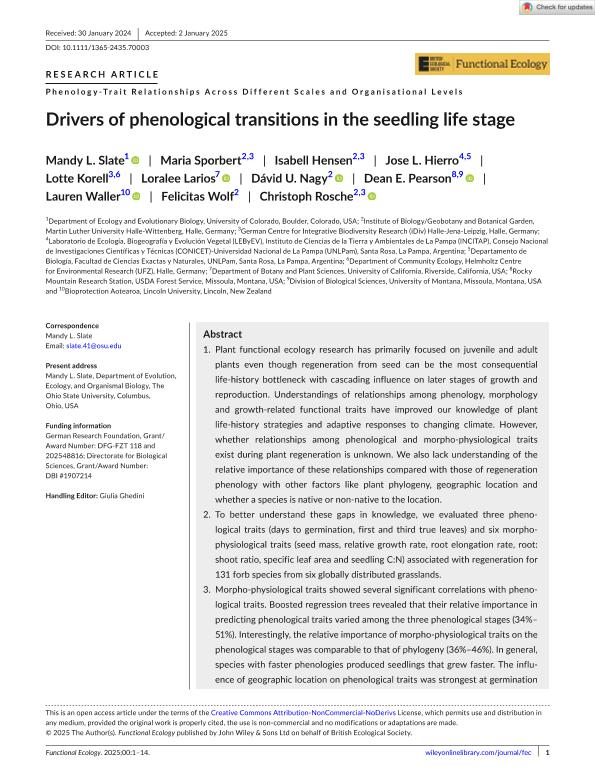
1. Plant functional ecology research has primarily focused on juvenile and adult plants even though regeneration from seed can be the most consequential life-history bottleneck with cascading influence on later stages of growth and reproduction. Understandings of relationships among phenology, morphology and growth-related functional traits have improved our knowledge of plant life-history strategies and adaptive responses to changing climate. However, whether relationships among phenological and morpho-physiological traits exist during plant regeneration is unknown. We also lack understanding of the relative importance of these relationships compared with those of regeneration phenology with other factors like plant phylogeny, geographic location and whether a species is native or non-native to the location.2. To better understand these gaps in knowledge, we evaluated three pheno- logical traits (days to germination, first and third true leaves) and six morpho- physiological traits (seed mass, relative growth rate, root elongation rate, root: shoot ratio, specific leaf area and seedling C:N) associated with regeneration for 131 forb species from six globally distributed grasslands.3. Morpho-physiological traits showed several significant correlations with pheno- logical traits. Boosted regression trees revealed that their relative importance in predicting phenological traits varied among the three phenological stages (34%– 51%). Interestingly, the relative importance of morpho-physiological traits on the phenological stages was comparable to that of phylogeny (36%–46%). In general, species with faster phenologies produced seedlings that grew faster. The influ- ence of geographic location on phenological traits was strongest at germination (29%) and decreased (8%–15%) at later phenological stages. Native versus non-native origin had little to no impact (0%–2%) on regeneration phenology.4. Strong relationships between days to germination and geographic location in- dicate signatures of local adaptation in the earliest life stages. Similar morpho- physiological trait values between native and non-native forbs imply that trait matching may be essential for non-native establishment. While associations between phenological and morpho-physiological traits during regeneration have not been previously recognized, our results suggest that these are com- plex and variable across plant regeneration. Better understanding of these as- sociations and their variation across plant life stages may help capture species shifts with ongoing climate change and be used to develop novel approachesto seed-based restoration.
Palabras clave:
BIOGEOGRAPHY
,
FORB
,
GERMINATION
,
GRASSLAND
Archivos asociados

Tamaño:
1.724Mb
Formato:
PDF
Licencia
 Excepto donde se diga explícitamente, este item se publica bajo la siguiente descripción:
Atribución-NoComercial-SinDerivadas 2.5 Argentina (CC BY-NC-ND 2.5 AR)
Excepto donde se diga explícitamente, este item se publica bajo la siguiente descripción:
Atribución-NoComercial-SinDerivadas 2.5 Argentina (CC BY-NC-ND 2.5 AR)
Identificadores
Colecciones
Articulos(INCITAP)
Articulos de INST.D/CS D/L/TIERRA Y AMBIENTALES D/L/PAMPA
Articulos de INST.D/CS D/L/TIERRA Y AMBIENTALES D/L/PAMPA
Citación
Slate, Mandy L.; Sporbert, Maria; Hensen, Isabell; Hierro, Jose Luis; Korell, Lotte; et al.; Drivers of phenological transitions in the seedling life stage; Wiley Blackwell Publishing, Inc; Functional Ecology; 2-2025; 1-14
Compartir


Altmétricas