Artículo
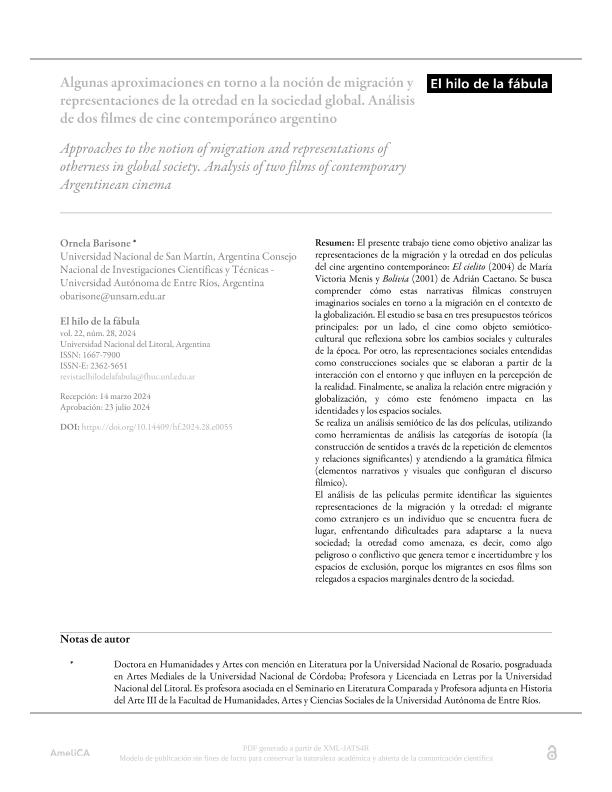
El presente trabajo tiene como objetivo analizar las representaciones de la migración y la otredad en dos películas del cine argentino contemporáneo: El cielito (2004) de María Victoria Menis y Bolivia (2001) de Adrián Caetano. Se busca comprender cómo estas narrativas fílmicas construyen imaginarios sociales en torno a la migración en el contexto de la globalización. El estudio se basa en tres presupuestos teóricos principales: por un lado, el cine como objeto semiótico- cultural que reflexiona sobre los cambios sociales y culturales de la época. Por otro, las representaciones sociales entendidas como construcciones sociales que se elaboran a partir de la interacción con el entorno y que influyen en la percepción de la realidad. Finalmente, se analiza la relación entre migración yglobalización, y cómo este fenómeno impacta en las identidades y los espacios sociales.Se realiza un análisis semiótico de las dos películas, utilizando como herramientas de análisis las categorías de isotopía (la construcción de sentidos a través de la repetición de elementosy relaciones significantes) y atendiendo a la gramática fílmica (elementos narrativos y visuales que configuran el discurso fílmico).El análisis de las películas permite identificar las siguientes representaciones de la migración y la otredad: el migrante como extranjero es un individuo que se encuentra fuera de lugar, enfrentando dificultades para adaptarse a la nueva sociedad; la otredad como amenaza, es decir, como algo peligroso o conflictivo que genera temor e incertidumbre y los espacios de exclusión, porque los migrantes en esos films son relegados a espacios marginales dentro de la sociedad. Las películas analizadas reflejan una visión negativa de la migración y la otredad, reforzando estereotipos y prejuicios existentes en la sociedad. Se observa una tendencia a la construcción de espacios de exclusión para los migrantes, lo que dificulta su integración social. No obstante, en el límite en el que el corpus elegido se acerca a la tematización de las migraciones en la sociedad global, la tematización misma genera una opacidad y una interpretación en su aparente cristalización.ACLARACIÓN: El trabajo se vincula con mi proyecto de investigación al analizar representaciones de la otredad y la migración desde una perspectiva comparatista y transnacional. Asimismo, articula con el seminario en Literaturas Comparadas por su enfoque intermedial entre cine y narrativas sociales en el contexto de la globalización. This paper aims to analyse the representations of migration and otherness in two films of contemporary Argentine cinema: El cielito (2004) by María Victoria Menis and Bolivia (2001) by Adrián Caetano. The aim is to understand how these filmic narratives construct social imaginaries around migration in the context of globalization. The study is based on three main theoretical assumptions: firstly, film as a semiotic-cultural object that reflects on the social and cultural changes of the time. Secondly social representations understood as social constructions that are elaborated from the interaction with the environment and that influence the perception of reality. Finally, the relationship between migration and globalisation is analysed, and how this phenomenon impacts on identities and social spaces. A semiotic analysis of both films is carried out, using as analytical tools the categories of isotopy (the construction of meaning through the repetition of elements and significant relationships) and attending to filmic grammar (narrative and visual elements that configure the filmic discourse). The analysis of the films allows us to identify the following representations of migration and otherness: the migrant as a foreigner is an individual who is out of place, facing difficulties in adapting to the new society, otherness as a threat, that is, as something dangerous or conflictive that generates fear and uncertainty, and spaces of exclusion because migrants in these films are relegated to marginal spaces within society. The analysed films reflect a negative view of migration and otherness, reinforcing existing stereotypes and prejudices in society. There is a tendency to construct spaces of exclusion for migrants, which hinders their social integration. However, at the limit where the chosen corpus approaches the thematization of migrations in global society, the thematization itself generates an opacity and an interpretation in its apparent crystallisation.
Algunas aproximaciones en torno a la noción de migración y representaciones de la otredad en la sociedad global. Análisis de dos filmes de cine contemporáneo argentino
Título:
Approaches to the notion of migration and representations of otherness in global society. Analysis of two films of contemporary Argentinean cinema

Fecha de publicación:
12/2024
Editorial:
Universidad Nacional del Litoral. Facultad de Humanidades y Ciencias
Revista:
El Hilo de la Fabula
ISSN:
1667-7900
e-ISSN:
2362-5651
Idioma:
Español
Tipo de recurso:
Artículo publicado
Clasificación temática:
Resumen
Archivos asociados

Tamaño:
302.0Kb
Formato:
PDF
Licencia
 Excepto donde se diga explícitamente, este item se publica bajo la siguiente descripción:
Creative Commons Attribution-NonCommercial-ShareAlike 2.5 Unported (CC BY-NC-SA 2.5)
Excepto donde se diga explícitamente, este item se publica bajo la siguiente descripción:
Creative Commons Attribution-NonCommercial-ShareAlike 2.5 Unported (CC BY-NC-SA 2.5)
Identificadores
Colecciones
Articulos (CIAP)
Articulos de CENTRO DE INVESTIGACIONES EN ARTE Y PATRIMONIO
Articulos de CENTRO DE INVESTIGACIONES EN ARTE Y PATRIMONIO
Citación
Barisone, Ornela Soledad; Algunas aproximaciones en torno a la noción de migración y representaciones de la otredad en la sociedad global. Análisis de dos filmes de cine contemporáneo argentino; Universidad Nacional del Litoral. Facultad de Humanidades y Ciencias; El Hilo de la Fabula; 28; 12-2024; 1-15
Compartir


Altmétricas