Evento
Respiratory infections by human Rhinoviruses in oncohematological and stem cell transplant patients: do they have the same clinical impact as other respiratory viruses?
Zerboni, S.; Chevel, J.; Torres, D.; Rearte, A. N.; Bonvehi, Pablo; Temporiti, E.; Querci, Marcia; Videla, C.; Romano, Vanesa; Echavarría, Marcela Silvia ; Marcone, Débora Natalia
; Herrera, F.
; Marcone, Débora Natalia
; Herrera, F.
; Marcone, Débora Natalia
; Herrera, F.
Tipo del evento:
Congreso
Nombre del evento:
18th International Congress on Infectious Diseases
Fecha del evento:
06/2018
Institución Organizadora:
International Society for Infectious Diseases;
Título de la revista:
International Journal of Infectious Diseases
Editorial:
Elsevier
Idioma:
Inglés
Clasificación temática:
Resumen
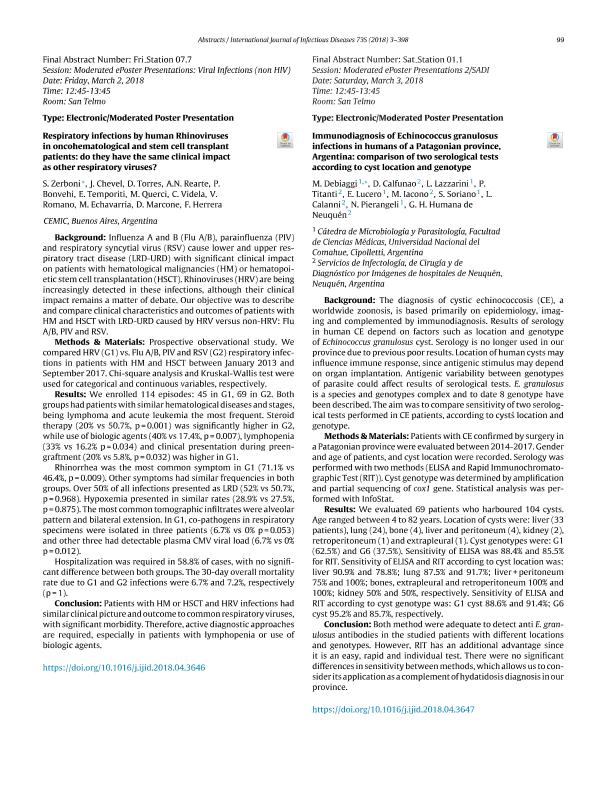
Background: Influenza A and B (Flu A/B), parainfluenza (PIV) and respiratory syncytial virus (RSV) cause lower and upper respiratory tract disease (LRD-URD) with significant clinical impact on patients with hematological malignancies (HM) or hematopoietic stem cell transplantation (HSCT). Rhinoviruses (HRV) are being increasingly detected in these infections, although their clinical impact remains a matter of debate. Our objective was to describe and compare clinical characteristics and outcomes of patients with HM and HSCT with LRD-URD caused by HRV versus non-HRV: Flu A/B, PIV and RSV. Methods & Materials: Prospective observational study. We compared HRV (G1) vs. Flu A/B, PIV and RSV (G2) respiratory infections in patients with HM and HSCT between January 2013 and September 2017. Chi-square analysis and Kruskal-Wallis test were used for categorical and continuous variables, respectively. Results: We enrolled 114 episodes: 45 in G1, 69 in G2. Both groups had patients with similar hematological diseases and stages, being lymphoma and acute leukemia the most frequent. Steroid therapy (20% vs 50.7%, p = 0.001) was significantly higher in G2, while use of biologic agents (40% vs 17.4%, p = 0.007), lymphopenia (33% vs 16.2% p = 0.034) and clinical presentation during preengraftment (20% vs 5.8%, p = 0.032) was higher in G1. Rhinorrhea was the most common symptom in G1 (71.1% vs 46.4%, p = 0.009). Other symptoms had similar frequencies in both groups. Over 50% of all infections presented as LRD (52% vs 50.7%, p = 0.968). Hypoxemia presented in similar rates (28.9% vs 27.5%, p = 0.875). The most common tomographic infiltrates were alveolar pattern and bilateral extension. In G1, co-pathogens in respiratory specimens were isolated in three patients (6.7% vs 0% p = 0.053) and other three had detectable plasma CMV viral load (6.7% vs 0% p = 0.012). Hospitalization was required in 58.8% of cases, with no significant difference between both groups. The 30-day overall mortality rate due to G1 and G2 infections were 6.7% and 7.2%, respectively (p = 1). Conclusion: Patients with HM or HSCT and HRV infections had similar clinical picture and outcome to common respiratory viruses, with significant morbidity. Therefore, active diagnostic approaches are required, especially in patients with lymphopenia or use of biologic agents.
Palabras clave:
Rhinovirus
,
Transplant
Archivos asociados

Tamaño:
169.3Kb
Formato:
PDF
Licencia
 Excepto donde se diga explícitamente, este item se publica bajo la siguiente descripción:
Atribución-NoComercial-SinDerivadas 2.5 Argentina (CC BY-NC-ND 2.5 AR)
Excepto donde se diga explícitamente, este item se publica bajo la siguiente descripción:
Atribución-NoComercial-SinDerivadas 2.5 Argentina (CC BY-NC-ND 2.5 AR)
Identificadores
Colecciones
Eventos(CEMIC-CONICET)
Eventos de CENTRO DE EDUCACION MEDICA E INVESTIGACIONES CLINICAS "NORBERTO QUIRNO"
Eventos de CENTRO DE EDUCACION MEDICA E INVESTIGACIONES CLINICAS "NORBERTO QUIRNO"
Eventos(OCA HOUSSAY)
Eventos de OFICINA DE COORDINACION ADMINISTRATIVA HOUSSAY
Eventos de OFICINA DE COORDINACION ADMINISTRATIVA HOUSSAY
Citación
Respiratory infections by human Rhinoviruses in oncohematological and stem cell transplant patients: do they have the same clinical impact as other respiratory viruses?; 18th International Congress on Infectious Diseases; Argentina; 2018; 1-1
Compartir


Altmétricas