Artículo
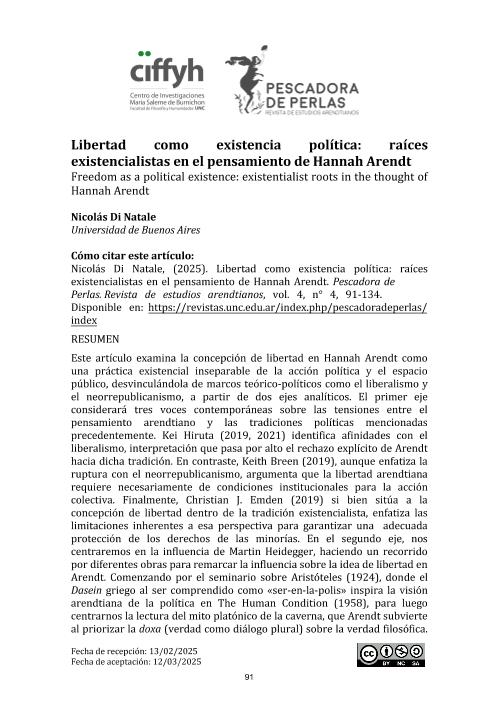
Este artículo analiza la concepción de libertad en Hannah Arendt como una práctica existencial inseparable de la acción política y el espacio público, desvinculándola de marcos teórico-políticos como el liberalismo y el neorrepublicanismo. A través de dos ejes, se examina primero cómo, pese al rechazo explícito de Arendt al liberalismo, autores como Kei Hiruta (2019, 2021) identifican afinidades con esta tradición, mientras Keith Breen (2019) la distancia del neorrepublicanismo al vincular su libertad a la acción colectiva del pueblo. Christian J. Emden (2019) advierte, además, que el existencialismo arendtiano del modo de concebir la libertad es pernicioso para los derechos de las minorías. En segundo lugar, se explora la influencia de Heidegger: desde su seminario sobre Aristóteles (1924), donde el Dasein griego como «ser-en-la-polis» inspira la visión arendtiana de la política en The Human Condition (1958), hasta su lectura del mito platónico de la caverna, que Arendt subvierte al priorizar la doxa (verdad como diálogo plural) sobre la verdad filosófica. Así, se concluye que la libertad en Arendt no es un concepto abstracto ni una garantía institucional, sino un ejercicio dinámico que se actualiza en la acción, redefiniendo lo humano como un devenir en el mundo común, donde la contingencia y la pluralidad son condiciones irreductibles de la existencia política. This article examines Hannah Arendt's conception of freedom as an existential practice inseparable from political action and public space, dissociating it from theoretical and political frameworks such as liberalism and neo-republicanism, based on two analytical axes. The first axis will consider three contemporary voices on the tensions between Arendtian thought and the aforementioned political traditions. Kei Hiruta (2019, 2021) identifies affinities with liberalism, an interpretation that overlooks Arendt's explicit rejection of this tradition. In contrast, Keith Breen (2019), while emphasizing the break with neo-republicanism, argues that Arendtian freedom necessarily requires institutional conditions for collective action. Finally, Christian J. Emden (2019), while situating the conception of freedom within the existentialist tradition, emphasizes the inherent limitations of this perspective in guaranteeing adequate protection of minority rights. In the second axis, we will focus on the influence of Martin Heidegger, reviewing different works to highlight the influence on the idea of freedom in Arendt. Beginning with the seminar on Aristotle (1924), where the Greek Dasein, understood as "being-in-the-polis," inspires Arendt's vision of politics in The Human Condition (1958), we will then focus on the reading of the Platonic myth of the cave, which Arendt subverts by prioritizing doxa (truth as plural dialogue) over philosophical truth. Thus, we conclude that freedom in Arendt is not an abstract concept or an institutional guarantee, but a dynamic exercise that is actualized in action, redefining the human as a becoming in the common world, where contingency and plurality are irreducible conditions of political existence.
Libertad como existencia política: raíces existencialistas en el pensamiento de Hannah Arendt
Título:
Freedom as a political existence: existentialist roots in the thought of Hannah Arendt

Fecha de publicación:
08/2025
Editorial:
Universidad Nacional de Córdoba. Facultad de Filosofía y Humanidades. Centro de Investigaciones
Revista:
Pescadora de perlas
ISSN:
2953-4410
Idioma:
Español
Tipo de recurso:
Artículo publicado
Clasificación temática:
Resumen
Palabras clave:
LIBERTAD
,
DOXA
,
DASEIN
,
VERDAD
Archivos asociados

Tamaño:
1.602Mb
Formato:
PDF
Licencia
 Excepto donde se diga explícitamente, este item se publica bajo la siguiente descripción:
Creative Commons Attribution-NonCommercial-ShareAlike 2.5 Unported (CC BY-NC-SA 2.5)
Excepto donde se diga explícitamente, este item se publica bajo la siguiente descripción:
Creative Commons Attribution-NonCommercial-ShareAlike 2.5 Unported (CC BY-NC-SA 2.5)
Identificadores
Colecciones
Articulos(SEDE CENTRAL)
Articulos de SEDE CENTRAL
Articulos de SEDE CENTRAL
Citación
Di Natale, Nicolás Víctor; Libertad como existencia política: raíces existencialistas en el pensamiento de Hannah Arendt; Universidad Nacional de Córdoba. Facultad de Filosofía y Humanidades. Centro de Investigaciones; Pescadora de perlas; 4; 4; 8-2025; 91-134
Compartir

