Artículo
Dipole Potential of Monolayers with Biologically Relevant Lipid Compositions
Cardoso, Renato M. S.; Lairion, Fabiana Norma; Disalvo, Edgardo Anibal ; Loura, Luís M. S.; Moreno, Maria João
; Loura, Luís M. S.; Moreno, Maria João
Fecha de publicación:
12/2024
Editorial:
Multidisciplinary Digital Publishing Institute
Revista:
Molecules
ISSN:
1420-3049
Idioma:
Inglés
Tipo de recurso:
Artículo publicado
Clasificación temática:
Resumen
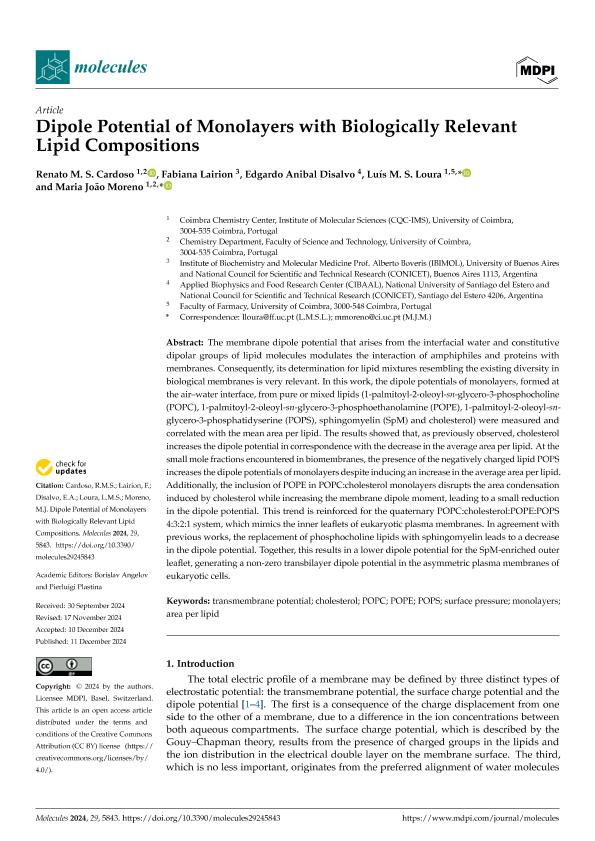
The membrane dipole potential that arises from the interfacial water and constitutive dipolar groups of lipid molecules modulates the interaction of amphiphiles and proteins with membranes. Consequently, its determination for lipid mixtures resembling the existing diversity in biological membranes is very relevant. In this work, the dipole potentials of monolayers, formed at the air-water interface, from pure or mixed lipids (1-palmitoyl-2-oleoyl-sn-glycero-3-phosphocholine (POPC), 1-palmitoyl-2-oleoyl-sn-glycero-3-phosphoethanolamine (POPE), 1-palmitoyl-2-oleoyl-sn-glycero-3-phosphatidyserine (POPS), sphingomyelin (SpM) and cholesterol) were measured and correlated with the mean area per lipid. The results showed that, as previously observed, cholesterol increases the dipole potential in correspondence with the decrease in the average area per lipid. At the small mole fractions encountered in biomembranes, the presence of the negatively charged lipid POPS increases the dipole potentials of monolayers despite inducing an increase in the average area per lipid. Additionally, the inclusion of POPE in POPC:cholesterol monolayers disrupts the area condensation induced by cholesterol while increasing the membrane dipole moment, leading to a small reduction in the dipole potential. This trend is reinforced for the quaternary POPC:cholesterol:POPE:POPS 4:3:2:1 system, which mimics the inner leaflets of eukaryotic plasma membranes. In agreement with previous works, the replacement of phosphocholine lipids with sphingomyelin leads to a decrease in the dipole potential. Together, this results in a lower dipole potential for the SpM-enriched outer leaflet, generating a non-zero transbilayer dipole potential in the asymmetric plasma membranes of eukaryotic cells.
Palabras clave:
POPC
,
LIPIDS
,
CHOLESTEROL
,
AREA
Archivos asociados

Tamaño:
2.745Mb
Formato:
PDF
Licencia
 Excepto donde se diga explícitamente, este item se publica bajo la siguiente descripción:
Creative Commons Attribution 2.5 Unported (CC BY 2.5)
Excepto donde se diga explícitamente, este item se publica bajo la siguiente descripción:
Creative Commons Attribution 2.5 Unported (CC BY 2.5)
Identificadores
Colecciones
Articulos (CIBAAL)
Articulos de CENTRO DE INVESTIGACION EN BIOFISICA APLICADA Y ALIMENTOS
Articulos de CENTRO DE INVESTIGACION EN BIOFISICA APLICADA Y ALIMENTOS
Citación
Cardoso, Renato M. S.; Lairion, Fabiana Norma; Disalvo, Edgardo Anibal; Loura, Luís M. S.; Moreno, Maria João; Dipole Potential of Monolayers with Biologically Relevant Lipid Compositions; Multidisciplinary Digital Publishing Institute; Molecules; 29; 24; 12-2024; 1-19
Compartir


Altmétricas