Artículo
Effectiveness of infection control measures informed by a modified Blue-Carba test in reducing rectal carriage of carbapenemase-producing bacteria in general wards: a prospective interrupted time series study
Castro, Maximiliano Gabriel; Argarañá, María Fernanda; Bernasconi, Carla; Margenet, Leticia Elena; Amato, Ana Paula; Coduri Anthonioz Blanc, Joaquín Ignacio; Rottoli, Erwin Alexander; Protto Baglione, Manuel; Vicino, Macarena; Sadonio, María José; Galluccio, Federico Rafael; Musacchio, Héctor Mario ; Pasteran, Fernando; Gómez, Sonia Alejandra
; Pasteran, Fernando; Gómez, Sonia Alejandra
Fecha de publicación:
09/2025
Editorial:
Frontiers Media
Revista:
Frontiers in Pharmacology
e-ISSN:
1663-9812
Idioma:
Inglés
Tipo de recurso:
Artículo publicado
Clasificación temática:
Resumen
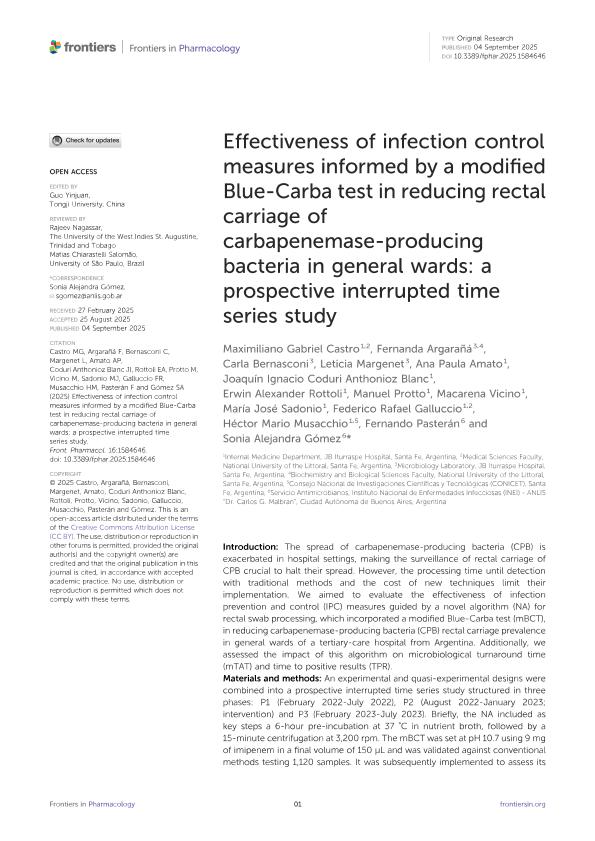
Introduction: The spread of carbapenemase-producing bacteria (CPB) isexacerbated in hospital settings, making the surveillance of rectal carriage ofCPB crucial to halt their spread. However, the processing time until detectionwith traditional methods and the cost of new techniques limit theirimplementation. We aimed to evaluate the effectiveness of infectionprevention and control (IPC) measures guided by a novel algorithm (NA) forrectal swab processing, which incorporated a modified Blue-Carba test (mBCT),in reducing carbapenemase-producing bacteria (CPB) rectal carriage prevalencein general wards of a tertiary-care hospital from Argentina. Additionally, weassessed the impact of this algorithm on microbiological turnaround time(mTAT) and time to positive results (TPR).Materials and methods: An experimental and quasi-experimental designs werecombined into a prospective interrupted time series study structured in threephases: P1 (February 2022-July 2022), P2 (August 2022-January 2023;intervention) and P3 (February 2023-July 2023). Briefly, the NA included askey steps a 6-hour pre-incubation at 37 °C in nutrient broth, followed by a15-minute centrifugation at 3,200 rpm. The mBCT was set at pH 10.7 using 9 mgof imipenem in a final volume of 150 μL and was validated against conventionalmethods testing 1,120 samples. It was subsequently implemented to assess itsimpact on hospital CPB prevalence and the effectiveness of IPC measures. Patientswere randomly selected for CPB rectal screening during Phases 1 and 3 andprovided informed consent for inclusion.Results: The mBCT significantly shortened the mTAT and TPR compared tostandard approaches (<24 h vs. 4d, p < 0.001), showing moderate sensitivity[54.6% (IC95% 45.2–63.7)] and high specificity [99.8% (IC 95% 99.3–100)]. TheIPC intervention guided by the mBCT reduced CPB prevalence in general wards(8.1% vs. 13.8%, p = 0.006).Conclusion: The implementation of the NA reduced mTAT with high sensitivity,while the mBCT also contributed to reducing TPR with high specificity. Integratingthe NA and mBCT into IPC protocols led to a decrease in CPB rectal carriageprevalence in general wards, underscoring their diagnostic, epidemiological andthus IPC benefits.
Archivos asociados

Tamaño:
1.368Mb
Formato:
PDF
Licencia
 Excepto donde se diga explícitamente, este item se publica bajo la siguiente descripción:
Creative Commons Attribution 2.5 Unported (CC BY 2.5)
Excepto donde se diga explícitamente, este item se publica bajo la siguiente descripción:
Creative Commons Attribution 2.5 Unported (CC BY 2.5)
Identificadores
Colecciones
Articulos(SEDE CENTRAL)
Articulos de SEDE CENTRAL
Articulos de SEDE CENTRAL
Citación
Castro, Maximiliano Gabriel; Argarañá, María Fernanda; Bernasconi, Carla; Margenet, Leticia Elena; Amato, Ana Paula; et al.; Effectiveness of infection control measures informed by a modified Blue-Carba test in reducing rectal carriage of carbapenemase-producing bacteria in general wards: a prospective interrupted time series study; Frontiers Media; Frontiers in Pharmacology; 16; 9-2025; 1-14
Compartir


Altmétricas