Mostrar el registro sencillo del ítem
dc.contributor.author
Toledo, Santiago
dc.contributor.author
Diaz, Boris Gastón
dc.contributor.author
Duarte Guardia, Sandra
dc.contributor.author
Peri, Pablo Luis
dc.date.available
2025-11-25T13:19:06Z
dc.date.issued
2025-10
dc.identifier.citation
Toledo, Santiago; Diaz, Boris Gastón; Duarte Guardia, Sandra; Peri, Pablo Luis; Degradation of soil microbiome and carbon dynamics in response to overgrazing in Austral wetland ecosystems; Elsevier; Total Environment Microbiology; 1; 4; 10-2025; 1-11
dc.identifier.uri
http://hdl.handle.net/11336/276102
dc.description.abstract
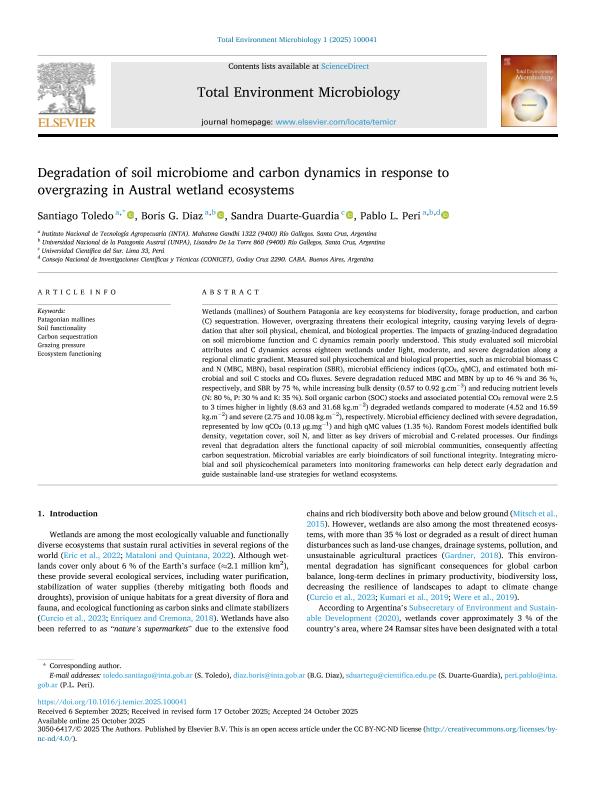
Wetlands (mallines) of Southern Patagonia are key ecosystems for biodiversity, forage production, and carbon (C) sequestration. However, overgrazing threatens their ecological integrity, causing varying levels of degradation that alter soil physical, chemical, and biological properties. The impacts of grazing-induced degradation on soil microbiome function and C dynamics remain poorly understood. This study evaluated soil microbial attributes and C dynamics across eighteen wetlands under light, moderate, and severe degradation along a regional climatic gradient. Measured soil physicochemical and biological properties, such as microbial biomass C and N (MBC, MBN), basal respiration (SBR), microbial efficiency indices (qCO₂, qMC), and estimated both microbial and soil C stocks and CO₂ fluxes. Severe degradation reduced MBC and MBN by up to 46 % and 36 %, respectively, and SBR by 75 %, while increasing bulk density (0.57 to 0.92 g.cm− 3) and reducing nutrient levels (N: 80 %, P: 30 % and K: 35 %). Soil organic carbon (SOC) stocks and associated potential CO₂ removal were 2.5 to 3 times higher in lightly (8.63 and 31.68 kg.m− 2) degraded wetlands compared to moderate (4.52 and 16.59 kg.m− 2) and severe (2.75 and 10.08 kg.m− 2), respectively. Microbial efficiency declined with severe degradation, represented by low qCO₂ (0.13 µg.mg− 1) and high qMC values (1.35 %). Random Forest models identified bulk density, vegetation cover, soil N, and litter as key drivers of microbial and C-related processes. Our findings reveal that degradation alters the functional capacity of soil microbial communities, consequently affecting carbon sequestration. Microbial variables are early bioindicators of soil functional integrity. Integrating microbial and soil physicochemical parameters into monitoring frameworks can help detect early degradation and guide sustainable land-use strategies for wetland ecosystems.
dc.format
application/pdf
dc.language.iso
eng
dc.publisher
Elsevier
dc.rights
info:eu-repo/semantics/openAccess
dc.rights.uri
https://creativecommons.org/licenses/by-nc-nd/2.5/ar/
dc.subject
Soil functionality
dc.subject
Grazing pressure
dc.subject
Carbon sequestration
dc.subject
Ecosystem functioning
dc.subject.classification
Ecología
dc.subject.classification
Ciencias Biológicas
dc.subject.classification
CIENCIAS NATURALES Y EXACTAS
dc.title
Degradation of soil microbiome and carbon dynamics in response to overgrazing in Austral wetland ecosystems
dc.type
info:eu-repo/semantics/article
dc.type
info:ar-repo/semantics/artículo
dc.type
info:eu-repo/semantics/publishedVersion
dc.date.updated
2025-11-18T13:25:58Z
dc.identifier.eissn
3050-6417
dc.journal.volume
1
dc.journal.number
4
dc.journal.pagination
1-11
dc.journal.pais
Países Bajos
dc.journal.ciudad
Amsterdam
dc.description.fil
Fil: Toledo, Santiago. Instituto Nacional de Tecnología Agropecuaria; Argentina
dc.description.fil
Fil: Diaz, Boris Gastón. Instituto Nacional de Tecnología Agropecuaria; Argentina. Universidad Nacional de la Patagonia Austral; Argentina
dc.description.fil
Fil: Duarte Guardia, Sandra. Universidad Cientifica del Sur;
dc.description.fil
Fil: Peri, Pablo Luis. Consejo Nacional de Investigaciones Científicas y Técnicas. Centro de Investigaciones y Transferencia de Santa Cruz. Universidad Tecnológica Nacional. Facultad Regional Santa Cruz. Centro de Investigaciones y Transferencia de Santa Cruz. Universidad Nacional de la Patagonia Austral. Centro de Investigaciones y Transferencia de Santa Cruz; Argentina
dc.journal.title
Total Environment Microbiology
dc.relation.alternativeid
info:eu-repo/semantics/altIdentifier/url/https://www.sciencedirect.com/science/article/pii/S3050641725000412
dc.relation.alternativeid
info:eu-repo/semantics/altIdentifier/doi/https://doi.org/10.1016/j.temicr.2025.100041
Archivos asociados

Tamaño:
5.907Mb
Formato:
PDF