Artículo
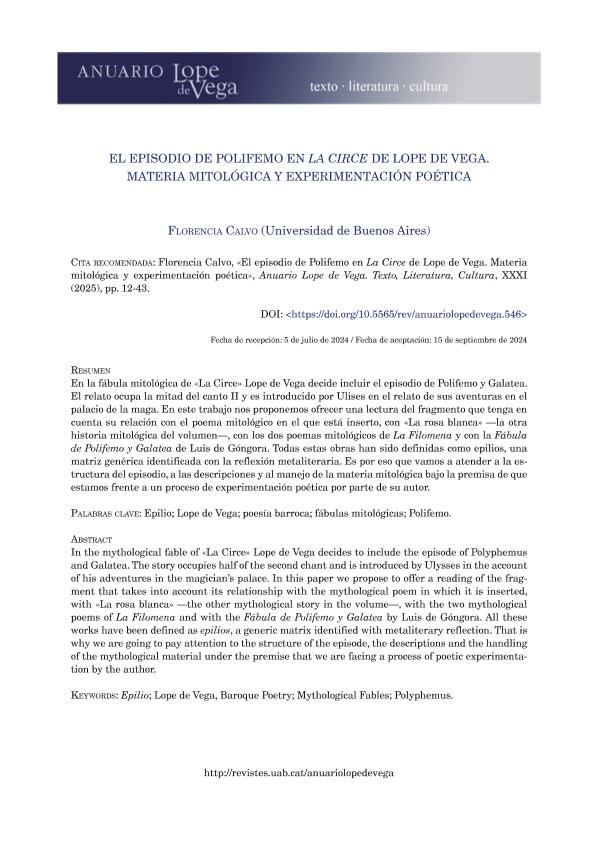
En la fábula mitológica de «La Circe» Lope de Vega decide incluir el episodio de Polifemo y Galatea, El relato ocupa la mitad del Canto II y es introducido por Ulises en el relato de sus aventuras en el palacio de la maga. En este trabajo nos proponemos ofrecer una lectura del fragmento que tenga en cuenta su relación con el poema mitológico en el que esta inserto, con «La rosa blanca» -la otra historia mitológica del volumen-, con los dos poemas mitológicos de La Filomena y con la Fábula de Polifemo y Galatea de Luis de Góngora. Todas estas obras han sido definidas como epilios, una matriz genérica identificada con la reflexión metaliteraria. Es por eso que vamos a atender a la estructura del episodio, a las descripciones y al manejo de la materia mitológica bajo la premisa de que estamos frente a un proceso de experimentación poética por parte de su autor. In the mythological fable of «La Circe» Lope de Vega decides to include the episode of Polyphemus and Galatea. The story occupies half of the second chant and is introduced by Ulysses in the account of his adventures in the magician’s palace. In this paper we propose to offer a reading of the fragment that takes into account its relationship with the mythological poem in which it is inserted, with «La rosa blanca» —the other mythological story in the volume—, with the two mythological poems of La Filomena and with the Fábula de Polifemo y Galatea by Luis de Góngora. All these works have been defined as epilios, a generic matrix identified with metaliterary reflection. That is why we are going to pay attention to the structure of the episode, the descriptions and the handling of the mythological material under the premise that we are facing a process of poetic experimentation by the author.
El episodio de Polifemo en «La Circe» de Lope de Vega: Materia mitológica y experimentación poética

Fecha de publicación:
01/2025
Editorial:
Universitat Autònoma de Barcelona
Revista:
Anuario Lope de Vega
e-ISSN:
2014-8860
Idioma:
Español
Tipo de recurso:
Artículo publicado
Clasificación temática:
Resumen
Palabras clave:
Lope de Vega
,
Luis de Góngora
,
Poesía barroca
,
Mitologia
Archivos asociados

Tamaño:
319.1Kb
Formato:
PDF
Licencia
 Excepto donde se diga explícitamente, este item se publica bajo la siguiente descripción:
Creative Commons Attribution 2.5 Unported (CC BY 2.5)
Excepto donde se diga explícitamente, este item se publica bajo la siguiente descripción:
Creative Commons Attribution 2.5 Unported (CC BY 2.5)
Identificadores
Colecciones
Articulos(SEDE CENTRAL)
Articulos de SEDE CENTRAL
Articulos de SEDE CENTRAL
Citación
Calvo, Florencia Nora; El episodio de Polifemo en «La Circe» de Lope de Vega: Materia mitológica y experimentación poética; Universitat Autònoma de Barcelona; Anuario Lope de Vega; 31; 1-2025; 12-43
Compartir


Altmétricas