Artículo
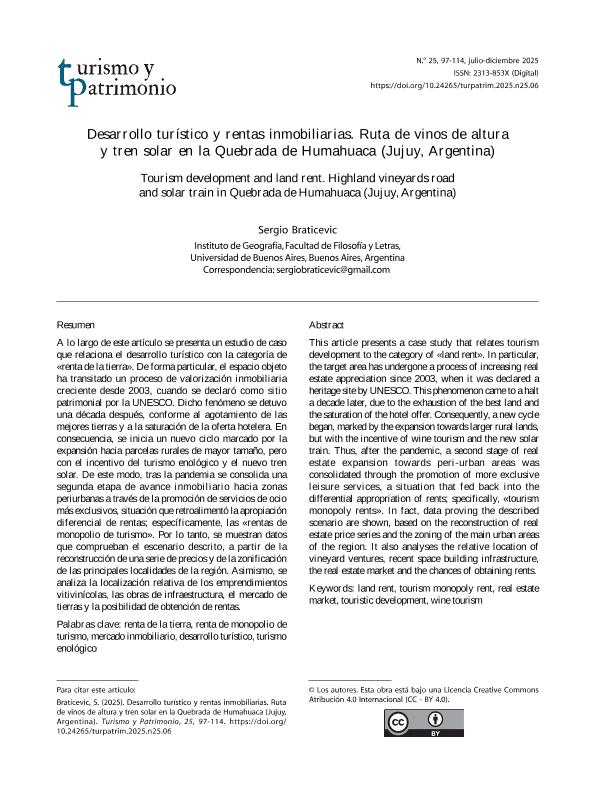
A lo largo de este artículo se presenta un estudio de caso que relaciona el desarrollo turístico con la categoría de «renta de la tierra». De forma particular, el espacio objeto ha transitado un proceso de valorización inmobiliaria creciente desde 2003, cuando se declaró como sitio patrimonial por la UNESCO. Dicho fenómeno se detuvo una década después, conforme al agotamiento de las mejores tierras y a la saturación de la oferta hotelera. En consecuencia, se inicia un nuevo ciclo marcado por la expansión hacia parcelas rurales de mayor tamaño, pero con el incentivo del turismo enológico y el nuevo tren solar. De este modo, tras la pandemia se consolida una segunda etapa de avance inmobiliario hacia zonas periurbanas a través de la promoción de servicios de ocio más exclusivos, situación que retroalimentó la apropiación diferencial de rentas; específicamente, las «rentas de monopolio de turismo». Por lo tanto, se muestran datos que comprueban el escenario descrito, a partir de la reconstrucción de una serie de precios y de la zonificación de las principales localidades de la región. Asimismo, se analiza la localización relativa de los emprendimientos vitivinícolas, las obras de infraestructura, el mercado de tierras y la posibilidad de obtención de rentas. This article presents a case study that relates tourism development to the category of «land rent». In particular, the target area has undergone a process of increasing real estate appreciation since 2003, when it was declared a heritage site by UNESCO. This phenomenon came to a halt a decade later, due to the exhaustion of the best land and the saturation of the hotel offer. Consequently, a new cycle began, marked by the expansion towards larger rural lands, but with the incentive of wine tourism and the new solar train. Thus, after the pandemic, a second stage of real estate expansion towards peri-urban areas was consolidated through the promotion of more exclusive leisure services, a situation that fed back into the differential appropriation of rents; specifically, «tourism monopoly rents». In fact, data proving the described scenario are shown, based on the reconstruction of real estate price series and the zoning of the main urban areas of the region. It also analyses the relative location of vineyard ventures, recent space building infrastructure, the real estate market and the chances of obtaining rents.
Desarrollo turístico y rentas inmobiliarias: Ruta de vinos de altura y tren solar en la Quebrada de Humahuaca (Jujuy, Argentina)
Título:
Tourism development and land rent: Highland vineyards road and solar train in Quebrada de Humahuaca (Jujuy, Argentina)

Fecha de publicación:
09/2025
Editorial:
Universidad de San Martín de Porres. Facultad de Ciencias de la Comunicación, Turismo y Psicología. Instituto de Investigación
Revista:
Turismo y Patrimonio
ISSN:
1680-9556
e-ISSN:
2313-853X
Idioma:
Español
Tipo de recurso:
Artículo publicado
Clasificación temática:
Resumen
Archivos asociados

Tamaño:
613.9Kb
Formato:
PDF
Licencia
 Excepto donde se diga explícitamente, este item se publica bajo la siguiente descripción:
Creative Commons Attribution 2.5 Unported (CC BY 2.5)
Excepto donde se diga explícitamente, este item se publica bajo la siguiente descripción:
Creative Commons Attribution 2.5 Unported (CC BY 2.5)
Identificadores
Colecciones
Articulos(SEDE CENTRAL)
Articulos de SEDE CENTRAL
Articulos de SEDE CENTRAL
Citación
Braticevic, Sergio Iván; Desarrollo turístico y rentas inmobiliarias: Ruta de vinos de altura y tren solar en la Quebrada de Humahuaca (Jujuy, Argentina); Universidad de San Martín de Porres. Facultad de Ciencias de la Comunicación, Turismo y Psicología. Instituto de Investigación; Turismo y Patrimonio; 25; 9-2025; 97-114
Compartir


Altmétricas