Artículo
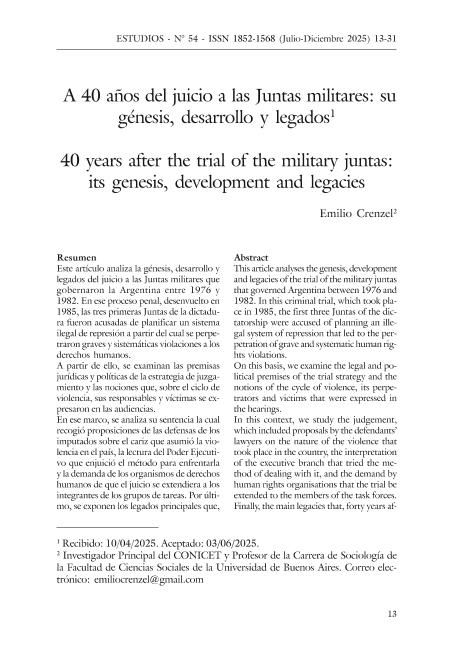
Este artículo analiza la génesis, desarrollo y legados del juicio a las Juntas militares que gobernaron la Argentina entre 1976 y 1982. En ese proceso penal, desenvuelto en 1985, las tres primeras Juntas de la dictadura fueron acusadas de planificar un sistema ilegal de represión a partir del cual se perpetraron graves y sistemáticas violaciones a los derechos humanos. A partir de ello, se examinan las premisas jurídicas y políticas de la estrategia de juzgamiento y las nociones que, sobre el ciclo de violencia, sus responsables y víctimas se expresaron en las audiencias. En ese marco, se analiza su sentencia la cual recogió proposiciones de las defensas de los imputados sobre el cariz que asumió la violencia en el país, la lectura del Poder Ejecutivo que enjuició el método para enfrentarla y la demanda de los organismos de derechos humanos de que el juicio se extendiera a los integrantes de los grupos de tareas. Por último, se exponen los legados principales que a cuarenta años de la realización del juicio a las Juntas, perduran en el país y en las políticas de justicia transicional que se implementan a escala global para enfrentar los legados de violencias masivas y sistemáticas. This article analyses the genesis, development and legacies of the trial of the military juntas that governed Argentina between 1976 and 1982. In this criminal trial, which took place in 1985, the first three Juntas of the dictatorship were accused of planning an illegal system of repression that led to the perpetration of grave and systematic human rights violations. On this basis, we examine the legal and political premises of the trial strategy and the notions of the cycle of violence, its perpetrators and victims that were expressed in the hearings. In this context, we study the judgement, which included proposals by the defendants’ lawyers on the nature of the violence that took place in the country, the interpretation of the executive branch that tried the method of dealing with it, and the demand by human rights organisations that the trial be extended to the members of the task forces. Finally, the main legacies that, forty years after the trial of the Juntas, remain in the country and in the transitional justice policies that are being implemented on a global scale to confront the legacies of massive processes of violence.
A 40 años del juicio a las Juntas militares: Su génesis, desarrollo y legados
Título:
40 years after the trial of the military juntas: Its genesis, development and legacies

Fecha de publicación:
08/2025
Editorial:
Universidad Nacional de Córdoba. Centro de Estudios Avanzados
Revista:
Estudios
ISSN:
1852-1568
Idioma:
Español
Tipo de recurso:
Artículo publicado
Clasificación temática:
Resumen
Palabras clave:
ARGENTINA
,
JUICIO
,
JUNTAS
,
LEGADOS
Archivos asociados

Tamaño:
108.2Kb
Formato:
PDF
Licencia
 Excepto donde se diga explícitamente, este item se publica bajo la siguiente descripción:
Creative Commons Attribution-NonCommercial 2.5 Unported (CC BY-NC 2.5)
Excepto donde se diga explícitamente, este item se publica bajo la siguiente descripción:
Creative Commons Attribution-NonCommercial 2.5 Unported (CC BY-NC 2.5)
Identificadores
Colecciones
Articulos(SEDE CENTRAL)
Articulos de SEDE CENTRAL
Articulos de SEDE CENTRAL
Citación
Crenzel, Emilio Ariel; A 40 años del juicio a las Juntas militares: Su génesis, desarrollo y legados; Universidad Nacional de Córdoba. Centro de Estudios Avanzados; Estudios; 54; 8-2025; 13-31
Compartir

