Artículo
Bacteria from the Amphibian Skin Inhibit the Growth of Phytopathogenic Fungi and Control Postharvest Rots
Gutiérrez Pavón, Adriana J.; Pereyra, Martina María ; Chacón, Florencia Isabel
; Monroy Morales, Elizabeth; Rebollar, Eria A.; Dib, Julian Rafael
; Serrano, Mario; Romero Contreras, Yordan J.
; Chacón, Florencia Isabel
; Monroy Morales, Elizabeth; Rebollar, Eria A.; Dib, Julian Rafael
; Serrano, Mario; Romero Contreras, Yordan J.
; Chacón, Florencia Isabel
; Monroy Morales, Elizabeth; Rebollar, Eria A.; Dib, Julian Rafael
; Serrano, Mario; Romero Contreras, Yordan J.
Fecha de publicación:
09/2025
Editorial:
Springer
Revista:
Microbial Ecology
ISSN:
1432-184X
Idioma:
Inglés
Tipo de recurso:
Artículo publicado
Clasificación temática:
Resumen
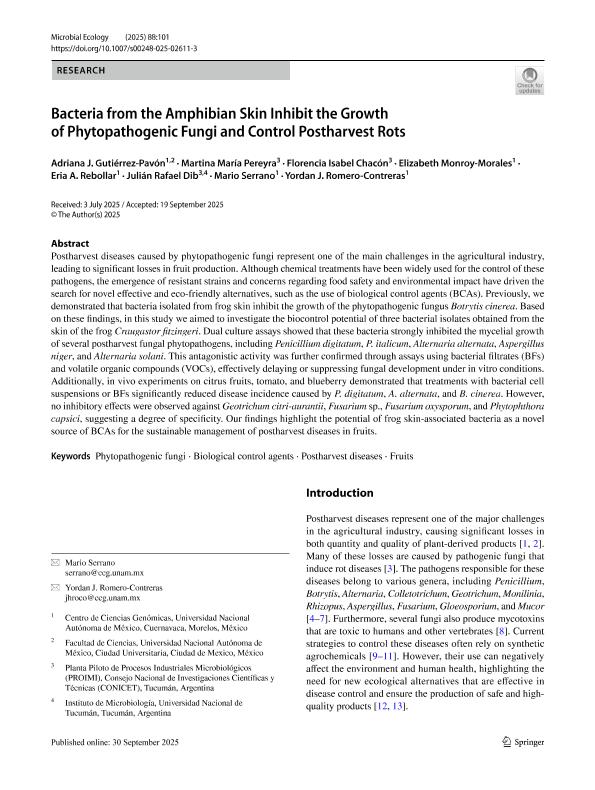
Postharvest diseases caused by phytopathogenic fungi represent one of the main challenges in the agricultural industry, leading to significant losses in fruit production. Although chemical treatments have been widely used for the control of these pathogens, the emergence of resistant strains and concerns regarding food safety and environmental impact have driven the search for novel effective and eco-friendly alternatives, such as the use of biological control agents (BCAs). Previously, we demonstrated that bacteria isolated from frog skin inhibit the growth of the phytopathogenic fungus Botrytis cinerea. Based on these findings, in this study we aimed to investigate the biocontrol potential of three bacterial isolates obtained from the skin of the frog Craugastor fitzingeri. Dual culture assays showed that these bacteria strongly inhibited the mycelial growth of several postharvest fungal phytopathogens, including Penicillium digitatum, P. italicum, Alternaria alternata, Aspergillus niger, and Alternaria solani. This antagonistic activity was further confirmed through assays using bacterial filtrates (BFs) and volatile organic compounds (VOCs), effectively delaying or suppressing fungal development under in vitro conditions. Additionally, in vivo experiments on citrus fruits, tomato, and blueberry demonstrated that treatments with bacterial cell suspensions or BFs significantly reduced disease incidence caused by P. digitatum, A. alternata, and B. cinerea. However, no inhibitory effects were observed against Geotrichum citri-aurantii, Fusarium sp., Fusarium oxysporum, and Phytophthora capsici, suggesting a degree of specificity. Our findings highlight the potential of frog skin-associated bacteria as a novel source of BCAs for the sustainable management of postharvest diseases in fruits.
Palabras clave:
Phytopathogenic Fungi
,
Postharvest
,
Tomato
,
Blueberry
Archivos asociados

Tamaño:
12.32Mb
Formato:
PDF
Licencia
 Excepto donde se diga explícitamente, este item se publica bajo la siguiente descripción:
Creative Commons Attribution 2.5 Unported (CC BY 2.5)
Excepto donde se diga explícitamente, este item se publica bajo la siguiente descripción:
Creative Commons Attribution 2.5 Unported (CC BY 2.5)
Identificadores
Colecciones
Articulos(PROIMI)
Articulos de PLANTA PILOTO DE PROC.IND.MICROBIOLOGICOS (I)
Articulos de PLANTA PILOTO DE PROC.IND.MICROBIOLOGICOS (I)
Citación
Gutiérrez Pavón, Adriana J.; Pereyra, Martina María; Chacón, Florencia Isabel; Monroy Morales, Elizabeth; Rebollar, Eria A.; et al.; Bacteria from the Amphibian Skin Inhibit the Growth of Phytopathogenic Fungi and Control Postharvest Rots; Springer; Microbial Ecology; 88; 1; 9-2025; 1-13
Compartir


Altmétricas