Mostrar el registro sencillo del ítem
dc.contributor.author
Cancino, Jorge
dc.contributor.author
Ayala, Amanda
dc.contributor.author
Flores Sarmiento, Erick
dc.contributor.author
Moreno, Flor de María
dc.contributor.author
Suárez, Lorena
dc.contributor.author
Ovruski Alderete, Sergio Marcelo
dc.contributor.author
Montoya, Pablo
dc.date.available
2025-11-14T10:28:31Z
dc.date.issued
2025-09
dc.identifier.citation
Cancino, Jorge; Ayala, Amanda; Flores Sarmiento, Erick; Moreno, Flor de María; Suárez, Lorena; et al.; Egg Allocation on Anastrepha ludens Larvae by Mass-Reared Diachasmimorpha longicaudata Females; Multidisciplinary Digital Publishing Institute; Insects; 16; 9; 9-2025; 1-13
dc.identifier.issn
2075-4450
dc.identifier.uri
http://hdl.handle.net/11336/275584
dc.description.abstract
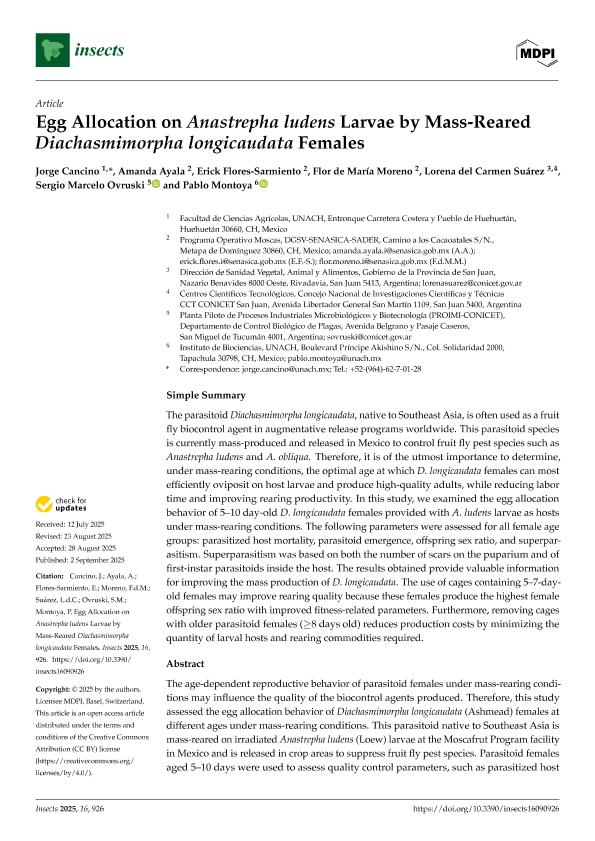
The age-dependent reproductive behavior of parasitoid females under mass-rearing conditions may influence the quality of the biocontrol agents produced. Therefore, this studyassessed the egg allocation behavior of Diachasmimorpha longicaudata (Ashmead) females atdifferent ages under mass-rearing conditions. This parasitoid native to Southeast Asia ismass-reared on irradiated Anastrepha ludens (Loew) larvae at the Moscafrut Program facilityin Mexico and is released in crop areas to suppress fruit fly pest species. Parasitoid femalesaged 5–10 days were used to assess quality control parameters, such as parasitized host mortality, parasitoid emergence, offspring sex ratio, and superparasitism. Anastrepha ludenspuparia were checked and dissected 72 h after being exposed to female parasitoids todetermine the number of scars on the puparium of first-instar parasitoids, respectively.Parasitized puparia were kept under lab conditions to assess adult emergence and offspring sex ratio. Host mortality, superparasitism, and parasitoid offspring sex ratio wereaffected by female age. The highest host mortality and superparasitism were caused by5–7-day-old females, which also produced a significantly higher female-to-male offspringratio with improved fitness-related parameters. The use of cages with females of these agesmay improve the quality parameters of parasitoids and result in higher female-to-maleoffspring sex ratios. Furthermore, production costs could be lowered by reducing thequantity of hosts and rearing commodities. These findings are a useful contribution toimproving the current method used for the mass rearing of D. longicaudata at the MoscafrutProgram facility.
dc.format
application/pdf
dc.language.iso
eng
dc.publisher
Multidisciplinary Digital Publishing Institute
dc.rights
info:eu-repo/semantics/openAccess
dc.rights.uri
https://creativecommons.org/licenses/by/2.5/ar/
dc.subject
FRUIT FLY PARASITOID
dc.subject
PARASITOID MASS REARING
dc.subject
QUALITY CONTROL PARAMETERS
dc.subject
FEMALE ALLOCATION
dc.subject.classification
Otros Tópicos Biológicos
dc.subject.classification
Ciencias Biológicas
dc.subject.classification
CIENCIAS NATURALES Y EXACTAS
dc.title
Egg Allocation on Anastrepha ludens Larvae by Mass-Reared Diachasmimorpha longicaudata Females
dc.type
info:eu-repo/semantics/article
dc.type
info:ar-repo/semantics/artículo
dc.type
info:eu-repo/semantics/publishedVersion
dc.date.updated
2025-11-10T14:11:46Z
dc.journal.volume
16
dc.journal.number
9
dc.journal.pagination
1-13
dc.journal.pais
Suiza
dc.journal.ciudad
Basilea
dc.description.fil
Fil: Cancino, Jorge. Universidad Autónoma de Chiapas; México
dc.description.fil
Fil: Ayala, Amanda. Gobierno de México. Secretaría de Agricultura y Desarrollo Rural. Servicio Nacional de Sanidad, Inocuidad y Calidad Agroalimentaria. Dirección General de Sanidad Vegetal; México
dc.description.fil
Fil: Flores Sarmiento, Erick. Gobierno de México. Secretaría de Agricultura y Desarrollo Rural. Servicio Nacional de Sanidad, Inocuidad y Calidad Agroalimentaria. Dirección General de Sanidad Vegetal; México
dc.description.fil
Fil: Moreno, Flor de María. Gobierno de México. Secretaría de Agricultura y Desarrollo Rural. Servicio Nacional de Sanidad, Inocuidad y Calidad Agroalimentaria. Dirección General de Sanidad Vegetal; México
dc.description.fil
Fil: Suárez, Lorena. Consejo Nacional de Investigaciones Científicas y Técnicas. Centro Científico Tecnológico Conicet - San Juan; Argentina. Gobierno de la Provincia de San Juan. Ministerio de Produccion y Desarrollo Economico. Secretaria de Agricultura Ganaderia y Agroindustria. Direccion de Sanidad Vegetal, Animal y Alimentos de San Juan.; Argentina
dc.description.fil
Fil: Ovruski Alderete, Sergio Marcelo. Consejo Nacional de Investigaciones Científicas y Técnicas. Centro Científico Tecnológico Conicet - Tucumán. Planta Piloto de Procesos Industriales Microbiológicos; Argentina
dc.description.fil
Fil: Montoya, Pablo. Universidad Autónoma de Chiapas; México
dc.journal.title
Insects
dc.relation.alternativeid
info:eu-repo/semantics/altIdentifier/url/https://www.mdpi.com/2075-4450/16/9/926
dc.relation.alternativeid
info:eu-repo/semantics/altIdentifier/doi/http://dx.doi.org/10.3390/insects16090926
Archivos asociados

Tamaño:
1.072Mb
Formato:
PDF