Mostrar el registro sencillo del ítem
dc.contributor.author
Tagliazucchi, Mario Eugenio
dc.contributor.author
Müller, Marcus
dc.date.available
2025-11-12T11:49:27Z
dc.date.issued
2025-01
dc.identifier.citation
Tagliazucchi, Mario Eugenio; Müller, Marcus; Morphology–Transport Coupling and Dissipative Structures in PEO–PS+LiTFSI Electrolytes In-Operando Conditions; American Chemical Society; ACS Applied Materials & Interfaces; 17; 6; 1-2025; 9278-9288
dc.identifier.issn
1944-8244
dc.identifier.uri
http://hdl.handle.net/11336/275405
dc.description.abstract
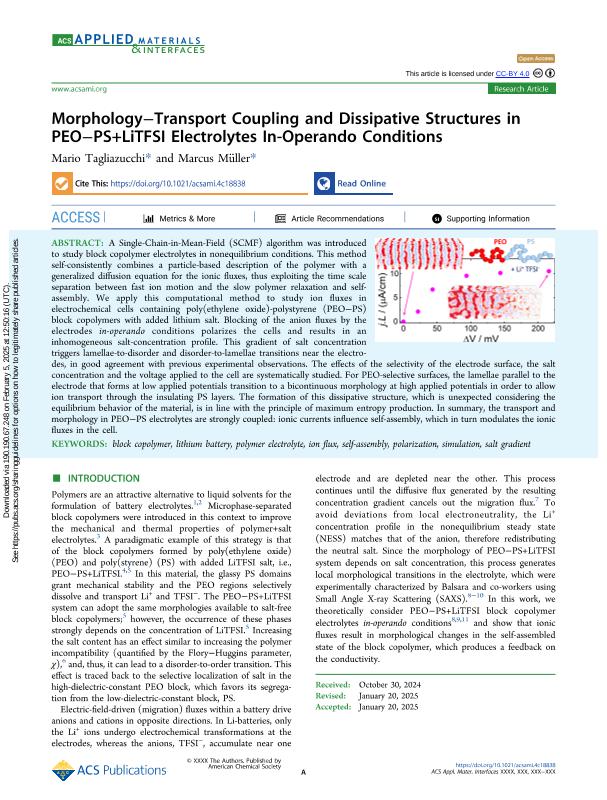
A Single-Chain-in-Mean-Field (SCMF) algorithm was introduced to study block copolymer electrolytes in nonequilibrium conditions. This method self-consistently combines a particle-based description of the polymer with a generalized diffusion equation for the ionic fluxes, thus exploiting the time scale separation between fast ion motion and the slow polymer relaxation and self-assembly. We apply this computational method to study ion fluxes in electrochemical cells containing poly(ethylene oxide)-polystyrene (PEO–PS) block copolymers with added lithium salt. Blocking of the anion fluxes by the electrodes in-operando conditions polarizes the cells and results in an inhomogeneous salt-concentration profile. This gradient of salt concentration triggers lamellae-to-disorder and disorder-to-lamellae transitions near the electrodes, in good agreement with previous experimental observations. The effects of the selectivity of the electrode surface, the salt concentration and the voltage applied to the cell are systematically studied. For PEO-selective surfaces, the lamellae parallel to the electrode that forms at low applied potentials transition to a bicontinuous morphology at high applied potentials in order to allow ion transport through the insulating PS layers. The formation of this dissipative structure, which is unexpected considering the equilibrium behavior of the material, is in line with the principle of maximum entropy production. In summary, the transport and morphology in PEO–PS electrolytes are strongly coupled: ionic currents influence self-assembly, which in turn modulates the ionic fluxes in the cell.
dc.format
application/pdf
dc.language.iso
eng
dc.publisher
American Chemical Society
dc.rights
info:eu-repo/semantics/openAccess
dc.rights.uri
https://creativecommons.org/licenses/by/2.5/ar/
dc.subject
Li battery
dc.subject
Electrolyte
dc.subject
Block copolymer
dc.subject
Simulation
dc.subject.classification
Físico-Química, Ciencia de los Polímeros, Electroquímica
dc.subject.classification
Ciencias Químicas
dc.subject.classification
CIENCIAS NATURALES Y EXACTAS
dc.title
Morphology–Transport Coupling and Dissipative Structures in PEO–PS+LiTFSI Electrolytes In-Operando Conditions
dc.type
info:eu-repo/semantics/article
dc.type
info:ar-repo/semantics/artículo
dc.type
info:eu-repo/semantics/publishedVersion
dc.date.updated
2025-11-11T11:10:02Z
dc.journal.volume
17
dc.journal.number
6
dc.journal.pagination
9278-9288
dc.journal.pais
Estados Unidos
dc.journal.ciudad
Washington
dc.description.fil
Fil: Tagliazucchi, Mario Eugenio. Consejo Nacional de Investigaciones Científicas y Técnicas. Oficina de Coordinación Administrativa Ciudad Universitaria. Instituto de Química, Física de los Materiales, Medioambiente y Energía. Universidad de Buenos Aires. Facultad de Ciencias Exactas y Naturales. Instituto de Química, Física de los Materiales, Medioambiente y Energía; Argentina
dc.description.fil
Fil: Müller, Marcus. Universität Göttingen; Alemania
dc.journal.title
ACS Applied Materials & Interfaces
dc.relation.alternativeid
info:eu-repo/semantics/altIdentifier/url/https://pubs.acs.org/doi/10.1021/acsami.4c18838
dc.relation.alternativeid
info:eu-repo/semantics/altIdentifier/doi/http://dx.doi.org/10.1021/acsami.4c18838
Archivos asociados

Tamaño:
7.962Mb
Formato:
PDF