Mostrar el registro sencillo del ítem
dc.contributor.author
Habit, Evelyn
dc.contributor.author
Piedra, Priscila
dc.contributor.author
Ruzzante, Daniel E.
dc.contributor.author
Walde, Sandra J.
dc.contributor.author
Belk, Mark C.
dc.contributor.author
Cussac, Victor Enrique
dc.contributor.author
Gonzalez, Jorge
dc.contributor.author
Colin, Nicole
dc.date.available
2025-11-12T10:14:35Z
dc.date.issued
2010-08
dc.identifier.citation
Habit, Evelyn; Piedra, Priscila; Ruzzante, Daniel E.; Walde, Sandra J.; Belk, Mark C.; et al.; Changes in the distribution of native fishes in response to introduced species and other anthropogenic effects; Wiley Blackwell Publishing, Inc; Global Ecology and Biogeography; 19; 5; 8-2010; 697-710
dc.identifier.issn
1466-822X
dc.identifier.uri
http://hdl.handle.net/11336/275357
dc.description.abstract
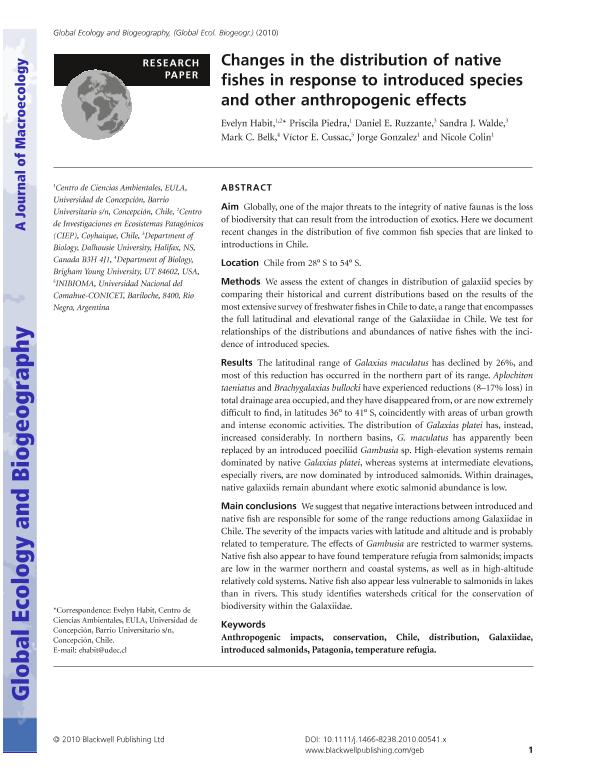
Aim: Globally, one of the major threats to the integrity of native faunas is the loss of biodiversity that can result from the introduction of exotics. Here we document recent changes in the distribution of five common fish species that are linked to introductions in Chile.Globally, one of the major threats to the integrity of native faunas is the loss of biodiversity that can result from the introduction of exotics. Here we document recent changes in the distribution of five common fish species that are linked to introductions in Chile. Location Chile from 28° S to 54° S.Chile from 28° S to 54° S. Methods We assess the extent of changes in distribution of galaxiid species by comparing their historical and current distributions based on the results of the most extensive survey of freshwater fishes in Chile to date, a range that encompasses the full latitudinal and elevational range of the Galaxiidae in Chile. We test for relationships of the distributions and abundances of native fishes with the incidence of introduced species.We assess the extent of changes in distribution of galaxiid species by comparing their historical and current distributions based on the results of the most extensive survey of freshwater fishes in Chile to date, a range that encompasses the full latitudinal and elevational range of the Galaxiidae in Chile. We test for relationships of the distributions and abundances of native fishes with the incidence of introduced species. Results The latitudinal range of Galaxias maculatus has declined by 26%, and most of this reduction has occurred in the northern part of its range. Aplochiton taeniatus and Brachygalaxias bullocki have experienced reductions (8–17% loss) in total drainage area occupied, and they have disappeared from, or are now extremely difficult to find, in latitudes 36° to 41° S, coincidently with areas of urban growth and intense economic activities. The distribution of Galaxias platei has, instead, increased considerably. In northern basins, G. maculatus has apparently been replaced by an introduced poeciliid Gambusia sp. High-elevation systems remain dominated by native Galaxias platei, whereas systems at intermediate elevations, especially rivers, are now dominated by introduced salmonids. Within drainages, native galaxiids remain abundant where exotic salmonid abundance is low.The latitudinal range of Galaxias maculatus has declined by 26%, and most of this reduction has occurred in the northern part of its range. Aplochiton taeniatus and Brachygalaxias bullocki have experienced reductions (8–17% loss) in total drainage area occupied, and they have disappeared from, or are now extremely difficult to find, in latitudes 36° to 41° S, coincidently with areas of urban growth and intense economic activities. The distribution of Galaxias platei has, instead, increased considerably. In northern basins, G. maculatus has apparently been replaced by an introduced poeciliid Gambusia sp. High-elevation systems remain dominated by native Galaxias platei, whereas systems at intermediate elevations, especially rivers, are now dominated by introduced salmonids. Within drainages, native galaxiids remain abundant where exotic salmonid abundance is low.Aplochiton taeniatus and Brachygalaxias bullocki have experienced reductions (8–17% loss) in total drainage area occupied, and they have disappeared from, or are now extremely difficult to find, in latitudes 36° to 41° S, coincidently with areas of urban growth and intense economic activities. The distribution of Galaxias platei has, instead, increased considerably. In northern basins, G. maculatus has apparently been replaced by an introduced poeciliid Gambusia sp. High-elevation systems remain dominated by native Galaxias platei, whereas systems at intermediate elevations, especially rivers, are now dominated by introduced salmonids. Within drainages, native galaxiids remain abundant where exotic salmonid abundance is low.and Brachygalaxias bullocki have experienced reductions (8–17% loss) in total drainage area occupied, and they have disappeared from, or are now extremely difficult to find, in latitudes 36° to 41° S, coincidently with areas of urban growth and intense economic activities. The distribution of Galaxias platei has, instead, increased considerably. In northern basins, G. maculatus has apparently been replaced by an introduced poeciliid Gambusia sp. High-elevation systems remain dominated by native Galaxias platei, whereas systems at intermediate elevations, especially rivers, are now dominated by introduced salmonids. Within drainages, native galaxiids remain abundant where exotic salmonid abundance is low.Galaxias platei has, instead, increased considerably. In northern basins, G. maculatus has apparently been replaced by an introduced poeciliid Gambusia sp. High-elevation systems remain dominated by native Galaxias platei, whereas systems at intermediate elevations, especially rivers, are now dominated by introduced salmonids. Within drainages, native galaxiids remain abundant where exotic salmonid abundance is low.G. maculatus has apparently been replaced by an introduced poeciliid Gambusia sp. High-elevation systems remain dominated by native Galaxias platei, whereas systems at intermediate elevations, especially rivers, are now dominated by introduced salmonids. Within drainages, native galaxiids remain abundant where exotic salmonid abundance is low.Gambusia sp. High-elevation systems remain dominated by native Galaxias platei, whereas systems at intermediate elevations, especially rivers, are now dominated by introduced salmonids. Within drainages, native galaxiids remain abundant where exotic salmonid abundance is low.Galaxias platei, whereas systems at intermediate elevations, especially rivers, are now dominated by introduced salmonids. Within drainages, native galaxiids remain abundant where exotic salmonid abundance is low. Main conclusions We suggest that negative interactions between introduced and native fish are responsible for some of the range reductions among Galaxiidae in Chile. The severity of the impacts varies with latitude and altitude and is probably related to temperature. The effects of Gambusia are restricted to warmer systems. Native fish also appear to have found temperature refugia from salmonids; impacts are low in the warmer northern and coastal systems, as well as in high-altitude relatively cold systems. Native fish also appear less vulnerable to salmonids in lakes than in rivers. This study identifies watersheds critical for the conservation of biodiversity within the Galaxiidae.We suggest that negative interactions between introduced and native fish are responsible for some of the range reductions among Galaxiidae in Chile. The severity of the impacts varies with latitude and altitude and is probably related to temperature. The effects of Gambusia are restricted to warmer systems. Native fish also appear to have found temperature refugia from salmonids; impacts are low in the warmer northern and coastal systems, as well as in high-altitude relatively cold systems. Native fish also appear less vulnerable to salmonids in lakes than in rivers. This study identifies watersheds critical for the conservation of biodiversity within the Galaxiidae.Gambusia are restricted to warmer systems. Native fish also appear to have found temperature refugia from salmonids; impacts are low in the warmer northern and coastal systems, as well as in high-altitude relatively cold systems. Native fish also appear less vulnerable to salmonids in lakes than in rivers. This study identifies watersheds critical for the conservation of biodiversity within the Galaxiidae.
dc.format
application/pdf
dc.language.iso
eng
dc.publisher
Wiley Blackwell Publishing, Inc
dc.rights
info:eu-repo/semantics/openAccess
dc.rights.uri
https://creativecommons.org/licenses/by-nc-sa/2.5/ar/
dc.subject
Anthropogenic impacts,
dc.subject
conservation,
dc.subject
Chile,
dc.subject
distribution,
dc.subject
Galaxiidae,
dc.subject.classification
Ecología
dc.subject.classification
Ciencias Biológicas
dc.subject.classification
CIENCIAS NATURALES Y EXACTAS
dc.title
Changes in the distribution of native fishes in response to introduced species and other anthropogenic effects
dc.type
info:eu-repo/semantics/article
dc.type
info:ar-repo/semantics/artículo
dc.type
info:eu-repo/semantics/publishedVersion
dc.date.updated
2025-11-11T11:13:43Z
dc.journal.volume
19
dc.journal.number
5
dc.journal.pagination
697-710
dc.journal.pais
Reino Unido
dc.journal.ciudad
Londres
dc.description.fil
Fil: Habit, Evelyn. Universidad de Concepción; Chile
dc.description.fil
Fil: Piedra, Priscila. Universidad de Concepción; Chile
dc.description.fil
Fil: Ruzzante, Daniel E.. Centro de Investigacion En Ecosistemas de la Patagonia;
dc.description.fil
Fil: Walde, Sandra J.. Centro de Investigacion En Ecosistemas de la Patagonia;
dc.description.fil
Fil: Belk, Mark C.. University Brigham Young; Estados Unidos
dc.description.fil
Fil: Cussac, Victor Enrique. Consejo Nacional de Investigaciones Científicas y Técnicas. Centro Científico Tecnológico Conicet - Patagonia Norte. Instituto de Investigaciones en Biodiversidad y Medioambiente. Universidad Nacional del Comahue. Centro Regional Universidad Bariloche. Instituto de Investigaciones en Biodiversidad y Medioambiente; Argentina
dc.description.fil
Fil: Gonzalez, Jorge. Universidad de Concepción; Chile
dc.description.fil
Fil: Colin, Nicole. Universidad de Concepción; Chile
dc.journal.title
Global Ecology and Biogeography
dc.relation.alternativeid
info:eu-repo/semantics/altIdentifier/url/https://onlinelibrary.wiley.com/doi/full/10.1111/j.1466-8238.2010.00541.x
dc.relation.alternativeid
info:eu-repo/semantics/altIdentifier/doi/http://dx.doi.org/10.1111/j.1466-8238.2010.00541.x
Archivos asociados

Tamaño:
1.581Mb
Formato:
PDF