Mostrar el registro sencillo del ítem
dc.contributor.author
Clauser, Nicolás Martín
dc.contributor.author
Scown, Corinne D.
dc.contributor.author
Pett-Ridge, Jennifer
dc.contributor.author
Sagues, William Joe
dc.date.available
2025-11-05T09:46:29Z
dc.date.issued
2025-07
dc.identifier.citation
Clauser, Nicolás Martín; Scown, Corinne D.; Pett-Ridge, Jennifer; Sagues, William Joe; A techno-economic assessment of carbon dioxide removal pathways via biochemical conversion of lignocellulose to biofuels and bioplastics; Pergamon-Elsevier Science Ltd; Renewable & Sustainable Energy Reviews; 216; 7-2025; 1-14
dc.identifier.issn
1364-0321
dc.identifier.uri
http://hdl.handle.net/11336/274805
dc.description.abstract
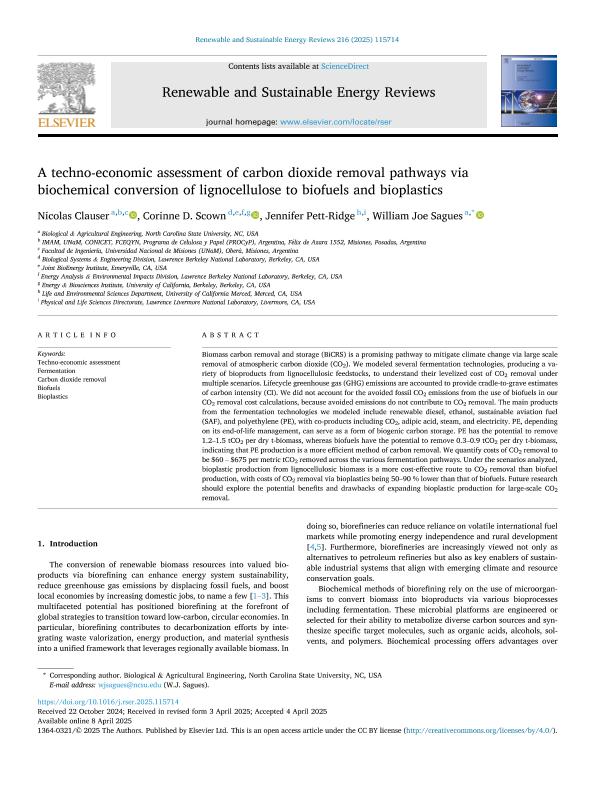
Biomass carbon removal and storage (BiCRS) is a promising pathway to mitigate climate change via large scale removal of atmospheric carbon dioxide (CO2). We modeled several fermentation technologies, producing a variety of bioproducts from lignocellulosic feedstocks, to understand their levelized cost of CO2 removal under multiple scenarios. Lifecycle greenhouse gas (GHG) emissions are accounted to provide cradle-to-grave estimates of carbon intensity (CI). We did not account for the avoided fossil CO2 emissions from the use of biofuels in our CO2 removal cost calculations, because avoided emissions do not contribute to CO2 removal. The main products from the fermentation technologies we modeled include renewable diesel, ethanol, sustainable aviation fuel (SAF), and polyethylene (PE), with co-products including CO2, adipic acid, steam, and electricity. PE, depending on its end-of-life management, can serve as a form of biogenic carbon storage. PE has the potential to remove 1.2–1.5 tCO2 per dry t-biomass, whereas biofuels have the potential to remove 0.3–0.9 tCO2 per dry t-biomass, indicating that PE production is a more efficient method of carbon removal. We quantify costs of CO2 removal to be $60 – $675 per metric tCO2 removed across the various fermentation pathways. Under the scenarios analyzed, bioplastic production from lignocellulosic biomass is a more cost-effective route to CO2 removal than biofuel production, with costs of CO2 removal via bioplastics being 50–90 % lower than that of biofuels. Future research should explore the potential benefits and drawbacks of expanding bioplastic production for large-scale CO2 removal.
dc.format
application/pdf
dc.language.iso
eng
dc.publisher
Pergamon-Elsevier Science Ltd
dc.rights
info:eu-repo/semantics/openAccess
dc.rights.uri
https://creativecommons.org/licenses/by/2.5/ar/
dc.subject
Bioeconomy
dc.subject
Carbon capture
dc.subject
Biorefinery
dc.subject.classification
Otras Ingenierías y Tecnologías
dc.subject.classification
Otras Ingenierías y Tecnologías
dc.subject.classification
INGENIERÍAS Y TECNOLOGÍAS
dc.title
A techno-economic assessment of carbon dioxide removal pathways via biochemical conversion of lignocellulose to biofuels and bioplastics
dc.type
info:eu-repo/semantics/article
dc.type
info:ar-repo/semantics/artículo
dc.type
info:eu-repo/semantics/publishedVersion
dc.date.updated
2025-11-04T11:26:31Z
dc.journal.volume
216
dc.journal.pagination
1-14
dc.journal.pais
Estados Unidos
dc.description.fil
Fil: Clauser, Nicolás Martín. Consejo Nacional de Investigaciones Científicas y Técnicas. Centro Científico Tecnológico Conicet - Nordeste. Instituto de Materiales de Misiones. Universidad Nacional de Misiones. Facultad de Ciencias Exactas Químicas y Naturales. Instituto de Materiales de Misiones; Argentina
dc.description.fil
Fil: Scown, Corinne D.. Lawrence Berkeley National Laboratory; Estados Unidos
dc.description.fil
Fil: Pett-Ridge, Jennifer. Lawrence Livermore National Laboratory; Estados Unidos. University of California; Estados Unidos
dc.description.fil
Fil: Sagues, William Joe. North Carolina State University; Estados Unidos
dc.journal.title
Renewable & Sustainable Energy Reviews
dc.relation.alternativeid
info:eu-repo/semantics/altIdentifier/url/https://linkinghub.elsevier.com/retrieve/pii/S1364032125003879
dc.relation.alternativeid
info:eu-repo/semantics/altIdentifier/doi/http://dx.doi.org/10.1016/j.rser.2025.115714
Archivos asociados

Tamaño:
4.786Mb
Formato:
PDF