Artículo
Why there are more species in several small patches versus few large patches: A multispecies modelling approach

Fecha de publicación:
11/2024
Editorial:
Wiley Blackwell Publishing, Inc
Revista:
Functional Ecology
ISSN:
0269-8463
Idioma:
Inglés
Tipo de recurso:
Artículo publicado
Clasificación temática:
Resumen
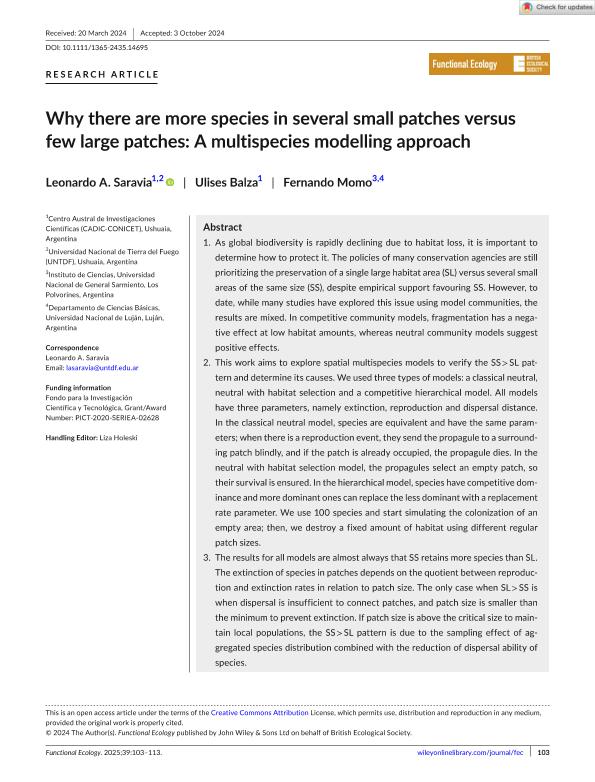
As global biodiversity is rapidly declining due to habitat loss, it is important to determine how to protect it. The policies of many conservation agencies are still prioritizing the preservation of a single large habitat area (SL) versus several small areas of the same size (SS), despite empirical support favouring SS. However, to date, while many studies have explored this issue using model communities, the results are mixed. In competitive community models, fragmentation has a negative effect at low habitat amounts, whereas neutral community models suggest positive effects.This work aims to explore spatial multispecies models to verify the SS > SL pattern and determine its causes. We used three types of models: a classical neutral, neutral with habitat selection and a competitive hierarchical model. All models have three parameters, namely extinction, reproduction and dispersal distance. In the classical neutral model, species are equivalent and have the same parameters; when there is a reproduction event, they send the propagule to a surrounding patch blindly, and if the patch is already occupied, the propagule dies. In the neutral with habitat selection model, the propagules select an empty patch, so their survival is ensured. In the hierarchical model, species have competitive dominance and more dominant ones can replace the less dominant with a replacement rate parameter. We use 100 species and start simulating the colonization of an empty area; then, we destroy a fixed amount of habitat using different regular patch sizes.The results for all models are almost always that SS retains more species than SL. The extinction of species in patches depends on the quotient between reproduction and extinction rates in relation to patch size. The only case when SL > SS is when dispersal is insufficient to connect patches, and patch size is smaller than the minimum to prevent extinction. If patch size is above the critical size to maintain local populations, the SS > SL pattern is due to the sampling effect of aggregated species distribution combined with the reduction of dispersal ability of species.High-dispersal rates produce the homogenization of species distribution and a reduction of species richness and this is why habitat fragmentation by habitat loss retains more species when patches are smaller. The model predicts that if a set of species have more dispersal capabilities, the SS effect would be lower than for species with less dispersal.
Palabras clave:
SLOSS debate
,
Habitat fragmentation
,
Metacommunity Models
,
Species Dispersal
Archivos asociados

Tamaño:
7.187Mb
Formato:
PDF
Licencia
 Excepto donde se diga explícitamente, este item se publica bajo la siguiente descripción:
Creative Commons Attribution 2.5 Unported (CC BY 2.5)
Excepto donde se diga explícitamente, este item se publica bajo la siguiente descripción:
Creative Commons Attribution 2.5 Unported (CC BY 2.5)
Identificadores
Colecciones
Articulos(CADIC)
Articulos de CENTRO AUSTRAL DE INVESTIGACIONES CIENTIFICAS
Articulos de CENTRO AUSTRAL DE INVESTIGACIONES CIENTIFICAS
Citación
Saravia, Leonardo Ariel; Balza, Ulises; Momo, Fernando Roberto; Why there are more species in several small patches versus few large patches: A multispecies modelling approach; Wiley Blackwell Publishing, Inc; Functional Ecology; 39; 1; 11-2024; 103-113
Compartir


Altmétricas