Mostrar el registro sencillo del ítem
dc.contributor.author
Muleras, Edna Analia
dc.date.available
2025-10-28T12:22:54Z
dc.date.issued
2025-08
dc.identifier.citation
Muleras, Edna Analia; The concept of epistemic change in Norbert Elias’ psychogenetic and sociogenetic research: an empirical illustration in the twenty first century; Universidade Estadual Paulista; Schème; 17; 1; 8-2025; 114-133
dc.identifier.issn
1984-1655
dc.identifier.uri
http://hdl.handle.net/11336/274147
dc.description.abstract
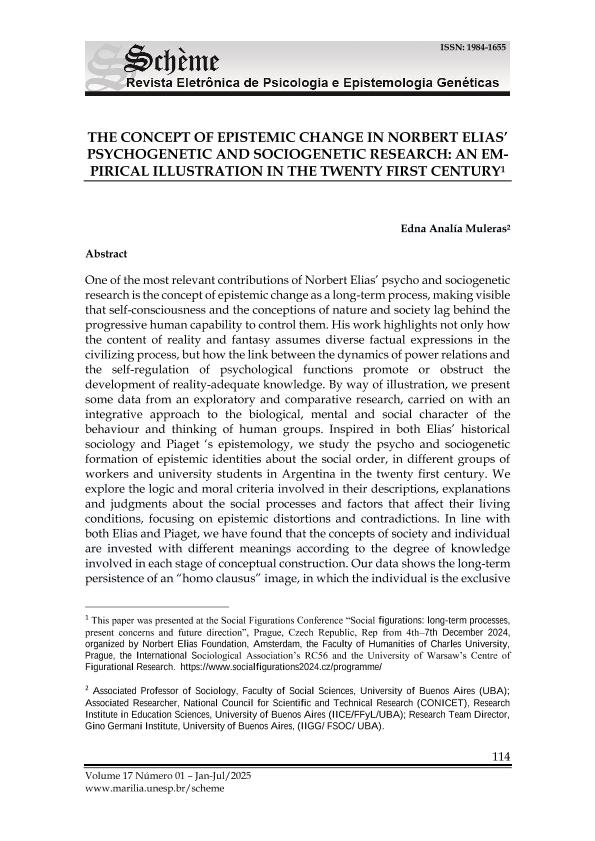
One of the most relevant contributions of Norbert Elias’ psycho and sociogenetic research is the concept of epistemic change as a long-term process, making visible that self-consciousness and the conceptions of nature and society lag behind the progressive human capability to control them. His work highlights not only how the content of reality and fantasy assumes diverse factual expressions in the civilizing process, but how the link between the dynamics of power relations and the self-regulation of psychological functions promote or obstruct the development of reality-adequate knowledge. By way of illustration, we present some data from an exploratory and comparative research, carried on with an integrative approach to the biological, mental and social character of the behaviour and thinking of human groups. Inspired in both Elias’ historical sociology and Piaget ‘s epistemology, we study the psycho and sociogenetic formation of epistemic identities about the social order, in different groups of workers and university students in Argentina in the twenty first century. We explore the logic and moral criteria involved in their descriptions, explanations and judgments about the social processes and factors that affect their living conditions, focusing on epistemic distortions and contradictions. In line with both Elias and Piaget, we have found that the concepts of society and individual are invested with different meanings according to the degree of knowledge involved in each stage of conceptual construction. Our data shows the long-term persistence of an “homo clausus” image, in which the individual is the exclusiveresponsible for his/her life situation and social factors are unobserved. Even in the case of those interviewees who question the meritocratic individualist conception, a distorted image prevails: society is conceptualised either as an exterior totality confronting and restricting personal decisions and choices, or as the sum of isolated individuals. In other words, without group membership, interacting with other social groups with reciprocal modifications. Although in the new millenium the social configuration involves the whole humanity as unit of survival, integrating groups of different organizational levels linked by conflicting and cooperative relations, an adecuate complex conception is absent in most of the interviewees.
dc.format
application/pdf
dc.language.iso
eng
dc.publisher
Universidade Estadual Paulista
dc.rights
info:eu-repo/semantics/openAccess
dc.rights.uri
https://creativecommons.org/licenses/by-nc-sa/2.5/ar/
dc.subject
Norbert Elias
dc.subject
Jean Piaget
dc.subject
Psycho and sociogenetic research.
dc.subject
Epistemic change.
dc.subject
Workers and Students
dc.subject
Argentina 21 st. century
dc.subject.classification
Otras Sociología
dc.subject.classification
Sociología
dc.subject.classification
CIENCIAS SOCIALES
dc.subject.classification
Otras Ciencias de la Educación
dc.subject.classification
Ciencias de la Educación
dc.subject.classification
CIENCIAS SOCIALES
dc.subject.classification
Otras Psicología
dc.subject.classification
Psicología
dc.subject.classification
CIENCIAS SOCIALES
dc.title
The concept of epistemic change in Norbert Elias’ psychogenetic and sociogenetic research: an empirical illustration in the twenty first century
dc.type
info:eu-repo/semantics/article
dc.type
info:ar-repo/semantics/artículo
dc.type
info:eu-repo/semantics/publishedVersion
dc.date.updated
2025-10-13T13:27:04Z
dc.journal.volume
17
dc.journal.number
1
dc.journal.pagination
114-133
dc.journal.pais
Brasil
dc.journal.ciudad
San Pablo
dc.description.fil
Fil: Muleras, Edna Analia. Consejo Nacional de Investigaciones Científicas y Técnicas; Argentina. Universidad de Buenos Aires. Facultad de Ciencias Sociales. Instituto de Investigación "Gino Germani". Área Conflicto y Cambio Social; Argentina. Universidad de Buenos Aires. Facultad de Filosofía y Letras. Instituto de Ciencias de la Educación; Argentina
dc.journal.title
Schème
dc.relation.alternativeid
info:eu-repo/semantics/altIdentifier/url/https://revistas.marilia.unesp.br/index.php/scheme/article/view/17856
dc.relation.alternativeid
info:eu-repo/semantics/altIdentifier/doi/https://doi.org/10.36311/1984-1655.2025.v17n1.p114-133
Archivos asociados

Tamaño:
647.5Kb
Formato:
PDF