Artículo
Life history data derived from the dental histological analysis of Giraffa camelopardalis : Implications for the palaeohistology of extinct giraffids

Fecha de publicación:
01/2025
Editorial:
Wiley Blackwell Publishing, Inc
Revista:
Journal of Anatomy
ISSN:
0021-8782
Idioma:
Inglés
Tipo de recurso:
Artículo publicado
Clasificación temática:
Resumen
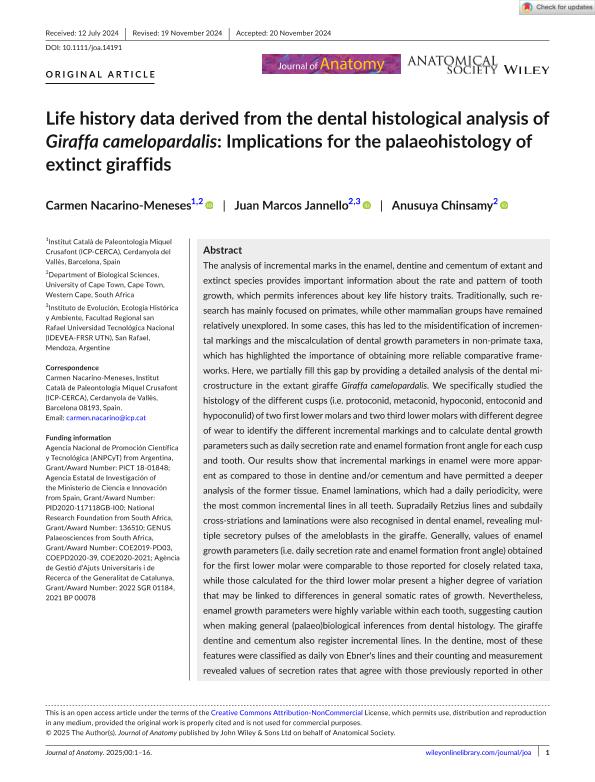
The analysis of incremental marks in the enamel, dentine and cementum of extant andextinct species provides important information about the rate and pattern of toothgrowth, which permits inferences about key life history traits. Traditionally, such re-search has mainly focused on primates, while other mammalian groups have remainedrelatively unexplored. In some cases, this has led to the misidentification of incremen-tal markings and the miscalculation of dental growth parameters in non-primate taxa,which has highlighted the importance of obtaining more reliable comparative frame-works. Here, we partially fill this gap by providing a detailed analysis of the dental mi-crostructure in the extant giraffe Giraffa camelopardalis. We specifically studied thehistology of the different cusps (i.e. protoconid, metaconid, hypoconid, entoconid andhypoconulid) of two first lower molars and two third lower molars with different degreeof wear to identify the different incremental markings and to calculate dental growthparameters such as daily secretion rate and enamel formation front angle for each cuspand tooth. Our results show that incremental markings in enamel were more appar-ent as compared to those in dentine and/or cementum and have permitted a deeperanalysis of the former tissue. Enamel laminations, which had a daily periodicity, werethe most common incremental lines in all teeth. Supradaily Retzius lines and subdailycross-striations and laminations were also recognised in dental enamel, revealing mul-tiple secretory pulses of the ameloblasts in the giraffe. Generally, values of enamelgrowth parameters (i.e. daily secretion rate and enamel formation front angle) obtainedfor the first lower molar were comparable to those reported for closely related taxa,while those calculated for the third lower molar present a higher degree of variationthat may be linked to differences in general somatic rates of growth. Nevertheless,enamel growth parameters were highly variable within each tooth, suggesting cautionwhen making general (palaeo)biological inferences from dental histology. The giraffedentine and cementum also register incremental lines. In the dentine, most of thesefeatures were classified as daily von Ebner´s lines and their counting and measurementrevealed values of secretion rates that agree with those previously reported in other sues are formed incrementally, leaving marks in their microstructurethat reflect their secretion rhythm(s) (Carlson, 1990; Hillson, 2005;Klevezal, 1996). More specifically, cementum has a yearly periodic-ity (Klevezal, 1996; Lieberman, 1993; Ungar, 2010), while enamel anddentine register subdaily, daily and supradaily incremental markings(Bromage, 1991; Dean, 2000; Emken et al., 2021; Kierdorf et al., 2013;Smith, 2006). Analyses of these lines (odontochronology) permit in-ferences to key development and life history information about theextant and extinct mammals (e.g. Funston et al., 2022; Nacarino-Meneses & Chinsamy, 2022) and have shed light on diverse evolu-tionary questions (e.g. Newham et al., 2020; Newham et al., 2022).Incremental marks in dental cementum, for instance, have been usedto reconstruct life history variables such as the age and/or the seasonof death of different taxa (Azorit et al., 2004; Burke & Castanet, 1995;Jordana et al., 2012; Klevezal, 1996; Lieberman, 1993; Newhamet al., 2020; Veitschegger et al., 2019). Daily and supradaily lines inenamel and dentine, on the other hand, have been widely analysedto calculate timings and rates of tooth formation (Dean, 1987; Dirkset al., 2009; Emken et al., 2023, 2024; Jordana & Köhler, 2011; Köhleret al., 2021; Nacarino-Meneses et al., 2017; Nacarino-Meneses &Chinsamy, 2022; Orlandi-Oliveras et al., 2019; Tafforeau et al., 2007).These data are especially important for reconstructing the life historystrategy of extant and extinct animals (Hogg, 2018), since some stagesof mammalian dental development, such as the eruption of the first orthe third permanent molar, might be tightly linked to key life historyevents (Dean, 2006). Precise information on the timing of some ofthese events, such as weaning, can indeed been obtained from thecombined analysis of dental histology and tooth chemistry (Smith,2013). Moreover, the study of incremental lines in dental enamel hasalso proven to be useful to shed light on other biological aspects apartfrom life history, such as illness or diet (Smith, 2013).Traditionally, odontochronological research aimed at obtain-ing life history information had focussed on primates [see Smith(Smith 2008) for a review]. Over the last decades, however, thisresearch has expanded considerably to other groups of mammals,including bovids (Jordana et al., 2014; Jordana & Köhler, 2011; Kahleet al., 2018; Kierdorf et al., 2013, 2012; Macho & Williamson, 2002),suids (Emken et al., 2021, 2023, 2024; Kierdorf et al., 2014, 2019),proboscideans (Dirks et al., 2012; Köhler et al., 2021; Metcalfe &Longstaffe, 2012), cervids (Iinuma, Suzuki, et al., 2004; Iinuma,Tanaka, et al., 2004; Jordana et al., 2014), rhinoceros (Tafforeauet al., 2007) and equids (Nacarino- Meneses et al., 2017; Nacarino-Meneses & Chinsamy, 2022; Orlandi-Oliveras et al., 2019), amongothers. There are, however, many mammalian taxa for which this in-formation is still lacking. Moreover, previous research has shown thatthere exist important differences between the dental microstruc-ture of primates and that of other mammalian orders (Hogg, 2018),which has been demonstrated to have caused the misidentificationof dental incremental markings (e.g. Emken et al., 2021; Kierdorfet al., 2019) and the subsequent erroneous calculation of den -tal growth parameters in several ungulates (Kierdorf et al., 2014;Nacarino-Meneses et al., 2017). Hence, an increase in sampling andexperimentation is urgently needed in mammalian groups other thanprimates (Hogg, 2018). This is particularly important for extant taxa,since they represent a solid framework that permits the comparisonand analysis of fossil forms (de Ricqlès, 2011).Here, we provide a detailed histological analysis of the growthand development of the lower molars of the extant giraffe Giraffacamelopardalis. In a pioneering study, Hall-Martin (1976) briefly de-scribed incremental lines in the dentine and cementum of giraffeteeth, but he did not provide any information about their growth pa-rameters. This has remained the only analysis of giraffe dental histol-ogy to date. It is, thus, timely that a more thorough investigation ofthe histology of giraffe teeth is conducted using modern techniques,cutting-edge software and microscopes to obtain baseline informa-tion that can later be extrapolated to extinct giraffids.2 | M ATE R I A L S A N D M E TH O DSWe studied two first lower molars (m1) and two third lower molars(m3) of G. camelopardalis that present different stages of develop -ment and degrees of wear (Table 1, Supplementary Figure S1A–S4A). These teeth were selected because they are reliable to obtainlife history data (e.g. Jordana et al., 2014; Nacarino-Meneses &Chinsamy, 2022), since their eruption is, respectively, correlatedwith the age at weaning and the age at skeletal maturity (Demisch &Wartmann, 1956; Orlandi-Oliveras et al., 2019; Smith, 2000).artiodactyls. The age calculated from the incremental lines in the dental cementummatches that deduced from dental wear, suggesting that the counting of yearly linesin this tissue is a reliable tool to estimate individual age in giraffids. This study furthersuggests ways to refine future analyses of dentine and cementum and sets the stage fordental palaeohistology of extinct giraffids and closely related ungulates for which lifehistory information is still unknown.
Archivos asociados

Tamaño:
3.077Mb
Formato:
PDF
Licencia
 Excepto donde se diga explícitamente, este item se publica bajo la siguiente descripción:
Creative Commons Attribution-NonCommercial 2.5 Unported (CC BY-NC 2.5)
Excepto donde se diga explícitamente, este item se publica bajo la siguiente descripción:
Creative Commons Attribution-NonCommercial 2.5 Unported (CC BY-NC 2.5)
Identificadores
Colecciones
Articulos (IDEVEA)
Articulos de INSTITUTO DE EVOLUCION, ECOLOGIA HISTORICA Y AMBIENTE
Articulos de INSTITUTO DE EVOLUCION, ECOLOGIA HISTORICA Y AMBIENTE
Citación
Nacarino Meneses, Carmen; Jannello, Juan Marcos; Chinsamy, Anusuya; Life history data derived from the dental histological analysis of Giraffa camelopardalis : Implications for the palaeohistology of extinct giraffids; Wiley Blackwell Publishing, Inc; Journal of Anatomy; 247; 3-4; 1-2025; 869-884
Compartir


Altmétricas