Artículo
Age-independent osteopathology in skeletons of a south American cervid, the Patagonian huemul (Hippocamelus bisulcus)

Fecha de publicación:
12/2008
Editorial:
Wildlife Disease Association
Revista:
Journal of Wildlife Diseases
ISSN:
0090-3558
Idioma:
Inglés
Tipo de recurso:
Artículo publicado
Clasificación temática:
Resumen
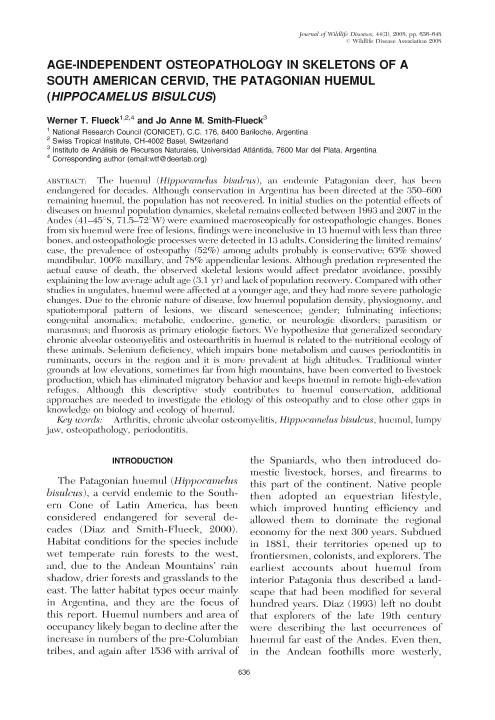
Huemul (Hippocamelus bisulcus), an endemic Patagonian deer, has been considered endangered for decades, conservation in Argentina has been directed at the 350-600 remaining deer, but without seeing recovery. To study effects of diseases on population dynamics the first time, skeletal remains collected between 1993-2007 in the Andes (41-45° S, 71.5-72° W) were examined macroscopically for osteopathology. Six huemul were free of lesions, 13 huemul with <3 bones were inconclusive, and osteopathological processes were detected in 13 adults. Considering the limited remains/case, the prevalence of osteopathology of 52% among adults is conservative; 63% showed mandibular, 100% maxillary and 78% appendicular lesions. Although predation causes of deaths, these skeletal lesions would affect the capacity for predator avoidance, possibly explaining the low average adult age (3.1 years) and lack of population recovery. Other ungulate studies differ in that only appendicular bones, or mainly mandibles, or mainly maxillary bones were involved, and predominantly in older animals. Huemul were affected at young ages and with more severe pathologies. Due to the chronic nature, low huemul density, physiognomy and spatiotemporal pattern of lesions, we discard senescence, gender, fulminating infections, congenital anomalies, metabolic, endocrine, genetic or neuropathic disorders, parasitism or marasmus, and fluorosis as primary etiological factors. We hypothesize that generalized secondary chronic alveolar osteomyelitis and osteoarthritis in huemul is related to nutritional ecology. Selenium (Se) deficiency, more prevalent at high altitudes, occurs in the region. Traditional winter grounds at low elevations, sometimes far from high mountains, were converted to livestock production which eliminated migratory behavior and keeps huemul in remote high elevation refugees. Se deficiency also impairs bone metabolism and causes periodontitis in ruminants. While this descriptive study contributes to conservation, more experimental approaches are needed to investigate the etiology of this osteopathology and to close other gaps in knowledge on biology and ecology of huemul.
Palabras clave:
Arthritis
,
chronic alveolar osteomyelitis
,
Hippocamelus bisulcus
,
lumpy jaw
Archivos asociados

Tamaño:
1.252Mb
Formato:
PDF
Licencia
 Excepto donde se diga explícitamente, este item se publica bajo la siguiente descripción:
Creative Commons Attribution-NonCommercial-ShareAlike 2.5 Unported (CC BY-NC-SA 2.5)
Excepto donde se diga explícitamente, este item se publica bajo la siguiente descripción:
Creative Commons Attribution-NonCommercial-ShareAlike 2.5 Unported (CC BY-NC-SA 2.5)
Identificadores
Colecciones
Articulos(CCT - MAR DEL PLATA)
Articulos de CTRO.CIENTIFICO TECNOL.CONICET - MAR DEL PLATA
Articulos de CTRO.CIENTIFICO TECNOL.CONICET - MAR DEL PLATA
Citación
Fluck, Werner Thomas; Smith Flueck, Jo Anne M.; Age-independent osteopathology in skeletons of a south American cervid, the Patagonian huemul (Hippocamelus bisulcus); Wildlife Disease Association; Journal of Wildlife Diseases; 44; 3; 12-2008; 636-648
Compartir


Altmétricas