Artículo
Biotic Translocation of Phosphorus: The Role of Deer in Protected Areas

Fecha de publicación:
04/2009
Editorial:
Molecular Diversity Preservation International
Revista:
Sustainability
ISSN:
2071-1050
Idioma:
Inglés
Tipo de recurso:
Artículo publicado
Clasificación temática:
Resumen
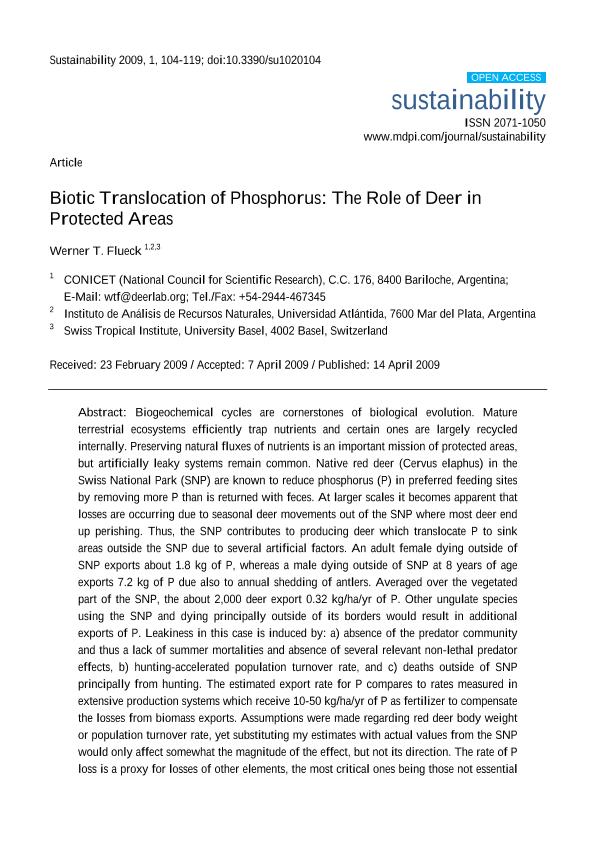
Biogeochemical cycles are cornerstones of biological evolution. Mature terrestrial ecosystems efficiently trap nutrients and certain ones are largely recycled internally. Preserving natural fluxes of nutrients is an important mission of protected areas, but artificially leaky systems remain common. Native red deer (Cervus elaphus) in the Swiss national park (SNP) are known to reduce phosphorus (P) in preferred feeding sites by removing more P than is returned with feces. At larger scales it becomes apparent that losses are occurring due to seasonal deer movements out of the SNP where most deer end up perishing. Thus, the SNP contributes to producing deer which translocate P to sink areas outside the SNP due to several artificial factors. An adult female dying outside of SNP exports about 1.8 kg of P, whereas a male dying outside of SNP at 8 years of age exports 7.2 kg of P due also to annual shedding of antlers. Averaged over the vegetated part of the SNP, the about 2000 deer export 0.32 kg/ha/yr of P. Other ungulate species using the SNP and dying principally outside of its borders would result in additional exports of P. Leakiness in this case is induced by: a) absence of the predator community and thus a lack of summer mortalities and absence of several relevant non-lethal predator effects, b) hunting-accelerated population turnover rate, and c) deaths outside of SNP principally from hunting. The estimated export rate for P compares to rates measured in extensive production systems which receive 10-50 kg/ha/yr of P as fertilizer to compensate the losses from biomass exports. Assumptions were made regarding red deer body weight or population turnover rate, yet substituting my estimates with actual values from the SNP would only affect somewhat the magnitude of the effect, but not its direction. The rate of P loss is a proxy for losses of other elements, the most critical ones being those not essential to autotrophs, but essential to heterotrophs. High deer turnover rates combined with accelerated biomass export warrants detailed mass balances of macro and micro nutrients, and studies of biogeochemical cycles in protected areas are essential if preserving natural processes is a mandate.
Palabras clave:
Cervus elaphus
,
phosphorus
,
biogeochemical cycles
,
biomass export
Archivos asociados

Tamaño:
332.6Kb
Formato:
PDF
Licencia
 Excepto donde se diga explícitamente, este item se publica bajo la siguiente descripción:
Creative Commons Attribution 2.5 Unported (CC BY 2.5)
Excepto donde se diga explícitamente, este item se publica bajo la siguiente descripción:
Creative Commons Attribution 2.5 Unported (CC BY 2.5)
Identificadores
Colecciones
Articulos(CCT - MAR DEL PLATA)
Articulos de CTRO.CIENTIFICO TECNOL.CONICET - MAR DEL PLATA
Articulos de CTRO.CIENTIFICO TECNOL.CONICET - MAR DEL PLATA
Citación
Fluck, Werner Thomas; Biotic Translocation of Phosphorus: The Role of Deer in Protected Areas; Molecular Diversity Preservation International; Sustainability; 1; 2; 4-2009; 104-119
Compartir


Altmétricas