Artículo
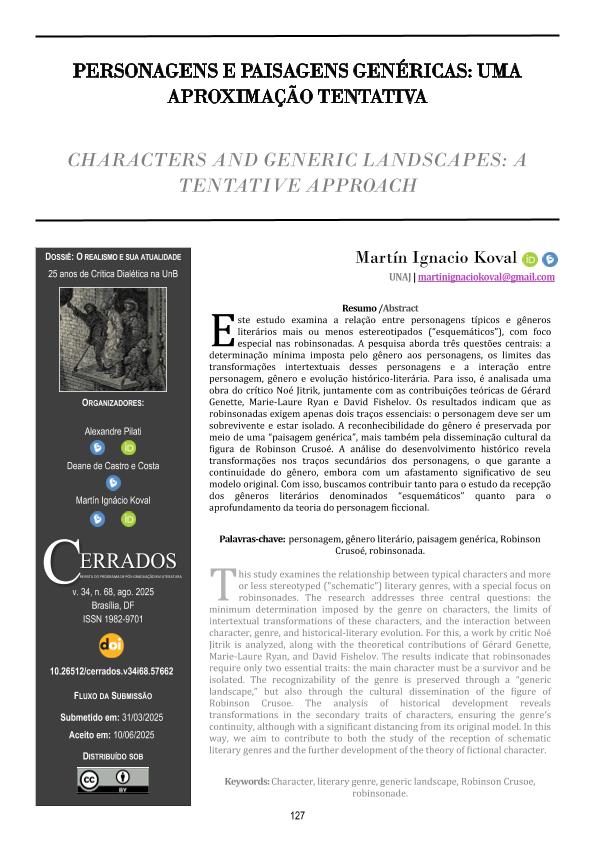
Este estudio examina la relación entre personajes típicos y géneros literarios más o menos estereotipados ("esquemáticos"), con especial atención a las robinsonadas. La investigación aborda tres cuestiones centrales: la determinación mínima impuesta por el género a los personajes, los límites de las transformaciones intertextuales de esos personajes y la interacción entre personaje, género y evolución histórico-literaria. Para ello, se analiza una obra del crítico Noé Jitrik, junto con los aportes teóricos de Gérard Genette, Marie-Laure Ryan y David Fishelov. Los resultados indican que las robinsonadas exigen solo dos rasgos esenciales: el personaje debe ser un sobreviviente y estar aislado. El reconocimiento del género se preserva mediante un "paisaje genérico", pero también gracias a la difusión cultural de la figura de Robinson Crusoe. El análisis del desarrollo histórico revela transformaciones en los rasgos secundarios de los personajes, lo que garantiza la continuidad del género, aunque con un distanciamiento significativo respecto de su modelo original. Con esto, buscamos contribuir tanto al estudio de la recepción de los géneros literarios denominados "esquemáticos" como al desarrollo de la teoría del personaje ficcional. T his study examines the relationship between typical characters and more or less stereotyped ("schematic") literary genres, with a special focus on robinsonades. The research addresses three central questions: the minimum determination imposed by the genre on characters, the limits of intertextual transformations of these characters, and the interaction between character, genre, and historical-literary evolution. For this, a work by critic Noe Jitrik is analyzed, along with the theoretical contributions of Ge rard Genette, Marie-Laure Ryan, and David Fishelov. The results indicate that robinsonades require only two essential traits: the main character must be a survivor and be isolated. The recognizability of the genre is preserved through a “generic landscape,” but also through the cultural dissemination of the figure of Robinson Crusoe. The analysis of historical development reveals transformations in the secondary traits of characters, ensuring the genre’s continuity, although with a significant distancing from its original model. In this way, we aim to contribute to both the study of the reception of schematic literary genres and the further development of the theory of fictional character.
Personagens e paisagens genéricas: Uma aproximação tentativa

Fecha de publicación:
08/2025
Editorial:
Universidade de Brasília. Departamento de Teoria Literária e Literaturas
Revista:
Cerrados
ISSN:
1982-9701
Idioma:
Portugues
Tipo de recurso:
Artículo publicado
Clasificación temática:
Resumen
Palabras clave:
PERSONAJE
,
GÉNERO LITERARIO
,
PAISAJE GENÉRICO
,
ROBINSON CRUSOE
Archivos asociados

Tamaño:
2.626Mb
Formato:
PDF
Licencia
 Excepto donde se diga explícitamente, este item se publica bajo la siguiente descripción:
Creative Commons Attribution 2.5 Unported (CC BY 2.5)
Excepto donde se diga explícitamente, este item se publica bajo la siguiente descripción:
Creative Commons Attribution 2.5 Unported (CC BY 2.5)
Identificadores
Colecciones
Articulos(SEDE CENTRAL)
Articulos de SEDE CENTRAL
Articulos de SEDE CENTRAL
Citación
Koval, Martín Ignacio; Personagens e paisagens genéricas: Uma aproximação tentativa; Universidade de Brasília. Departamento de Teoria Literária e Literaturas; Cerrados; 34; 68; 8-2025; 1-10
Compartir

