Artículo
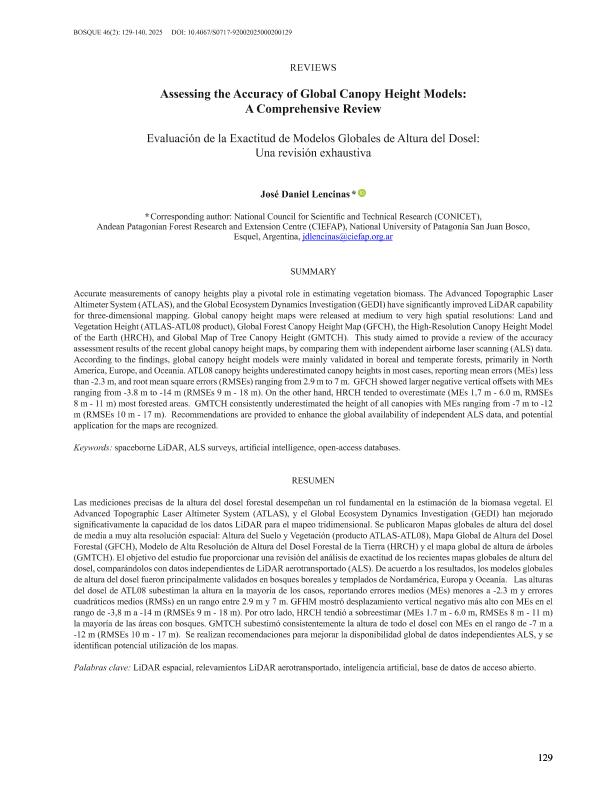
Las mediciones precisas de la altura del dosel forestal desempeñan un rol fundamental en la estimación de la biomasa vegetal. El Advanced Topographic Laser Altimeter System (ATLAS), y el Global Ecosystem Dynamics Investigation (GEDI) han mejorado significativamente la capacidad de los datos LiDAR para el mapeo tridimensional. Se publicaron Mapas globales de altura del dosel de media a muy alta resolución espacial: Altura del Suelo y Vegetación (producto ATLAS-ATL08), Mapa Global de Altura del Dosel Forestal (GFCH), Modelo de Alta Resolución de Altura del Dosel Forestal de la Tierra (HRCH) y el mapa global de altura de árboles (GMTCH). El objetivo del estudio fue proporcionar una revisión del análisis de exactitud de los recientes mapas globales de altura del dosel, comparándolos con datos independientes de LiDAR aerotransportado (ALS). De acuerdo a los resultados, los modelos globales de altura del dosel fueron principalmente validados en bosques boreales y templados de Nordamérica, Europa y Oceanía. Las alturas del dosel de ATL08 subestiman la altura en la mayoría de los casos, reportando errores medios (MEs) menores a -2.3 m y errores cuadráticos medios (RMSs) en un rango entre 2.9 m y 7 m. GFHM mostró desplazamiento vertical negativo más alto con MEs en el rango de -3,8 m a -14 m (RMSEs 9 m - 18 m). Por otro lado, HRCH tendió a sobreestimar (MEs 1.7 m - 6.0 m, RMSEs 8 m - 11 m) la mayoría de las áreas con bosques. GMTCH subestimó consistentemente la altura de todo el dosel con MEs en el rango de -7 m a -12 m (RMSEs 10 m - 17 m). Se realizan recomendaciones para mejorar la disponibilidad global de datos independientes ALS, y se identifican potencial utilización de los mapas. Accurate measurements of canopy heights play a pivotal role in estimating vegetation biomass. The Advanced Topographic Laser Altimeter System (ATLAS), and the Global Ecosystem Dynamics Investigation (GEDI) have significantly improved LiDAR capability for three-dimensional mapping. Global canopy height maps were released at medium to very high spatial resolutions: Land andVegetation Height (ATLAS-ATL08 product), Global Forest Canopy Height Map (GFCH), the High-Resolution Canopy Height Model of the Earth (HRCH), and Global Map of Tree Canopy Height (GMTCH). This study aimed to provide a review of the accuracy assessment results of the recent global canopy height maps, by comparing them with independent airborne laser scanning (ALS) data. According to the findings, global canopy height models were mainly validated in boreal and temperate forests, primarily in North America, Europe, and Oceania. ATL08 canopy heights underestimated canopy heights in most cases, reporting mean errors (MEs) less than -2.3 m, and root mean square errors (RMSEs) ranging from 2.9 m to 7 m. GFCH showed larger negative vertical offsets with MEs ranging from -3.8 m to -14 m (RMSEs 9 m - 18 m). On the other hand, HRCH tended to overestimate (MEs 1,7 m - 6.0 m, RMSEs 8 m - 11 m) most forested areas. GMTCH consistently underestimated the height of all canopies with MEs ranging from -7 m to -12m (RMSEs 10 m - 17 m). Recommendations are provided to enhance the global availability of independent ALS data, and potential application for the maps are recognized.
Assessing the Accuracy of Global Canopy Height Models: A Comprehensive Review
Título:
Evaluación de la Exactitud de Modelos Globales de Altura del Dosel: Una revisión exhaustiva

Fecha de publicación:
09/2025
Editorial:
Universidad Austral de Chile
Revista:
Bosque (Valdivia)
ISSN:
0304-8799
e-ISSN:
0717-9200
Idioma:
Inglés
Tipo de recurso:
Artículo publicado
Clasificación temática:
Resumen
Archivos asociados

Tamaño:
393.5Kb
Formato:
PDF
Licencia
 Excepto donde se diga explícitamente, este item se publica bajo la siguiente descripción:
Atribución-NoComercial-SinDerivadas 2.5 Argentina (CC BY-NC-ND 2.5 AR)
Excepto donde se diga explícitamente, este item se publica bajo la siguiente descripción:
Atribución-NoComercial-SinDerivadas 2.5 Argentina (CC BY-NC-ND 2.5 AR)
Identificadores
Colecciones
Articulos(SEDE CENTRAL)
Articulos de SEDE CENTRAL
Articulos de SEDE CENTRAL
Citación
Lencinas, José Daniel; Assessing the Accuracy of Global Canopy Height Models: A Comprehensive Review; Universidad Austral de Chile; Bosque (Valdivia); 46; 2; 9-2025; 129-140
Compartir


Altmétricas