Artículo
BiSpeD: Binary Spectral Disentangling applied to binary low-mass star searches

Fecha de publicación:
01/2025
Editorial:
EDP Sciences
Revista:
Astronomy and Astrophysics
ISSN:
0004-6361
Idioma:
Inglés
Tipo de recurso:
Artículo publicado
Clasificación temática:
Resumen
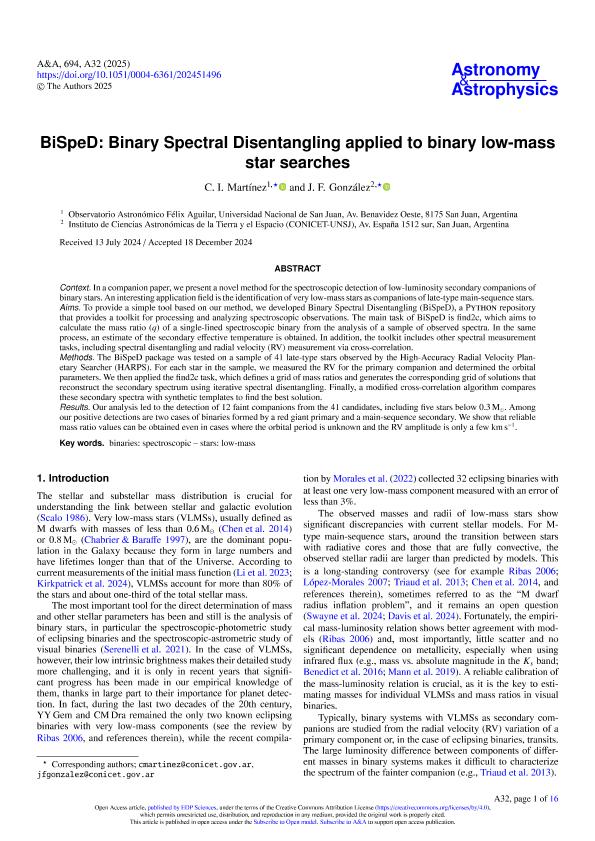
Context. In a companion paper, we present a novel method for the spectroscopic detection of low-luminosity secondary companions of binary stars. An interesting application field is the identification of very low-mass stars as companions of late-type main-sequence stars.Aims. To provide a simple tool based on our method, we developed Binary Spectral Disentangling (BiSpeD), a Python repository that provides a toolkit for processing and analyzing spectroscopic observations. The main task of BiSpeD is find2c, which aims to calculate the mass ratio (q) of a single-lined spectroscopic binary from the analysis of a sample of observed spectra. In the same process, an estimate of the secondary effective temperature is obtained. In addition, the toolkit includes other spectral measurement tasks, including spectral disentangling and radial velocity (RV) measurement via cross-correlation.Methods. The BiSpeD package was tested on a sample of 41 late-type stars observed by the High-Accuracy Radial Velocity Planetary Searcher (HARPS). For each star in the sample, we measured the RV for the primary companion and determined the orbital parameters. We then applied the find2c task, which defines a grid of mass ratios and generates the corresponding grid of solutions that reconstruct the secondary spectrum using iterative spectral disentangling. Finally, a modified cross-correlation algorithm compares these secondary spectra with synthetic templates to find the best solution.Results. Our analysis led to the detection of 12 faint companions from the 41 candidates, including five stars below 0.3 Msun. Among our positive detections are two cases of binaries formed by a red giant primary and a main-sequence secondary. We show that reliable mass ratio values can be obtained even in cases where the orbital period is unknown and the RV amplitude is only a few km/s.
Palabras clave:
binaries: spectroscopic
,
stars: low-mass
Archivos asociados

Tamaño:
6.485Mb
Formato:
PDF
Licencia
 Excepto donde se diga explícitamente, este item se publica bajo la siguiente descripción:
Creative Commons Attribution-NonCommercial-ShareAlike 2.5 Unported (CC BY-NC-SA 2.5)
Excepto donde se diga explícitamente, este item se publica bajo la siguiente descripción:
Creative Commons Attribution-NonCommercial-ShareAlike 2.5 Unported (CC BY-NC-SA 2.5)
Identificadores
Colecciones
Articulos(CCT - SAN JUAN)
Articulos de CENTRO CIENTIFICO TECNOLOGICO CONICET - SAN JUAN
Articulos de CENTRO CIENTIFICO TECNOLOGICO CONICET - SAN JUAN
Articulos(ICATE)
Articulos de INST.D/CS ASTRONOMICAS D/LA TIERRA Y DEL ESPACIO
Articulos de INST.D/CS ASTRONOMICAS D/LA TIERRA Y DEL ESPACIO
Citación
Martinez, Cristian Israel; Gonzalez, Jorge Federico; BiSpeD: Binary Spectral Disentangling applied to binary low-mass star searches; EDP Sciences; Astronomy and Astrophysics; 694; 1-2025; 1-16
Compartir


Altmétricas