Mostrar el registro sencillo del ítem
dc.contributor.author
Gimenez, Paula Victoria
dc.contributor.author
Conde, Karina Natalia
dc.contributor.author
Peltzer, Raquel Inés
dc.contributor.author
Cremonte, Mariana
dc.date.available
2025-10-09T21:15:34Z
dc.date.issued
2019
dc.identifier.citation
Employment and living arrangement moderate the effectiveness of BI among university students; 16th annual conference of INEBRIA; Alemania; 2019; 6-6
dc.identifier.issn
1940-0640
dc.identifier.uri
http://hdl.handle.net/11336/273289
dc.description.abstract
Background: Although BI has shown to be effective among university students in high income countries, little research has been done in Latin-America. Furthermore, evidence examining moderators of intervention efficacy is scarce. Certain characteristics that make alcohol more easily available to students, such as living outside of parental control or having economic autonomy to spend money on alcohol, could moderate BI effectiveness. The objective of this study is to evaluate the moderator role of the living arrangements and the employment situation on BI effectiveness.Materials and methods: Participants were 473 students from Mar del Plata National University (60% women, 40% men; between 17 and 46 years old (M = 20.34, SD = 3.9)). Prospective participants were screened and those with high-risk alcohol consumption in the last 12 months were randomly assigned to a control group or BI. After 3 months, they were re-assessed. The measures were: effectiveness (i.e. decrease in AUDIT scores (yes/no)), employment situation (work: yes/no) and living arrangements (living with family: yes/no). Fisher´s exact test was used to analyze the moderator effects of living arrangements and employment situation on effectiveness. Logistic regression analyses were performed in order to control the possible effect of age.Results: 76% of students lived with their families, while 24% lived alone or with friends; 42% of the students were employed. Living with family moderated (increased) BI effectiveness (9,310, p = 0.01). Similarly, not having employment (i.e. being supported by family) also moderated (increased) BI effectiveness (7,611, p = 0.02). These moderator effects were not accounted for by age.Conclusions: Living arrangement and employment moderated effectiveness of BI, suggesting that restricted access to alcohol may improve the effectiveness of interventions among university students.
dc.format
application/pdf
dc.language.iso
eng
dc.publisher
Springer
dc.rights
info:eu-repo/semantics/openAccess
dc.rights.uri
https://creativecommons.org/licenses/by-nc-sa/2.5/ar/
dc.subject
INEBRIA
dc.subject
BI
dc.subject
Employment
dc.subject
effectiveness
dc.subject.classification
Otras Psicología
dc.subject.classification
Psicología
dc.subject.classification
CIENCIAS SOCIALES
dc.title
Employment and living arrangement moderate the effectiveness of BI among university students
dc.type
info:eu-repo/semantics/publishedVersion
dc.type
info:eu-repo/semantics/conferenceObject
dc.type
info:ar-repo/semantics/documento de conferencia
dc.date.updated
2023-02-16T10:35:17Z
dc.journal.pagination
6-6
dc.journal.pais
Estados Unidos
dc.journal.ciudad
Washington
dc.description.fil
Fil: Gimenez, Paula Victoria. Consejo Nacional de Investigaciones Científicas y Técnicas. Centro Científico Tecnológico Conicet - Mar del Plata. Instituto de Psicología Básica, Aplicada y Tecnología. Universidad Nacional de Mar del Plata. Facultad de Psicología. Instituto de Psicología Básica, Aplicada y Tecnología; Argentina
dc.description.fil
Fil: Conde, Karina Natalia. Consejo Nacional de Investigaciones Científicas y Técnicas. Centro Científico Tecnológico Conicet - Mar del Plata. Instituto de Psicología Básica, Aplicada y Tecnología. Universidad Nacional de Mar del Plata. Facultad de Psicología. Instituto de Psicología Básica, Aplicada y Tecnología; Argentina
dc.description.fil
Fil: Peltzer, Raquel Inés. Consejo Nacional de Investigaciones Científicas y Técnicas. Centro Científico Tecnológico Conicet - Mar del Plata. Instituto de Psicología Básica, Aplicada y Tecnología. Universidad Nacional de Mar del Plata. Facultad de Psicología. Instituto de Psicología Básica, Aplicada y Tecnología; Argentina
dc.description.fil
Fil: Cremonte, Mariana. Consejo Nacional de Investigaciones Científicas y Técnicas. Centro Científico Tecnológico Conicet - Mar del Plata. Instituto de Psicología Básica, Aplicada y Tecnología. Universidad Nacional de Mar del Plata. Facultad de Psicología. Instituto de Psicología Básica, Aplicada y Tecnología; Argentina
dc.relation.alternativeid
info:eu-repo/semantics/altIdentifier/url/https://ascpjournal.biomedcentral.com/articles/10.1186/s13722-019-0157-1
dc.relation.alternativeid
info:eu-repo/semantics/altIdentifier/doi/http://dx.doi.org/10.1186/s13722-019-0157-1
dc.conicet.rol
Autor
dc.conicet.rol
Autor
dc.conicet.rol
Autor
dc.conicet.rol
Autor
dc.coverage
Internacional
dc.type.subtype
Encuentro
dc.description.nombreEvento
16th annual conference of INEBRIA
dc.date.evento
2019-09-26
dc.description.paisEvento
Alemania
dc.type.publicacion
Journal
dc.description.institucionOrganizadora
Red Internacional sobre Intervenciones Breves en Alcohol y otras Drogas
dc.source.revista
Addiction Science & Clinical Practice
dc.date.eventoHasta
2019-09-27
dc.type
Encuentro
Archivos asociados
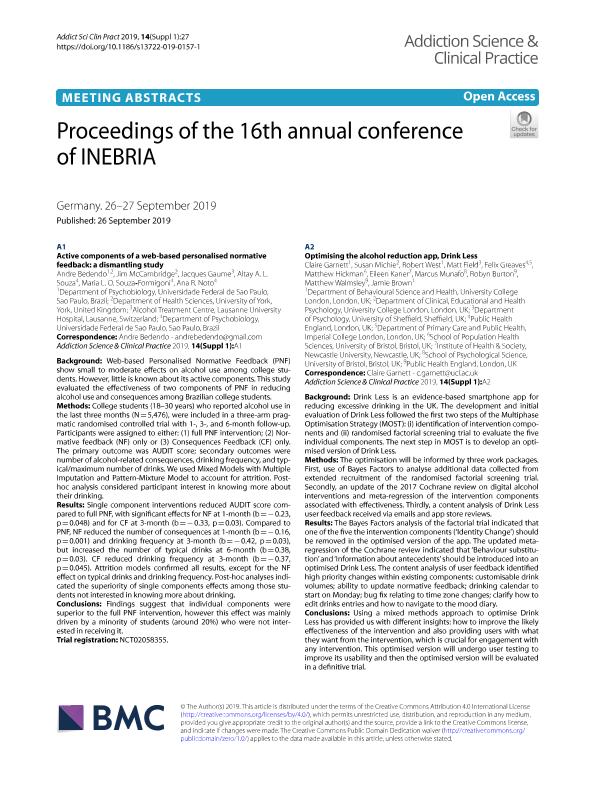

Tamaño:
310.3Kb
Formato:
PDF