Artículo
Genetic consequences of habitat fragmentation in plant populations: susceptible signals in plant traits and methodological approaches

Fecha de publicación:
12/2008
Editorial:
Wiley Blackwell Publishing, Inc
Revista:
Molecular Ecology
ISSN:
0962-1083
e-ISSN:
1365-294X
Idioma:
Inglés
Tipo de recurso:
Artículo publicado
Clasificación temática:
Resumen
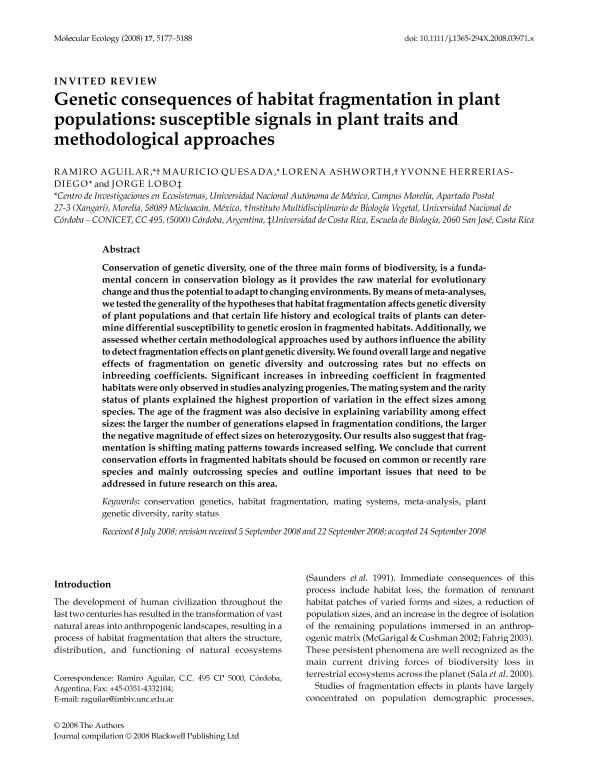
Conservation of genetic diversity, one of the three main forms of biodiversity, is a fundamental concern in conservation biology as it provides the raw material for evolutionary change and thus the potential to adapt to changing environments. By means of meta-analyses, we tested the generality of the hypotheses that habitat fragmentation affects genetic diversity of plant populations and that certain life history and ecological traits of plants can determine differential susceptibility to genetic erosion in fragmented habitats. Additionally, we assessed whether certain methodological approaches used by authors influence the ability to detect fragmentation effects on plant genetic diversity. We found overall large and negative effects of fragmentation on genetic diversity and outcrossing rates but no effects on inbreeding coefficients. Significant increases in inbreeding coefficient in fragmented habitats were only observed in studies analyzing progenies. The mating system and the rarity status of plants explained the highest proportion of variation in the effect sizes among species. The age of the fragment was also decisive in explaining variability among effect sizes: the larger the number of generations elapsed in fragmentation conditions, the larger the negative magnitude of effect sizes on heterozygosity. Our results also suggest that fragmentation is shifting mating patterns towards increased selfing. We conclude that current conservation efforts in fragmented habitats should be focused on common or recently rare species and mainly outcrossing species and outline important issues that need to be addressed in future research on this area.
Palabras clave:
Genetic Diversity
,
Inbreeding
,
Mating Systems
,
Rarity Status
Archivos asociados

Tamaño:
239.3Kb
Formato:
PDF
Licencia
 Excepto donde se diga explícitamente, este item se publica bajo la siguiente descripción:
Creative Commons Attribution-NonCommercial-ShareAlike 2.5 Unported (CC BY-NC-SA 2.5)
Excepto donde se diga explícitamente, este item se publica bajo la siguiente descripción:
Creative Commons Attribution-NonCommercial-ShareAlike 2.5 Unported (CC BY-NC-SA 2.5)
Identificadores
Colecciones
Articulos(IMBIV)
Articulos de INST.MULTIDISCIPL.DE BIOLOGIA VEGETAL (P)
Articulos de INST.MULTIDISCIPL.DE BIOLOGIA VEGETAL (P)
Citación
Aguilar, Ramiro; Quesada, Mauricio; Ashworth, Lorena; Herrerias Diego, Yvonne; Lobo, Jorge; Genetic consequences of habitat fragmentation in plant populations: susceptible signals in plant traits and methodological approaches; Wiley Blackwell Publishing, Inc; Molecular Ecology; 17; 24; 12-2008; 5177-5188
Compartir


Altmétricas