Mostrar el registro sencillo del ítem
dc.contributor.author
Kepko, Larry
dc.contributor.author
Nakamura, Rumi
dc.contributor.author
Saito, Yoshifumi
dc.contributor.author
Vourlidas, Angelos
dc.contributor.author
Taylor, Matthew G.G.T.
dc.contributor.author
Mandrini, Cristina Hemilse
dc.contributor.author
Blanco Cano, Xochitl Guillermina
dc.contributor.author
Chakrabarty, Dibyendu
dc.contributor.author
Daglis, Ioannis A.
dc.contributor.author
De Nardin, Clezio Marcos
dc.contributor.author
Petrukovich, Anatoli
dc.contributor.author
Palmroth, Minna
dc.contributor.author
Ho, George
dc.contributor.author
Harra, Louise
dc.contributor.author
Rae, Jonathan
dc.contributor.author
Owens, Mathew
dc.contributor.author
Donovan, Eric
dc.contributor.author
Lavraud, Benoit
dc.contributor.author
Reeves, Geoff
dc.contributor.author
Tripathi, Durgesh
dc.contributor.author
Vilmer, Nicole
dc.contributor.author
Hwang, Junga
dc.contributor.author
Antiochos, Spiro
dc.contributor.author
Wang, Chi
dc.date.available
2025-10-08T13:42:41Z
dc.date.issued
2024-05
dc.identifier.citation
Kepko, Larry; Nakamura, Rumi; Saito, Yoshifumi; Vourlidas, Angelos; Taylor, Matthew G.G.T.; et al.; Heliophysics Great Observatories and international cooperation in Heliophysics: An orchestrated framework for scientific advancement and discovery; Elsevier; Advances in Space Research; 73; 10; 5-2024; 5383-5405
dc.identifier.issn
0273-1177
dc.identifier.uri
http://hdl.handle.net/11336/273154
dc.description.abstract
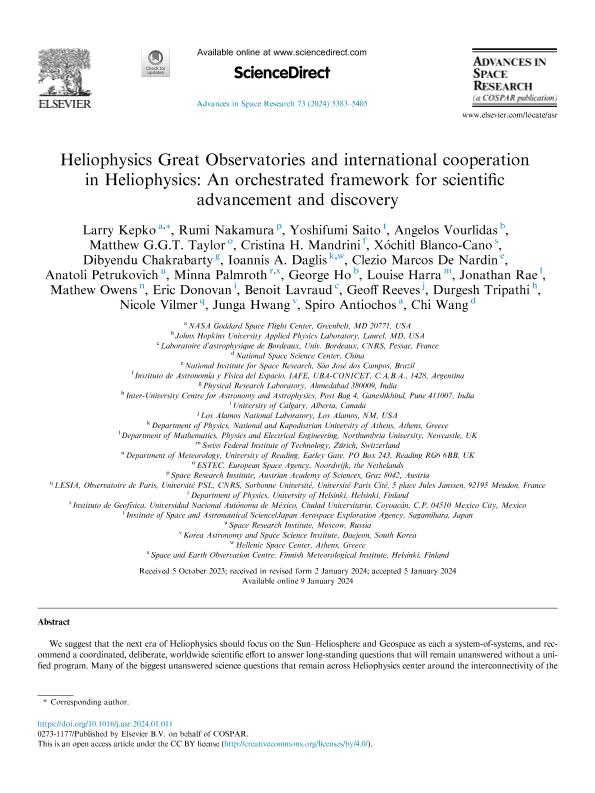
We suggest that the next era of Heliophysics should focus on the Sun–Heliosphere and Geospace as each a system-of-systems, and recommend a coordinated, deliberate, worldwide scientific effort to answer long-standing questions that will remain unanswered without a unified program. Many of the biggest unanswered science questions that remain across Heliophysics center around the interconnectivity of the different physical systems and the role of mesoscale dynamics in modulating, regulating, and controlling that interconnected behavior. Heliophysics has made key progress understanding both the large-scale dynamics and the microphysical processes that occur in these dynamic systems. Such understanding grew out of a systematic approach to study both limits of the system, from global, with the coordinated missions of the International Solar Terrestrial Physics (ISTP) program, to micro, with largely uncoordinated (albeit coincident) missions such as Cluster, Time History of Events and Macroscale Interactions during Substorms (THEMIS), Van Allen Probes, Magnetospheric Multiscale (MMS), Parker Solar Probe, and Solar Orbiter. We suggest that the international Heliophysics community should embark on a grand program to study these system-of-systems holistically, with coordinated, multipoint measurements. We particularly recommend an emphasis on resolving the mesoscale dynamics that links micro to global, and a whole-of-science approach that includes ground-based measurements and advanced numerical modeling. In effect, we propose a mesoscale ISTP type program that would consist of a system of Great Observatories capable of revealing the connections among systems from the solar interior to the top of Earth’s atmosphere. The paradigm and specific approaches outlined in this paper could serve as a strategic imperative and overarching theme that binds our Solar and Space Physics communities together under a common scientific objective. By its very nature, the type of program we argue for would be large, with several coordinated elements, and international in scope. It would include space-borne missions and coordinated ground-based observatories, artificial intelligence/machine learning (AI/ML) methods of analyzing large and complex datasets, and next-generation numerical modeling. The need to coordinate and integrate these different elements is independent of any specific mission implementation. Hence, we suggest the Heliophysics community organize around an ISTP-type program, ISTPNext, with associated Heliophysics “Great Observatories”.
dc.format
application/pdf
dc.language.iso
eng
dc.publisher
Elsevier
dc.rights
info:eu-repo/semantics/openAccess
dc.rights.uri
https://creativecommons.org/licenses/by-nc-sa/2.5/ar/
dc.subject
HELIOPHYSICS
dc.subject
ISTP
dc.subject
SYSTEM SCIENCE
dc.subject.classification
Astronomía
dc.subject.classification
Ciencias Físicas
dc.subject.classification
CIENCIAS NATURALES Y EXACTAS
dc.title
Heliophysics Great Observatories and international cooperation in Heliophysics: An orchestrated framework for scientific advancement and discovery
dc.type
info:eu-repo/semantics/article
dc.type
info:ar-repo/semantics/artículo
dc.type
info:eu-repo/semantics/publishedVersion
dc.date.updated
2025-10-02T11:33:26Z
dc.journal.volume
73
dc.journal.number
10
dc.journal.pagination
5383-5405
dc.journal.pais
Países Bajos
dc.journal.ciudad
Amsterdam
dc.description.fil
Fil: Kepko, Larry. National Aeronautics and Space Administration; Estados Unidos
dc.description.fil
Fil: Nakamura, Rumi. Austrian Academy Of Sciences (oaw);
dc.description.fil
Fil: Saito, Yoshifumi. JAXA Institute of Space and Astronautical Science; Japón
dc.description.fil
Fil: Vourlidas, Angelos. John Hopkins University; Estados Unidos
dc.description.fil
Fil: Taylor, Matthew G.G.T.. European Space Agency; Países Bajos
dc.description.fil
Fil: Mandrini, Cristina Hemilse. Consejo Nacional de Investigaciones Científicas y Técnicas. Oficina de Coordinación Administrativa Ciudad Universitaria. Instituto de Astronomía y Física del Espacio. - Universidad de Buenos Aires. Facultad de Ciencias Exactas y Naturales. Instituto de Astronomía y Física del Espacio; Argentina
dc.description.fil
Fil: Blanco Cano, Xochitl Guillermina. Consejo Nacional de Investigaciones Científicas y Técnicas. Oficina de Coordinación Administrativa Ciudad Universitaria. Instituto de Astronomía y Física del Espacio. - Universidad de Buenos Aires. Facultad de Ciencias Exactas y Naturales. Instituto de Astronomía y Física del Espacio; Argentina
dc.description.fil
Fil: Chakrabarty, Dibyendu. Physical Research Laboratory India; India
dc.description.fil
Fil: Daglis, Ioannis A.. National and Kapodistrian University of Athens; Grecia
dc.description.fil
Fil: De Nardin, Clezio Marcos. National Institute for Space Research; Brasil
dc.description.fil
Fil: Petrukovich, Anatoli. Russian Academy of Sciences; Rusia
dc.description.fil
Fil: Palmroth, Minna. Helsingin Yliopisto; Finlandia
dc.description.fil
Fil: Ho, George. Southwest Research Institute.; Estados Unidos
dc.description.fil
Fil: Harra, Louise. Swiss Federal Institute of Technology Zurich; Suiza
dc.description.fil
Fil: Rae, Jonathan. Northumbria University; Reino Unido
dc.description.fil
Fil: Owens, Mathew. University of Reading; Reino Unido
dc.description.fil
Fil: Donovan, Eric. University of Calgary; Canadá
dc.description.fil
Fil: Lavraud, Benoit. Laboratoire d'Astrophysique de Bordeaux; Francia
dc.description.fil
Fil: Reeves, Geoff. Los Alamos National Laboratory; Estados Unidos
dc.description.fil
Fil: Tripathi, Durgesh. Inter-University Centre for Astronomy and Astrophysics; India
dc.description.fil
Fil: Vilmer, Nicole. L'Observatoire de Paris; Francia
dc.description.fil
Fil: Hwang, Junga. Korea Astronomy and Space Science Institute; Corea del Sur
dc.description.fil
Fil: Antiochos, Spiro. University of Michigan; Estados Unidos
dc.description.fil
Fil: Wang, Chi. National Space Science Center; China
dc.journal.title
Advances in Space Research
dc.relation.alternativeid
info:eu-repo/semantics/altIdentifier/url/https://linkinghub.elsevier.com/retrieve/pii/S0273117724000292
dc.relation.alternativeid
info:eu-repo/semantics/altIdentifier/doi/http://dx.doi.org/10.1016/j.asr.2024.01.011
Archivos asociados

Tamaño:
2.780Mb
Formato:
PDF