Artículo
The uplift of nutrients by plants: Consequences across scales

Fecha de publicación:
12/2004
Editorial:
Ecological Society of America
Revista:
Ecology
ISSN:
0012-9658
Idioma:
Inglés
Tipo de recurso:
Artículo publicado
Clasificación temática:
Resumen
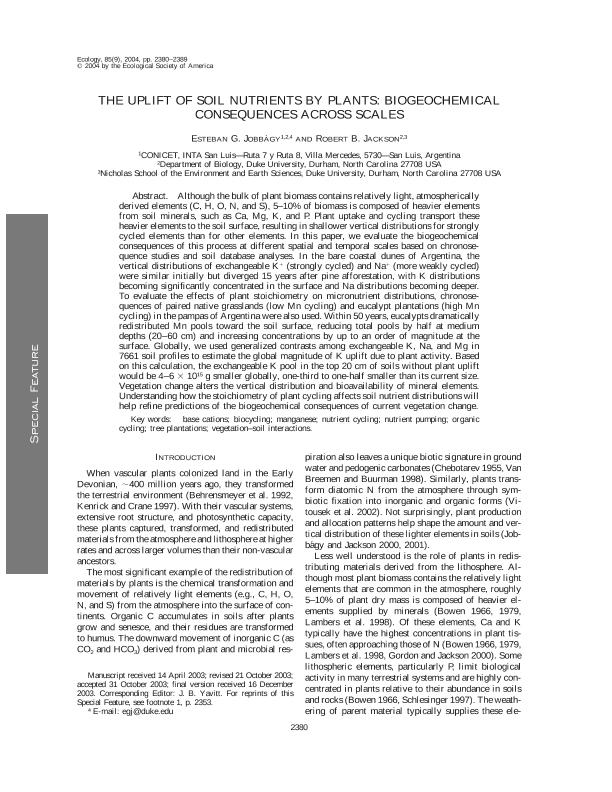
Although the bulk of plant biomass contains relatively light, atmospherically derived elements (C, H, O, N, and S), 5–10% of biomass is composed of heavier elements from soil minerals, such as Ca, Mg, K, and P. Plant uptake and cycling transport these heavier elements to the soil surface, resulting in shallower vertical distributions for strongly cycled elements than for other elements. In this paper, we evaluate the biogeochemical consequences of this process at different spatial and temporal scales based on chronosequence studies and soil database analyses. In the bare coastal dunes of Argentina, the vertical distributions of exchangeable K1 (strongly cycled) and Na1 (more weakly cycled) were similar initially but diverged 15 years after pine afforestation, with K distributions becoming significantly concentrated in the surface and Na distributions becoming deeper. To evaluate the effects of plant stoichiometry on micronutrient distributions, chronosequences of paired native grasslands (low Mn cycling) and eucalypt plantations (high Mn cycling) in the pampas of Argentina were also used. Within 50 years, eucalypts dramatically redistributed Mn pools toward the soil surface, reducing total pools by half at medium depths (20–60 cm) and increasing concentrations by up to an order of magnitude at the surface. Globally, we used generalized contrasts among exchangeable K, Na, and Mg in 7661 soil profiles to estimate the global magnitude of K uplift due to plant activity. Based on this calculation, the exchangeable K pool in the top 20 cm of soils without plant uplift would be 4–6 3 1015 g smaller globally, one-third to one-half smaller than its current size. Vegetation change alters the vertical distribution and bioavailability of mineral elements. Understanding how the stoichiometry of plant cycling affects soil nutrient distributions will help refine predictions of the biogeochemical consequences of current vegetation change.
Palabras clave:
BASE CATATIONS
,
BIOCICLYING
,
MANGANESE
Archivos asociados

Tamaño:
153.9Kb
Formato:
PDF
Licencia
 Excepto donde se diga explícitamente, este item se publica bajo la siguiente descripción:
Creative Commons Attribution-NonCommercial-ShareAlike 2.5 Unported (CC BY-NC-SA 2.5)
Excepto donde se diga explícitamente, este item se publica bajo la siguiente descripción:
Creative Commons Attribution-NonCommercial-ShareAlike 2.5 Unported (CC BY-NC-SA 2.5)
Identificadores
Colecciones
Articulos(IMASL)
Articulos de INST. DE MATEMATICA APLICADA DE SAN LUIS
Articulos de INST. DE MATEMATICA APLICADA DE SAN LUIS
Citación
Jobbagy Gampel, Esteban Gabriel; Jackson, Robert B.; The uplift of nutrients by plants: Consequences across scales; Ecological Society of America; Ecology; 85; 9; 12-2004; 2380-2389
Compartir


Altmétricas