Artículo
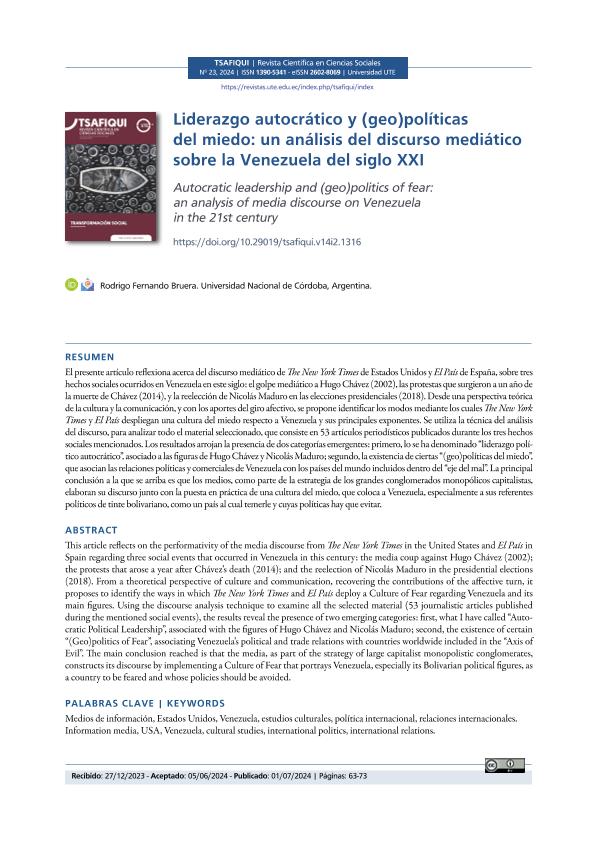
El presente artículo reflexiona acerca de la performatividad del discurso mediático de The New York Times de Estados Unidos y El País de España sobre tres hechos sociales ocurridos en Venezuela en este siglo: el golpe mediático a Hugo Chávez (2002); las protestas que surgieron a un año de la muerte de Chávez (2014); y la reelección de Nicolás Maduro en las elecciones presidenciales (2018). Desde una perspectiva teórica de la cultura y la comunicación, recuperando los aportes del giro afectivo, propone identificar los modos mediante los cuales The New York Times y El País despliegan una Cultura del Miedo respecto de Venezuela y sus principales exponentes. Utilizando la técnica del análisis del discurso para analizar todo el material seleccionado (53 artículos periodísticos publicados durante los tres hechos sociales mencionados), los resultados arrojan la presencia de dos categorías emergentes: primero, lo que he denominado «Liderazgo político autocrático» asociado a las figuras de Hugo Chávez y Nicolás Maduro; segundo, la existencia de ciertas «(Geo)políticas del miedo», que asocian las relaciones políticas y comerciales de Venezuela con los países del mundo incluidos dentro del «eje del mal». La principal conclusión a la que se arriba es que los medios, como parte de la estrategia de los grandes conglomerados monopólicos capitalistas, elaboran su discurso poniendo en práctica una Cultura del Miedo que pone a Venezuela, especialmente a sus referentes políticos de tinte bolivariano, como un país al cual temerle y cuyas políticas hay que evitar. This article reflects on the performativity of the media discourse from The New York Times in the United States and El País in Spain regarding three social events that occurred in Venezuela in this century: the media coup against Hugo Chávez (2002); the protests that arose a year after Chávez’s death (2014); and the reelection of Nicolás Maduro in the presidential elections (2018). From a theoretical perspective of culture and communication, recovering the contributions of the affective turn, it proposes to identify the ways in which The New York Times and El País deploy a Culture of Fear regarding Venezuela and its main figures. Using the discourse analysis technique to examine all the selected material (53 journalistic articles published during the mentioned social events), the results reveal the presence of two emerging categories: first, what I have called “Autocratic Political Leadership”, associated with the figures of Hugo Chávez and Nicolás Maduro; second, the existence of certain “(Geo)politics of Fear”, associating Venezuela’s political and trade relations with countries worldwide included in the “Axis of Evil”. The main conclusion reached is that the media, as part of the strategy of large capitalist monopolistic conglomerates, constructs its discourse by implementing a Culture of Fear that portrays Venezuela, especially its Bolivarian political figures, as a country to be feared and whose policies should be avoided.
Liderazgo autocrático y (geo)políticas del miedo: un análisis del discurso mediático sobre la Venezuela del siglo XXI
Título:
Autocratic leadership and (geo)politics of fear: an analysis of media discourse on Venezuela in the 21st century

Fecha de publicación:
07/2024
Editorial:
Universidad UTE
Revista:
Tsafiqui
e-ISSN:
2602-8069
Idioma:
Español
Tipo de recurso:
Artículo publicado
Clasificación temática:
Resumen
Palabras clave:
Medios de información
,
Estados Unidos
,
Venezuela
,
estudios culturales
Archivos asociados

Tamaño:
765.8Kb
Formato:
PDF
Licencia
 Excepto donde se diga explícitamente, este item se publica bajo la siguiente descripción:
Creative Commons Attribution 2.5 Unported (CC BY 2.5)
Excepto donde se diga explícitamente, este item se publica bajo la siguiente descripción:
Creative Commons Attribution 2.5 Unported (CC BY 2.5)
Identificadores
Colecciones
Articulos(CIECS)
Articulos de CENTRO DE INVESTIGACIONES Y ESTUDIO SOBRE CULTURA Y SOCIEDAD
Articulos de CENTRO DE INVESTIGACIONES Y ESTUDIO SOBRE CULTURA Y SOCIEDAD
Citación
Bruera, Rodrigo Fernando; Liderazgo autocrático y (geo)políticas del miedo: un análisis del discurso mediático sobre la Venezuela del siglo XXI; Universidad UTE; Tsafiqui; 14; 2; 7-2024; 63-73
Compartir


Altmétricas